How can the survival rate of tree saplings be improved when planting in summer?
During landscape construction, we often still encounter the problem of transplanting trees in summer. Because high temperatures cause heavy transpiration from branches and leaves, tree survival is affected. Therefore, to improve the survival rate of seedling planting in summer, it is necessary to take some essential measures.
I. Selection of seedlings for planting
Since summer is not a planting season, with high temperatures and high evaporation, plants dehydrate very easily, so the requirements for the plants themselves are higher. When selecting material, choose seedlings with well-developed root systems, vigorous growth, and no pests or diseases wherever possible.
When the specifications and form meet the design requirements, the following principles should be followed: First, use small seedlings as much as possible; small seedlings have stronger root-generating ability than large ones and a higher transplant survival rate. Second, it is best to use heeled-in (temporarily planted) seedlings; seedlings that have been heeled in for a short time have more vigorous root activity. If no heeled-in seedlings are available, choose seedlings that have been transplanted within the past 2 years, as such seedlings have many fibrous roots, their root balls do not break apart easily, and their water-absorbing capacity is strong, giving a higher survival rate. In addition, note that for large seedlings, root pruning and transplanting measures should be prepared in advance.
II. Treatment of planting soil and digging of planting holes
For summer planting, the soil must be of sufficient depth and must be fertile, loose, and good in both air permeability and drainage. For plots containing harmful substances such as construction waste, remove the waste soil, replace it with good soil suitable for plant growth, and apply decomposed organic fertilizer as a base fertilizer. When planting seedlings in summer, the size of the planting hole must meet the standard requirements.
III. Lifting seedlings and transport
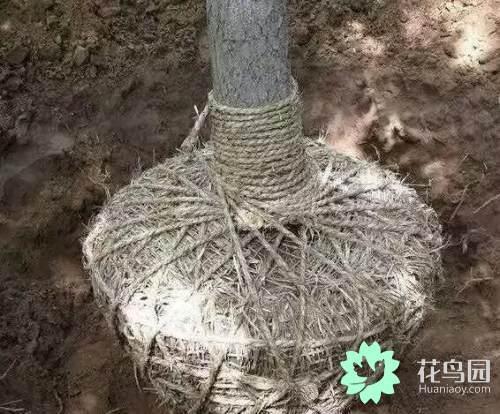
Lifting seedlings and transport are key links in ensuring planting survival, and control of root ball quality and transport speed in between is very important. When lifting and transporting seedlings, pay attention to weather changes; generally choose to lift seedlings on overcast days, transport them to the site overnight, and ensure that the branches and leaves of the seedlings arriving at the site are fresh and the root balls are intact and firm.
Increase the root ball size when lifting seedlings
The root ball diameter is generally 1.2 to 1.5 times that of normal-season transplanting. The larger the root ball, the more complete the root system, and the easier the planting is to survive. For seedling transplanting, avoid hot, dry weather as much as possible; lifting seedlings is best scheduled in the morning or after 4 p.m. to reduce water loss from the seedlings. Before lifting seedlings, an antitranspirant can be sprayed on the canopy, and transport should begin immediately after lifting. If the soil is loose and does not easily form a ball, immediately dip the roots in mud slurry after lifting to keep the root system moist.
Small flowering shrubs can be potted in spring
For example, Japanese boxwood, creeping juniper, golden privet, barberry, weigela, Chinese rose, etc., can be planted in 20-30cm black plastic pots, with the potting medium made from the original bed soil plus an appropriate amount of fertilizer, and given normal fertilizer and water maintenance. When transplanting is needed, simply remove the pot and plant directly into the hole. The seedling root ball does not break apart, and the survival rate can reach 100%.
Timely planting out
After the seedlings arrive at the construction site, promptly organize manpower and machinery to unload them; when unloading, take care to protect them and do not damage the tree body or root balls; after unloading on sunny days, arrange the seedlings closely and neatly, and promptly cover the root balls with shade netting to avoid direct sunlight. If they cannot be planted the same day, heel them in or spray water to keep the root balls moist. Bare-root seedlings should not be exposed for more than 8 hours from the start of lifting, and must be planted out completely the same day. When planting out, place rooting powder and a certain amount of phosphorus-based compound fertilizer mixed with soil into the holes for large flowering shrubs, fill to about 70%, then fill with soil until level with the ground; and build a watering ridge l0-375px high, then water thoroughly.