No need to buy a rose tree - follow along with Lan Yao and make one yourself, it's very simple
Click the [Follow] button in the top right corner for the Lan Yao Garden Toutiao account, send a private message with "Flower Growing Encyclopedia", and receive a free e-book that can solve 70&-80% of flower growing problems (updated regularly)
This is day 903 of Lan Yao's daily original articles
Rose cultivation series articles: No. 100
Yesterday Lan Yao shared the air layering method for roses. Those who read it carefully should have all learned it.
Previously Lan Yao promised to teach everyone how to build a rose tree, and today Lan Yao will share the grafting technique for rose trees.
To make a rose tree, first we need a rootstock trunk that can be used for grafting. The grafting rootstock for a rose tree is generally thornless rose (Rosa multiflora) or Banks' rose (Rosa banksiae). If you have roses (Rosa spp.) around you, you can use the air layering method Lan Yao taught yesterday to obtain rootstock.
If you don't have grafting rootstock yourself, you can buy Banks' rose or rose tree rootstock online for grafting. Of course, for beginner flower lovers who lack confidence, Lan Yao suggests that after learning today's bud grafting technique, you first practice on roses, and then make your rose tree.
Alright, back to the point. Now Lan Yao will specifically introduce the grafting method for rose trees.
Materials to prepare:
1. Grafting knife (sharp utility knife) x1
2. Grafting film (can be replaced with plastic wrap or grafting tape)
3. Rootstock
4. Scion
Grafting steps:
First, we clean the leaves and thorns off the grafting rootstock. This makes it easier to work with.
The grafting rootstock Lan Yao uses for the demonstration was obtained through air layering - a thick rose branch with many thorns. To avoid getting pricked, Lan Yao first removes all the thorns and leaves.
After dealing with the rootstock, we need to prepare the grafting film for wrapping the graft interface. If you use professional grafting film, you can use it directly. Lan Yao uses a plastic bag, so Lan Yao must first cut the plastic bag into small strips for later use.
Note: The grafting film must be clean. Contaminated grafting film can easily cause infection at the graft interface and lead to grafting failure.
Next we take the bud. Lan Yao uses the bud grafting method. In principle, rose bud grafting can be done in all four seasons, but winter temperatures are relatively low and can easily cause frost damage, so it is not recommended.
First cut off the leaf at the bud point. When cutting, be careful to keep a small section of the leaf stalk. The leaf stalk can protect the bud and can also serve as a reference for judging whether the graft has survived.
Cut at 0.8-1cm above and below the bud point. This basically determines the size of the bud you take.
Next, split the cut bud branch from the middle. Be careful not to damage the bud point. Here let me explain that generally, bud taking for bud grafting uses a slicing method, but because Lan Yao's rose branch is too thin and easy to cut your hand, I used a cutting method.
Whether you use slicing or cutting to take the bud doesn't matter. What matters is that you must not damage the bud point and must keep the bud point intact.
When the cut surface of the bud we take is uneven, we can trim the cut surface again to make the cut smooth. A smooth cut is more conducive to graft survival.
The above is the bud taken for bud grafting. To prevent it from drying out, Lan Yao suggests placing the taken bud in clean water or in a clean wet towel to keep it moist.
Now let's deal with the grafting rootstock. Choose the position where you want to graft and make the grafting cut. Bud grafting is a type of bark grafting, so the cut doesn't need to be too deep - just reaching the xylem is fine. Or slightly into the xylem is also acceptable. In short, don't make it too deep.
The bark at the rootstock cut can be directly cut off and discarded, but Lan Yao suggests keeping 1/3 of the bark - that is, keep 1/3 of the peeled-back bark. This way, when we insert the bud, it can be more secure.
When inserting the bud, try to align the cambium layers. Whether the cambium layers are aligned is the key to graft survival. Compared with branch grafting, bud grafting is simpler because the rootstock cut for bud grafting has a large area of cambium exposed outside, making it easier to align with the cambium of the grafted bud.
After fixing the bud point, we need to use grafting film to wrap the graft wound. When wrapping, be sure to wrap it tightly.
The purposes of wrapping with grafting film are: first, to maintain the moisture of the wound; second, to prevent the graft wound from external contamination that could cause grafting failure; and third, to fix the bud point so the bud does not easily fall off.
When wrapping the grafting film, be careful to leave the bud point exposed. If the bud point is also wrapped, then when the rose sprouts later it can easily be suffocated, causing bud death. After grafting is complete, normal management and care is all that's needed.
Note:
When the rootstock sprouts, remove them promptly to avoid competing with the grafted bud for nutrients. After about a week, lightly touch the leaf stalk. If the leaf stalk falls off naturally, it means the graft has survived. When the new shoot grows to about 10cm, pinch off the top promptly to promote branching.
Bud grafting can graft multiple buds on one branch. Just graft according to your own needs. The grafting rootstock can be planted first until it survives and then grafted, or grafted first and then planted. This makes no difference.
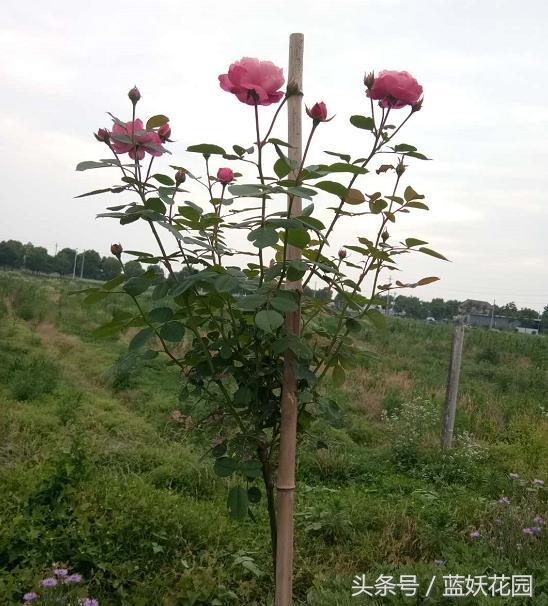
Now let's look at the rose tree Lan Yao bud grafted in spring! This was Lan Yao's first time trying bud grafting, and 2 rootstocks with 4 buds all survived!
Actually it's really not that difficult. As long as you are willing to try, you can do it too. At this point, the sharing about rose cultivation comes to an end. To see all rose cultivation series articles,please follow Lan Yao's WeChat public account: Lan Yao Garden (ilanyao)
Next, Lan Yao will bring everyone the [Flower Growing Beginner's Quick Advancement to Master] series of special articles. Let you learn systematic home flower growing knowledge even in scattered bits of time. Stay tuned.
Welcome to follow the [Lan Yao Garden] Toutiao account, accelerate your growth together, and become a flower growing expert. If you like my articles, feel free to like, forward, and bookmark them!