What methods are there for greening rocky slope land?
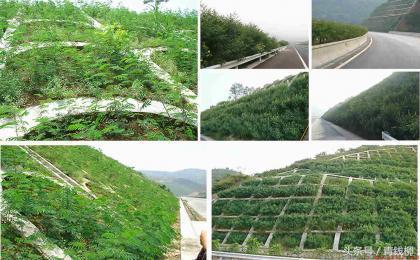
How to green and use rocky slope land?
1 Slope greening methods
According to the structural characteristics of the slope, classified greening is carried out, respectively using the following 8 types of slope sub-item greening methods: thick-layer substrate spray-seeding greening, platform soil replacement planting greening, vine net-assisted greening, masonry retaining wall backfill greening, etc.
(1) The greening method of excavating small platforms, building pits with vegetation bag cofferdams, and spray-seeding and planting with wrapped plastic net thick-layer substrate, abbreviated as the "pit excavation spray-seeding tree planting method".
(2) The greening method of laying vegetation bags along the slope, building pits with vegetation bag cofferdams, and spray-seeding and planting with wrapped plastic net + flexible net thick-layer substrate, abbreviated as the "slope-following pit-building double-net spray-seeding tree planting method".
(3) The greening method of drilling holes, adding wooden strip soil-retaining wings, building pits with vegetation bag cofferdams, and spray-seeding and planting with wrapped plastic net thick-layer substrate, abbreviated as the "hole drilling soil retaining pit building spray-seeding tree planting method".
(4) The greening method of drilling holes and spray-seeding with wrapped plastic net + flexible net thick-layer substrate, abbreviated as the "hole drilling double-net spray-seeding method".
(5) The greening method of laying vegetation bags along the slope, building pits with vegetation bag cofferdams, and spray-seeding and planting with wrapped plastic net thick-layer substrate, abbreviated as the "slope-following pit-building spray-seeding tree planting method".
(6) The greening method of platform vegetation bag cofferdams and foreign soil backfill planting, abbreviated as the "platform backfill tree planting method".
(7) The greening method of planting troughs with vegetation bag cofferdams at the slope toe, backfilling planting soil, and vine net-assisted greening, abbreviated as the "vine net-assisted method".
(8) The greening method of building a retaining wall at the slope toe and backfilling foreign soil along the slope for planting, abbreviated as the "retaining wall backfill tree planting method".
2 Greening design technical process
(1) Excavating small platforms. While cutting the slope, excavate pit-type small platforms, with the small platform 80cm wide and 120cm long. The spacing of the small platforms on the slope surface is about 4m x 4m, measured horizontally from left to right and measured along the slope from top to bottom.
(2) Building pits with vegetation bag cofferdams. Stack vegetation bags at the outer edge of the small platform to build a cofferdam and create a planting pit. Fill the inner side along the slope with a vegetation substrate prepared from garden soil + peat + perlite in a 5:3:2 ratio, then insert bamboo poles, etc. as markers, so as to facilitate planting seedlings in the corresponding positions after spray-seeding.
The vegetation bags are made of degradable non-woven fabric, with specifications of large vegetation bags 60cm long and 40cm wide, green in color, and the bags are filled with a substrate containing 10% peat and 90% sieved planting soil.
(3) Laying and hanging wrapped plastic net. Use green wrapped plastic net for net hanging and nailing. The wrapped plastic net is green, with mesh openings 5cm x 5cm in diameter, laid and hung from top to bottom. The upper end is fixed with threaded steel nails 60cm long, ?8mm, with hooks at the top, at a spacing of 40cm. Overlap between net pieces is 10cm. The net pieces are fixed to the rock surface with steel bars 30cm long and ?4mm used as anchor nails, with 5 anchor nails per sq m, ensuring that the distance between the net pieces and the rock surface is within 4cm, almost close to the rock surface, and anchor nails should be added when necessary. On local gravel rock surfaces, because the gravel thickness exceeds 30cm, the length of the anchor nails must be increased.
(4) Thick-layer substrate spray-seeding. The prepared plant growth substrate and seeds are fully mixed by a mixer, and the substrate and seeds are sprayed together onto the working rock surface with the net pieces hung on it through special spraying machinery. The spraying thickness is not less than 12cm. After spray-seeding, cover with a shade net in time, and water for maintenance to promote seed germination.
① Substrate ratio: The spray-seeding substrate is prepared from peat, planting soil, grass fiber, rice chaff, compound fertilizer, binder and water-retaining agent in a certain ratio. The planting soil needs to be sieved to remove soil particles and gravel with a particle size of not less than 2cm. Add 1kg of surrounding mountain body A-layer topsoil to every hundred jin of planting soil, so as to blend in seeds of natural vegetation.
② Plant seed ratio: The plant seeds adopt a mixed method of woody and herbaceous plants. Among them, the woody plants selected are beautiful lespedeza, Indigofera pseudotinctoria, senna corymbosa, black locust and Ligustrum sinense, and the herbaceous plants selected are bermudagrass, tall fescue and purple alfalfa.
(5) Planting greening seedlings. When the spray-seeded seeds emerge and grow to 3~4cm, remove the shade net in time, and for the planting pits built with vegetation bag cofferdams, cut off the net pieces, and plant container seedlings of glossy privet and Chinese pistache in a 1:1 configuration, with a height of 1.3~1.5m and a basal diameter (at 10cm from the base) of 1.5~2.0cm, of the full-crown type. During planting, properly trim branches and leaves to reduce transpiration and evaporation water loss.
(6) Laying vegetation bags along the slope. For local sunken slope surfaces, use vegetation bags along the slope, stacking the vegetation bags in the sunken body to make the slope surface smooth. The vegetation bags are made of degradable non-woven fabric, with specifications of small vegetation bags 50cm long and 30cm wide. For local small platforms, make full use of the small platforms and use vegetation bag cofferdams to build pits. The vegetation bags adopt large vegetation bags made of degradable non-woven fabric with specifications of 60cm long and 40cm wide. The pits are filled with a vegetation substrate containing 10% thoroughly decomposed commercial livestock and poultry organic fertilizer, then insert bamboo poles, etc. as markers, so as to facilitate planting seedlings in the corresponding positions after spray-seeding.
(7) Laying and hanging wrapped flexible net. On the basis of laying and hanging the wrapped plastic net, lay and nail the flexible net. Select a single-layer TECCO flexible protective net with mesh openings 25cm x 25cm. The flexible net is fixed with anchor rods 1.5m long and ?12mm with anchor heads, with anchor rod spacing of 2m x 2m, anchor hole diameter of 10cm, formed hole depth of 1.6m, and the anchor holes are grouted with M20 cement mortar. The flexible net and the wrapped plastic net are tied firmly with iron wire to ensure that the flexible net fits tightly on the wrapped plastic net.
(8) Drilling holes. Drill holes on local smooth rock surfaces. The hole diameter is 10cm, the hole depth is 50cm, and the density is a hole spacing of 1.2m x 1.2m. The holes are filled with a vegetation substrate containing 10% thoroughly decomposed commercial livestock and poultry organic fertilizer.
(9) Wooden strip soil-retaining wings. Add square wooden strips between the holes, and add soil-retaining wings 30cm below the holes.
The wooden strips are 4cm square and 1m long, with both ends fixed to the rock surface with steel bars 30cm long and ?4mm. The soil-retaining wings are made of galvanized iron sheet 60cm long, 12cm wide and 0.6mm thick, with steel bars 30cm long and ?4mm welded at both ends and fixed to the rock surface.
Highway slope watering maintenance and soil moisture conservation