What to Do About Spotted Lanternfly Damaging Grapevines? Detailed Control Methods
Damage and Control of Spotted Lanternfly on Grapevines
The spotted lanternfly (Lycorma delicatula), also known as the Ailanthus lanternfly or spotted wax cicada, belongs to the family Fulgoridae of the order Homoptera. It has a wide distribution range, being found in Liaoning, Shandong, Henan, Shanxi, Shaanxi, Gansu and other provinces. Its host range is broad: besides damaging grapevines, it also damages begonias, peach trees, pear trees, pomegranates and other tree species. In recent years, with the rise of ecological gardens, the damage caused by the spotted lanternfly on grapes has become increasingly severe.
1 Damage
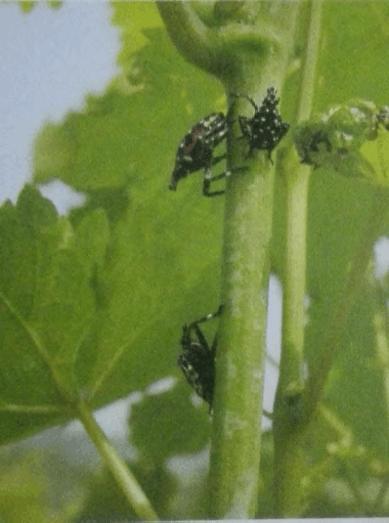
Adults and nymphs gather in groups on the undersides of leaves and on tender shoots to cause damage (Figure 1), sucking the sap from tender shoots and leaves. Damaged leaves develop pale yellow spots. Some leaf surfaces become covered with a dense, sticky sap that, after infection by various fungi, produces a black sooty mold layer. Because they suck the sap of the grapevine, they affect the plant's growth and development, and in severe cases the epidermis cracks and dries.
Figure 1 Nymph damage
2 Morphological Characteristics
2.1 Adult
Body length 15-20 mm, wingspan 40-50 mm, wings covered with white wax powder. The head tilts upward, antennae have 3 segments, bristle-like, red, with a swollen base. The forewings are leathery, with a pale grayish-brown base bearing about 20 black spots, a black tip, and pale veins; the hindwings have a red base with about 8 dark brown spots, a white translucent middle, and a black tip (Figure 2).
Figure 2 Adult
2.2 Egg
Oval, about 3 mm long, brown, shaped like a wheat grain, with the surface covered in white wax powder.
2.3 Nymph
Resembles the adult, with a pointed head and long legs, and a flattened body. Newly hatched nymphs are white, later turning black, with many white spots on the body surface. Fourth-instar nymphs have a red back with black-and-white alternating spots [Jishan Huayao].
3 Life History and Habits
One generation occurs per year. It overwinters as egg masses on the main trunk of the grapevine or on trellis materials. After mid-April of the following year, they hatch successively into nymphs; the nymphs damage tender stems and leaves and jump away when disturbed. Adults appear in mid-June, and in August the adults mate and lay eggs, continuing until late October. Generally, one egg mass contains 40-50 eggs, neatly arranged, with wax powder on the surface.
4 Control Methods
4.1 Agricultural Control
Do not plant Ailanthus altissima, Chinaberry (Melia azedarach) and other preferred host plants of the spotted lanternfly around the vineyard, to reduce the insect source and lessen the damage.
4.2 Physical Control
As part of winter orchard cleanup, use a steel brush to scrub off the egg masses (Figures 3 and 4).
Figure 3 Before scrubbing off
Figure 4 After scrubbing off
4.3 Chemical Control
During the peak period of nymph occurrence, spray the foliage with a 2.5% (mass fraction) lambda-cyhalothrin 1,000-fold dilution.