Detailed Explanation of Training and Renewal Techniques for Trellised Pear Branch Groups
Training and Renewal Techniques for Trellised Pear Branch Groups
Cultivating stable fruiting branch groups is one of the core techniques of fruit tree training and pruning. All scaffold branches and perennial branch groups of trellised pears are fixed on the trellis surface, and a large number of new shoots emerge on the upper side of the branches. These new shoots can conveniently be trained into new fruiting branch groups and fruiting branches bearing fruit. Varieties of the Pyrus pyrifolia (sand pear) system generally flower easily, but after continuous fruiting they tend to form chicken-claw branches, which in turn causes problems such as weakening of branch groups, smaller fruit size, and poorer quality. Therefore, in production it is best to adopt a trellis tree form to facilitate the cultivation of new branches for fruiting (fruiting branches generally do not exceed 4 years). In production, many people also use trellis techniques to produce pears, but they have not mastered the methods of using the trellis to cultivate and renew fruiting branch groups. This article provides a brief introduction to the techniques for training and renewing fruiting branch groups of trellised pears.
1 Training of Fruiting Branch Groups
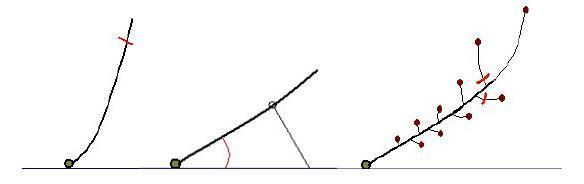
Fruiting branch groups are generally trained from vigorous new shoots on scaffold branches. After the new shoot has grown, it is appropriately headed back, and then in the second spring it is appropriately bent and tied, with an angle of 40° to the trellis surface being most suitable. In this way, in the second year the branch will form a certain number of long, medium, and short fruiting branches, forming a small fruiting branch group (Figure 1). During winter pruning in the second year, the two branches at the front with strong competitive ability are often removed (Figure 1). At the same time, the extension branch of the fruiting branch group is headed back (cutting off 1/3~1/6, 20~30 cm), generally selecting and retaining the upper bud. After winter pruning, the end of the two-year-old branch is fixed to the trellis surface, and the extension branch is appropriately bent and tied to form a 40° angle with the trellis surface (Figure 2). In the third and fourth years, the same method is used, and after 3 years a large, stable fruiting branch group can be formed (Figure 3) [Jishan Huayao].
Figure 1 Training process of a small fruiting branch group of trellised pear
Figure 2 Treatment of 3~4-year-old fruiting branch groups
Figure 3 Fruiting situation of trellised pear branch groups
In summer, it is often necessary to tie moderate-vigor branches sprouting on the fruiting branch group to facilitate flower formation and form small fruiting branches (Figure 4). When tying, pay attention to directing them toward spaces. A stable fruiting branch group (3 or 4 years old) is generally shaped like an isosceles triangle, retaining 8~12 fruits during the growing season, with a total leaf count of about 600 and a leaf-to-fruit ratio of 60~70 (Figure 3).
Figure 4 Tying of moderate-vigor branches
2 Pruning of Fruiting Branch Groups
Pear trees cultivated on trellises during the full fruiting period generally rely mainly on long-axis large fruiting branch groups for fruiting. For varieties that fruit mainly on short fruiting branches (such as Xinshui), branches are generally lightly headed back, selecting better flower buds newly formed in the middle of the branch. In the following year, 1~2 one-year-old branches at the front end of the branch group are selected and heavily headed back, in hopes of producing new shoots and then forming short fruiting branch flower buds, while the remaining one-year-old branches are removed. In this way, a long-axis branch group is trained, with a branch group lifespan of 4~5 years, after which it is removed from the base and a new fruiting branch group is trained. Be sure not to leave branches unpruned and not to retain too many branches, so as to avoid forming large numbers of chicken-claw branches (Figure 5).
Figure 5 Chicken-claw branches formed on the trellis surface
For varieties that fruit mainly on axillary flower buds, such as Kosui and Hosui (Figure 6), the lifespan of branch groups generally does not exceed 4 years. The one-year-old branches on the branch groups should be timely bent and tied to facilitate the formation of plump axillary flower buds. If they grow vigorously and upright, or if axillary flower buds are only at the tip, they are generally removed. During winter pruning, thicker water shoots and vegetative branches are generally removed. When reserve branches need to be retained, branches with a base diameter of 0.8~1.3 cm and moderate vigor are generally selected and headed back by half, retaining the upper bud. In winter they are not tied to the trellis surface, and are bent and tied again during the growing season.
Figure 6 Fruit set on axillary flower buds
3 Renewal of Fruiting Branch Groups
When fruiting branch groups on scaffold branches and side branches age, new fruiting branch groups need to be trained to replace them. Generally, 2~3-year-old new branches of sand pear varieties bear fruit of good quality. When fruiting branch groups weaken, they should be renewed in a timely manner by using vigorous new branches at the base to train new fruiting branch groups. There are two commonly used renewal methods. One is to use new branches sprouting on scaffold branches to renew branch groups (Figure 7). The other is to use new branches sprouting at the base of the branch group to renew the branch group (Figure 8). When renewing branch groups on scaffold branches of varieties such as Hosui, a stub is often left below the saw cut, and shoots sprouting from latent buds on the stub are used to renew the branch group (Figure 9). When renewing fruiting branch groups, branches from the middle and lower parts of the scaffold branch axis should be selected for training, as such branches flower easily and bear fruit stably.
Figure 7 Renewing fruiting branches using shoots sprouting from scaffold branches
Figure 8 Renewing fruiting branches using shoots sprouting from the base of the branch group
Figure 9 New shoots sprouting after leaving a stub during winter pruning