Hardwood Cutting Techniques for Euonymus fortunei and Factors Affecting Rooting and Survival Rates
Factors Affecting Rooting and Survival Rates of Euonymus fortunei Hardwood Cuttings and Cutting Techniques
1 Morphological Characteristics
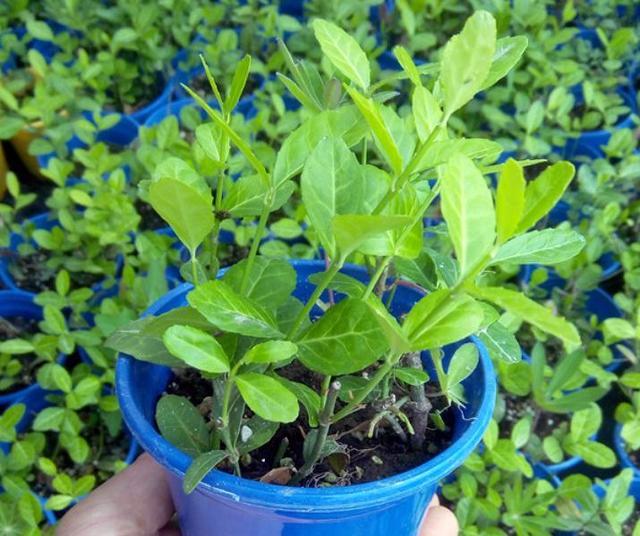
Euonymus fortunei, also known as climbing euonymus, is a type of ground cover plant belonging to the genus Euonymus in the family Celastraceae. It is an evergreen or deciduous vine, with many small fine roots often present on the stems and branches, and the branchlets are green; the leaves are thinly leathery, mainly elliptical, with variation in leaf width, bearing small tuberculate protrusions, simple leaves opposite, 2 to 5.5 cm in length, 2 to 3.5 cm in width, apex shortly acute or acuminate, base broadly cuneate, margins with obtuse serrations. The flowers are greenish-white, pedicels 2 to 5 mm long, sepals semicircular, petals nearly circular, flowers bisexual, cymes axillary. The capsule is nearly spherical, orange-yellow, and the seed aril is orange-red. The flowering period is from May to June, and the fruiting period is from October to November.
2 Ecological Habits
Euonymus fortunei grows vigorously and is easy to propagate. It has strong shade tolerance and cold tolerance, is tolerant of pruning, and is resistant to pests and diseases, saline-alkali conditions, and pollution. Therefore, it has earned the titles of "new star of landscaping" and "rare evergreen broadleaf treasure," and is a common ground cover plant in courtyards.
3 Factors Affecting Cutting Survival
3.1 Internal factors affecting cutting rooting. ① Age of the cutting: The rooting ability of collected branches decreases as the age of the mother plant increases. ② Different parts of the branch: The number of root primordia and stored nutrients differ among different parts of the same branch, resulting in significant differences in rooting rate, survival rate, and seedling growth of cuttings. ③ Position and developmental status of the branch: Shoots sprouting from tree roots and trunk bases have higher rooting rates. ④ Thickness and length of cuttings: Hardwood cuttings of Euonymus fortunei should be 10 to 12 cm. ⑤ Leaves and buds of cuttings: The buds on cuttings are the foundation for forming stems and trunks. The number of leaves retained on cuttings generally depends on specific circumstances.
3.2 External factors affecting cutting rooting and survival. ① Temperature: The optimal temperature for rooting of most tree species' cuttings is 20 °C. When soil temperature is 3 °C to 5 °C higher than air temperature, it is extremely favorable for rooting. ② Humidity: During the rooting process of cuttings, the key to cutting survival is the relative humidity of the air, the moisture of the cutting medium, and the water content of the cuttings themselves. ③ Aeration conditions: Cuttings need oxygen during rooting. Therefore, the cutting substrate should be loose and breathable. ④ Light: Light can promote rooting of cuttings. ⑤ Substrate: The environmental requirements for the substrate are: good water permeability, a certain water retention capacity, easy warming, and good insulation performance. Cuttings cannot absorb nutrients before rooting, so the substrate does not need nutrients. If organic matter is present, it may lead to pathogen invasion of the cuttings, greatly affecting rooting.
4 Key Points of Cutting Techniques
4.1 Cutting Preparation
4.1.1 Selection of cuttings. Cuttings should be collected during the period when branches contain the most nutrients, during the dormant period of the seedlings, when branches contain relatively more nutrients. First, collect branches from vigorous, pest-free, healthy mature seedlings. Select 1-year-old branches that are robust, with plump buds, well-developed, pest-free, and with relatively short internode spacing. Branches rich in external nutrients are preferable.
4.1.2 Cutting preparation. The cutting length is 10 to 12 cm. When cutting, use a flat cut; the upper and lower cuts should be sharp and smooth, otherwise it is not conducive to wound healing. Also pay attention to retaining leaves: remove the leaves below 3 to 4 cm from the base of the cutting, and retain the leaves above 3 to 4 cm.
4.2 Cutting. The plant spacing for cuttings is 4 to 5 cm, row spacing is 6 to 7 cm, and depth is 3 cm. A total of 10 rows of cuttings were set in the cutting bed, with each treatment group having 2 rows of cuttings, totaling 100 cuttings. Insert the soaked cuttings immediately into the cutting bed substrate, inserting them vertically into the cutting medium. During insertion, pay attention to the biological polarity of the cuttings, ensuring the buds face upward. After insertion, press the river sand firmly by hand so that the soil makes close contact with the cuttings.
4.3 Post-cutting management. After cutting, set up an arched frame over the cutting bed, then cut 50 cm × 50 cm polyethylene plastic film to seal the cutting bed, in order to maintain the relative air humidity inside the arched frame. After sealing, place it in a light incubator. Observe promptly after cutting, maintaining the moisture content of the cutting medium at 50% to 60%, and the relative air humidity above 80%. Check the temperature, humidity, and moisture content of the cutting medium irregularly to prevent root rot caused by water shortage, excessive water loss, or excessive moisture.