A Detailed Explanation of Lithops Growth, Molting and Watering
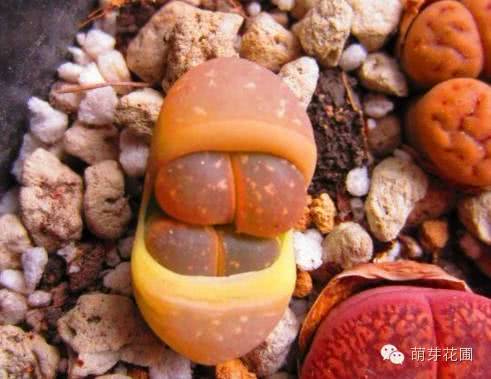
Understanding the annual growth pattern of Lithops is a great help for growing them. In the following text, the author'sLithops Headsummarizes that Lithops growth is an endless cycle: molting in spring, slowing growth in summer, flowering in autumn, and dormancy in winter.
Lithops in Spring
Molting: In spring, the new leaves have actually been slowly developing during winter. After the spring dormancy ends, the new leaves begin to grow rapidly. During this growth process, the new leaves mainly rely on absorbing nutrients from the old leaves, as well as external water and sunlight, to strengthen themselves.
As the new leaves grow, the old leaves will wrinkle, shrivel, and finally be sucked dry by the hungry babies until only a thin skin remains. Lithops molting is actually a process in which new leaves grow out and old leaves fade away.
Molting is a very slow process, basically lasting several months. During this process, seed maturation is also completed in succession. By the time the old skin fades away, the seed pods are basically mature too. At this point we can pick the seed pods and store them in a ventilated, shaded environment in preparation for autumn sowing. (Lithops Head generally uses a homemade paper bag, placed with a desiccant in a box, and stored in a drawer.)
Watering: The growth of new leaves requires water and nutrients. At this point, you might think that since dormancy has passed, a large amount of water should be given - but actually this is not the case. It is just like a newborn baby: external nutrients are not as appropriate as mother's milk.
Reasons:
1. The old leaves of Lithops contain almost everything the new leaves need for growth. During this period of new and old leaf replacement, Lithops Head does not recommend taking in external water.
2. The fading of the old leaves is a slow process. Watering during this time will cause the new leaves to grow excessively and become leggy, and the torn wounds of the old leaves will become infected by water and rot.
3. When the old leaves have become dry skin, water can be given appropriately. At this time Lithops grows very quickly, so it must be controlled in coordination with temperature and sunlight.
The following few pictures give a brief explanation:
Red Olive, it split from one into two! Woohoo... The new leaves are growing, and the old skin is splitting open, preparing to fade. Actually this molting is not very good - the nutrients of the old skin were not well absorbed by the new leaves.
Lithops julii, this one shed its old skin very well - it is already very thin, and the new leaves inside are also very sturdy.
The Lithops ruschiorum below became leggy after watering - so ugly. It will be restored later.
Two bad examples: the old skin has not yet faded, and new leaves are growing inside the new leaves again. Going crazy...
Lithops in Summer
Watering:In summer, temperatures are high, and Lithops slows its growth and enters a semi-dormant state. However, a small amount of water should still be given; water should not be cut off completely. Occasionally in the evening, spray water mist into the air above the Lithops area to lower the temperature. When watering in summer, be sure not to water in the sun - the water droplets will form a concave-convex lens, and combined with the scorching sun, they will sunburn the Lithops.
Lithops in Autumn
Early autumn is a rare period of growth and breeding for Lithops. At this time it has already begun to slowly develop flower buds. Starting around September, flower buds will appear one after another, ready to bloom and then opening gorgeously. At this time we can appropriately give a bit more water, about once every 2 weeks. The growth of flower buds also requires water and nutrients.
The picture below shows flower buds just poking out their heads. Sometimes it is really magical - the day before you could not see anything, and the next morning you might notice the change. Flower buds grow very quickly.
The flowering period of Lithops lasts about a week. If we count it as 7 days, then in the first 1-2 days after the flower first opens, the slender petals have not yet fully grown and the stamens are not yet mature, so pollination is not recommended at this time. From days 3-5, the stamens are basically mature, which is a good time for pollination. Lithops Head generally uses a cotton swab to dip and exchange pollen between flowers. (Lithops requires cross-pollination; self-pollination will not succeed.)
When pollination succeeds, the Lithops flowers will give us a signal - we will find that they become even more bewitchingly beautiful, like a very feminine woman. Then, the flowers slowly wither and dry up.
Then just wait for the seeds to mature...
Lithops in Winter
Watering: In winter, Lithops also enters semi-dormancy, and its growth rate is very slow. At this time, if we gently pinch the lower half of the Lithops with our hands, we can feel the new leaves. They can also be seen with a flashlight. Winter is the period when the new leaves grow. As winter is about to pass, some of the new leaves may become visible, and those with fast-maturing seeds are almost mature too. When watering at this time, be sure to pay attention: do not water from overhead.
The picture below was caused by Lithops Head not paying attention when watering - the seed pod burst open. When this happens, do not rush to remove the seed pod; after the seed pod dries, it will wrap back up.
Then, another cycle begins - molting in spring ing...
Those who like succulents can add the editor's WeChat to exchange and discuss experiences in growing succulents~ Feel free to bother us~ hahaha