How to Cultivate Shaggy Mane Mushrooms Under Economic Forests
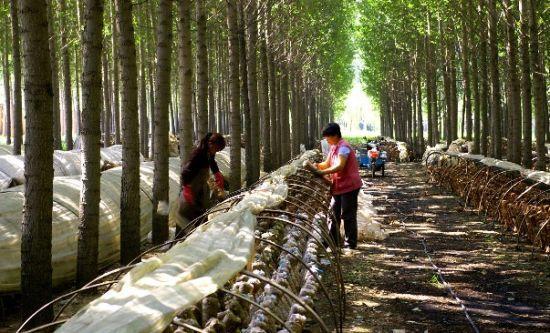
Cultivating Shaggy Mane Mushrooms Under Economic Forests
Fund project: Northeast Forestry University Student Innovation Training Program (201610225003)
Cultivating shaggy mane mushrooms under economic forests is an ecological and efficient cultivation model. Northeast China has a vast territory and an excellent ecological environment, with large areas of plantations of economic tree species such as larch, Manchurian walnut, and Manchurian ash. Cultivating shaggy mane mushrooms under the forest helps create suitable temperature, humidity, and good shading conditions for the mushrooms, and makes rational use of the space within the forest stand. After the shaggy mane mushroom cultivation is finished, the discarded spent mushroom substrate becomes an excellent organic fertilizer, improving the physical and chemical properties of the forest soil and increasing soil fertility, which benefits the growth of the economic forest. Cultivating shaggy mane mushrooms under economic forests not only fully and rationally utilizes space, but also saves the cost of building mushroom sheds, achieving the effect of dual income from both forest and mushrooms.
1 Growth Characteristics of Shaggy Mane Mushrooms
The shaggy mane mushroom is a straw-decaying fungus that can widely utilize carbon sources such as starch, cellulose, and lignin, but its utilization of lignin is relatively poor. It can be cultivated using various crop straws, rice straw, cottonseed hulls, and livestock manure [Jishan Huayao]. The shaggy mane mushroom is a medium-to-low temperature, temperature-variable fruiting edible fungus. Its mycelium can grow at temperatures from 3 to 35°C, with the optimum temperature being 25°C. Above 35°C, the mycelium stops growing and rapidly ages. When the fruiting temperature is 16 to 24°C, the fruiting bodies are produced in the greatest quantity; below 8°C or above 30°C, no fruiting bodies form. In Northeast China, based on local climatic conditions, spawn can be produced from May to July, and fruiting can occur from August to October.
2 Spawn Preparation
2.1 Liquid Spawn Preparation
Inoculate the preserved shaggy mane mushroom spawn onto PDA medium for activation, and culture at 25°C in the dark for 7 to 10 d until the mycelium covers the test tube, obtaining activated mother spawn. Under sterile conditions, inoculate the activated mother spawn into liquid medium; one test tube of mother spawn is inoculated into a 1000 mL Erlenmeyer flask containing 500 mL of liquid
medium. After inoculation, place it in a constant-temperature shaker and culture at 25°C, 130 r/min for 14 d. PDA medium formula: peeled potato 200 g, glucose 20 g, agar 15 g, water 1000 mL, natural pH. Liquid medium formula: corn flour 30 g, sucrose 20 g, yeast powder 5 g, monopotassium phosphate 2.5 g, magnesium sulfate 1 g, water 1000 mL, natural pH.
2.2 Stock Spawn Preparation
Stock spawn medium formula: wheat grains 88%, sawdust 10%, gypsum 1%, lime 1%. Weigh the ingredients according to the formula. Cook the wheat grains over low heat until there is no white core in the center, then remove and let cool. Add water to the sawdust to adjust the moisture content to 60%. Then mix the gypsum and lime with water until uniform and add to the sawdust. After stirring evenly, add the cooled wheat grains and stir again. Fill the uniformly mixed medium into mushroom bags (bag specifications: 17 cm x 35 cm polyethylene plastic mushroom bags), sterilize at 121°C for 120 min, and culture at a constant temperature of 25°C for 48 h. Use only after confirming complete sterilization.
Under sterile conditions, inoculate the shaggy mane mushroom liquid spawn onto the stock spawn medium, with each bag of stock spawn medium inoculated with 15 mL of liquid spawn. After inoculation, culture at 25°C in the dark for 18 to 20 d until the mycelium covers the mushroom bag, obtaining the stock spawn of the shaggy mane mushroom.
3 Cultivation Techniques
3.1 Site Selection
Choose a broadleaf forest or mixed coniferous-broadleaf forest with lush trees, good canopy closure, a large area, and gentle terrain, requiring a nearby water source, good water quality, and a clean environment. After determining the site, clean up the environment and burn or deeply bury miscellaneous items such as understory weeds and fallen leaves.
3.2 Cultivation Substrate Treatment
Prepare the raw materials for the cultivation spawn medium at the end of June, and pile and ferment the cultivation substrate one week before sowing.
Cultivation spawn medium formula: soybean stalks 88%, wheat bran 10%, gypsum 1%, lime 1%.
Choose fresh soybean stalks and wheat bran that are free of mold and insect damage. Accurately weigh the main ingredients and auxiliary ingredients according to the formula proportions. Pile the main ingredients on clean cement ground. Mix the gypsum and lime evenly and add to the main ingredients. After adding water, stir repeatedly and evenly, adjusting the moisture content to 60%. Pile the culture material into a fermentation heap 1 to 1.5 m high and 1.5 to 2 m wide, with unlimited length. Use wooden sticks to make holes in the middle-lower part and top of the heap for aeration, with a spacing of 0.5 m between aeration holes. Finally, cover with plastic film to retain moisture for fermentation. When the fermentation temperature of the heap reaches 60°C, maintain it for 10 h, then turn the heap. When turning, make the inside and outside, top and bottom uniform so that fermentation is thorough. After 3 turns, when the cultivation substrate produces a fragrant aroma, it is fully fermented and ready.
3.3 Sowing and Mycelial Growth
Sowing and mycelial growth should preferably be carried out in July, when the average temperature in Northeast China is 23 to 25°C.
Make beds under the forest, opening trenches 20 cm deep and 1.5 m wide, with unlimited length, leaving a 0.5 m working aisle between two trenches. After leveling the bottom surface, spread the material. Use the layer-sowing method, spreading 5 cm of material per layer. First spread a layer of material on the bottom of the bed. After patting it firm, break the shaggy mane mushroom spawn into pieces the size of pigeon eggs and evenly sprinkle them on the culture material, with a spawn amount of 2% to 5% of the weight of the culture material. Then spread the second layer of material, pat it firm, and sprinkle spawn again. Spread cultivation substrate as the final layer, cover with a layer of plastic film to retain moisture, and during the mycelial growth period, uncover the plastic film once a day for ventilation and air exchange. Wooden sticks can also be used to make holes on the surface of the material for aeration. Generally, the mycelium can cover the surface of the material in 2 to 3 weeks.
3.4 Casing Soil
Once the mycelium has covered the surface of the culture material, casing soil can be applied. The soil quality is best if it is nutrient-rich, well-aerated, and highly water-retentive humus soil, with a pH of 7.0 to 7.5, and a thickness of about 2 to 3 cm, with the soil layer uniform in thickness. After casing, spray water to adjust soil moisture, preferably with slight water remaining on the soil surface. After casing, still cover with the plastic film. After two weeks, the mycelium extends into the soil, and a small amount of white mycelium appears on the surface of the soil layer. At this time, remove the plastic film above the soil layer and carry out fruiting management.
3.5 Fruiting Management
During the fruiting period, spray water every day in a timely manner to maintain moisture, paying attention to frequent and light spraying, so that the soil layer does not accumulate water but remains moist. During the growth of the fruiting bodies, scattered light is needed. Under weak light, the fruiting bodies grown are white, smooth, and of good quality. The light conditions under the forest with high canopy density can just meet the fruiting requirements of the shaggy mane mushroom. During the growth and development of the fruiting bodies, a large amount of oxygen is consumed and carbon dioxide is produced. Compared with sheds, the cultivation environment under the forest does not have the problem of poor ventilation, which is beneficial to the fruiting of the shaggy mane mushroom.
3.6 Harvesting and Flush Turning
Harvest promptly when the fruiting bodies are 70% to 80% mature, 7 to 10 cm long, and the caps are tightly wrapped without loosening. When harvesting, pinch the base of the stipe with your hand and gently twist and pull it up, leaving no mushroom base. Fill the base holes with soil, otherwise they are prone to mold and rot, attracting diseases and pests. Fresh mushrooms have a short storage period, so after harvest they should be promptly sold fresh, refrigerated, or processed [9]. After the first flush of mushrooms is harvested, remove the mushroom bases and dead mushrooms, promptly replenish soil in areas lacking soil, and then water once heavily to let the mycelium recover. After two weeks, the second flush of mushrooms can emerge. The management of the second flush is the same as that of the first flush. Usually, 3 flushes of mushrooms can be harvested in 1 year.