Detailed Explanation of the Hanging-Basket Style Training and Pruning Technique for Red Fuji Apple
Hanging-Basket Style Training and Pruning Technique for Red Fuji Apple
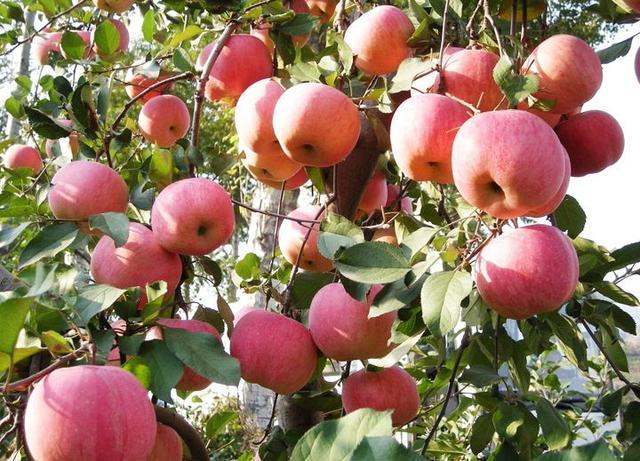
In the Red Fuji hanging-basket style tree form, the scaffold branches directly bear fruiting branches, and after fruiting they all hang down, giving the canopy a mushroom shape. Few large branches, many small branches, a high proportion of effective branches, branch count reaching 130,000 per 666.7 sq m, with short branches accounting for more than 90%; light reaches both inside and outside the entire canopy. It has the following characteristics: 1) Early fruiting and high yield. A newly established orchard bears fruit in 3 years, reaches high yield in 4 years, with an average yield of 2500 kg per 666.7 sq m in the 5th year, and 5000 kg after 8 years. After renovation of old trees, yield and quality improve markedly. 2) The proportion of high-quality fruit is 80.6%, fully red fruit is over 85%, with high sugar content, high firmness, and a smooth, clean fruit surface. 3) The tree is relatively small, easy to manage, saving labor and effort. 4) No pruning in winter, which reduces wounds, and ring rot and decay diseases are lessened. 5) Strong wind resistance; the hanging branches sway in the wind, buffering the shock to the fruit. 6) The fruit hangs on the fruiting branches like a curtain of pearls, highly ornamental.
Pruning for the hanging-basket style tree form: prune in early to mid-June (after bagging), thinning out overly dense new shoots. In late October after the fruit is harvested, thin out overly dense fruit spur branches and adjust the fruiting branch groups so they are evenly distributed. Appropriately retain and leave vigorous growing branches unpruned so they convert into fruiting branches as quickly as possible. Do not use measures such as ring-barking, ring-cutting, or pinching. 1) Young trees: newly planted seedlings are headed at a height of 1.2 to 1.5 m, leaving 5 to 7 plump leaf buds to grow into long branches; in the 2nd year they are left unpruned to form flower buds; in the 3rd year the fruiting mother branches bear fruit and hang down, and another 5 to 7 long branches are left on the upper side of each. The same method is then used to further develop fruiting mother branches that bear fruit, hang down, and extend. 2) Mature trees: first, raise the head by thinning out some of the lower scaffold branches, and the retained scaffold branches extend on a single axis. Second, thin out branches by removing large shade-casting branches within the canopy, crowded branches, and crossing branches, so that the large branches of the tree are bright and open and the small branches are lively and bustling. Each year, at a height of 1.8 to 2.3 m above the ground, leave 20 water sprouts on the upper side of the scaffold branches and leave them unpruned, spaced about 40 cm apart, as vegetative branches to rejuvenate the tree; they form flower buds in the 2nd year and bear fruit in the 3rd year.
Management:For young trees, leave 1 fruit per 30 cm of canopy; for large trees, leave 1 fruit per 20 cm. Fertilization: for trees in full fruiting stage with an average yield of about 5000 kg per 666.7 sq m, apply more than 6000 kg of farmyard manure and organic fertilizer per 666.7 sq m, more than 400 kg of bio-organic fertilizer or more than 300 kg of Yiyuan Red fruit tree special-purpose fertilizer, pay attention to supplementing medium and trace elements, and ensure the winter freezing water and pre-bud water are thoroughly and properly watered. Pest and disease control. When spraying, the leaves and fruit are covered with the spray everywhere, which facilitates control.