Analysis of the causes of low survival rates in apple grafting and measures to overcome them
Factors affecting the survival rate of apple grafting and measures to overcome them
Apple grafting can rejuvenate aging orchards through renovation and renewal, optimize and renew old varieties in young apple orchards, and also ensure that apple seedlings are true to variety and bear fruit uniformly. It can thus be seen that doing apple grafting well is extremely important. Factors affecting the survival rate of apple grafting and measures to overcome them should be considered from the following aspects.
1 Rootstock-scion combination
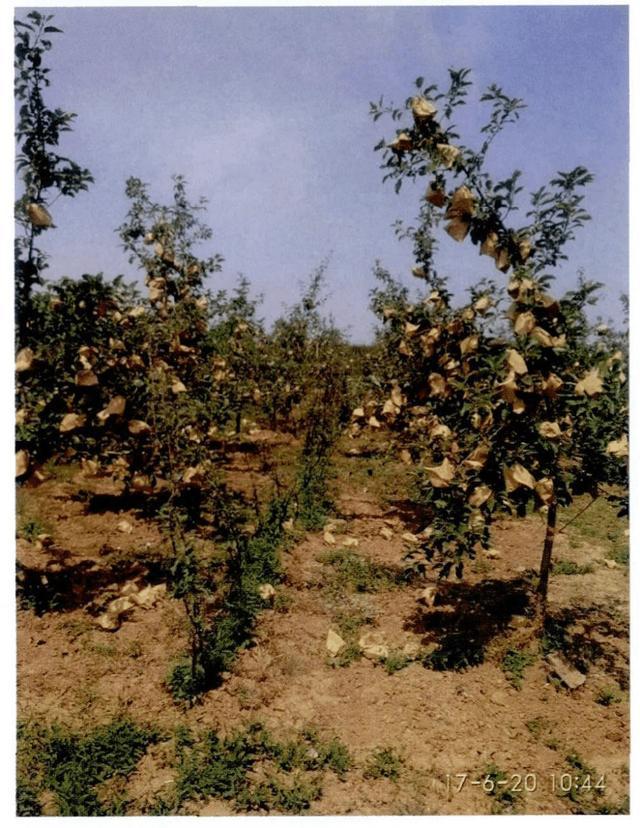
In China, M26 is mostly used as the dwarfing interstock for apples; it produces few root suckers and has good anchorage, but its compatibility and healing ability vary with the variety. On June 20, 2017, orchards in the main apple-producing area of Fengxiang County, Shaanxi Province, encountered a sudden wind disaster. In orchards without posts and ties, the graft unions were split open by the strong wind, causing varying degrees of damage to the trees.
The survey results showed that Fuji and M26 had strong compatibility and good healing ability, with no cracking, splitting or breaking (Figure 1). Varieties such as Huashuo and Honeycrisp all showed varying degrees of splitting, and the damage in Gala orchards was extremely severe (Figure 2). Therefore, when establishing new apple orchards in areas with strong winds, suitable varieties should be selected, and posts should be set up promptly after orchard establishment to tie the trees, reducing economic losses caused by wind disasters.
Figure 1 Fuji apple orchard suffered light damage
Figure 2 Gala apple orchard suffered severe damage
2 Selection of scions
2.1 Source of scions
The quality of scions is an important prerequisite for ensuring grafting survival. Scions should be collected from a mother orchard of improved varieties or from trees that are suitable for local production conditions, have excellent varietal characteristics and good fruiting performance, so as to ensure the purity and excellence of the variety.
2.2 Selection of scions
Select one-year-old branches that face the sun, grow vigorously, are well developed, have plump buds, and are free from pests, diseases and mechanical damage.
2.3 Collection of scions
When bud grafting during the growing season, scions should preferably be collected as needed and used immediately, with attention paid to preserving freshness and moisture. Whip and cleft grafting generally use one-year-old branches, which can be collected in conjunction with winter pruning.
2.4 Storage of scions
The temperature and humidity of the storage environment also affect scion quality.
2.4.1 The temperature should preferably be 0-5 °C. If the storage temperature is too low, the scion tissues freeze, the buds turn black, vitality decreases and viability is lost; if the storage environment temperature is too high, the scion buds swell or germinate, the cortex turns brown, callus tissue cannot form, and grafting is unlikely to survive.
2.4.2 The humidity should be around 90%. If storage humidity is too low, scions easily dry out and lose vitality; if storage environment humidity is too high, scions easily become moldy and lose their vital force.
3 Grafting operation
3.1 Treatment of scions
3.1.1 Cutting scions. The scion should be 5-10 cm long and bear more than two leaf buds.
3.1.2 Cutting the scion. First use a knife to start on the side of the scion base that has no bud, and cut a smooth long slope about 2.5 cm long, then cut a short slope about 1 cm long on the side with a bud, so that the lower end of the scion is a flat wedge shape. When cutting the scion, ensure that the cut surface is flat and smooth, preferably made with a single cut.
3.2 Treatment of rootstocks
First cut (saw) the rootstock off 5-10 cm above the ground and smooth the cut. According to the thickness of the rootstock, choose the number of scions. If it is an old orchard with large trees, 4-8 scions can be inserted at intervals (Figure 3). If the rootstock and scion thickness is not very large, 2-3 scions can be inserted (Figure 4). If it is a young tree, inserting one scion is sufficient.
3.3 Grafting
The cut surfaces of the rootstock and scion should be smooth, the cambium layers should be aligned with each other, and the upper end of the scion cut surface should be exposed by 0.2 cm, that is, "white exposure," which is beneficial for healing and growth.
3.4 Tying
Use plastic film to wrap the graft union, with the purpose of preserving heat and moisture. When tying, it should be firm, sealed and tight to improve the survival rate.
3.5 Precautions
The less time the scion cut is exposed to air, the less easily the cut oxidizes, and the higher the survival rate. Experienced fruit growers hold the scion cut in their mouths to prevent the cut from oxidizing, thereby improving the survival rate.
4 Post-grafting management
About 10 days after grafting, check promptly, and promptly regraft plants that have not survived. Generally, when new shoots grow to 15-20 cm, the binding should be loosened promptly; otherwise, constriction marks easily form and make that part too thin and weak, and in severe cases it breaks at the constriction mark. While loosening the binding and removing the plastic film, support stakes should be tied (Figure 5).
Figure 5 After survival, join and tie support stakes
After the graft survives, promptly remove shoots sprouting from the rootstock, so as to concentrate nutrients to supply the growth of the variety's buds and ensure the survival rate and growth amount.