Chemical control techniques for three major diseases and pests including kiwifruit bacterial canker
Chemical control techniques for three major diseases and pests including kiwifruit bacterial canker
Targeting the three common major diseases and pests on kiwifruit in southwestern Henan - bacterial canker (Figures 1-3), brown spot (Figure 4) and white peach scale (Figure 5) - the timing of chemical control and pesticide application schemes were preliminarily determined according to their respective disease occurrence patterns, for reference in production:
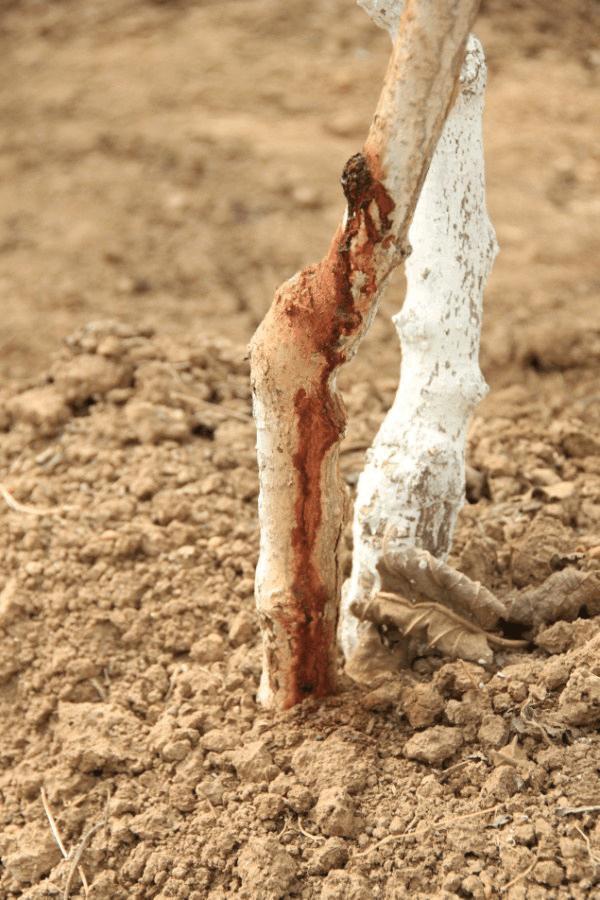
Figure 1 Kiwifruit bacterial canker damaging the main trunk
Figure 3 Kiwifruit bacterial canker damaging leaves
Figure 2 Kiwifruit bacterial canker causing tree death
Figure 4 Kiwifruit brown spot damaging leaves
Figure 5 White peach scale damaging kiwifruit vines
1 Chemical control techniques for kiwifruit bacterial canker
Kiwifruit bacterial canker is a bacterial disease that seriously threatens kiwifruit production. It can damage flowers, branches and trunks, leaves and fruit. After branches and trunks are affected, they exude red fluid, the bark splits longitudinally, and in severe cases the entire plant rots and dies.
1.1 Dormant period (December to February)
In early December, spray 0.136% (mass fraction, same hereafter) Bisu soluble powder at 15,000 times dilution, or 5% Haidaosu aqueous solution at 600-800 times dilution, or 1% S-abscisic acid water-dispersible granules at 6,000 times dilution, etc., to enhance the tree's cold resistance. After winter pruning (December), spray the entire orchard (including trellis materials) with 1:1:100 Bordeaux mixture, or 45% amobam (Schanin) aqueous solution at 150-300 times dilution, or 1.8% octylamine aqueous solution at 50 times dilution, and at the same time seal pruning and saw cuts with 1.6% benzothiazolinone smear or 2.4% copper humate smear.
In early February, spray the entire orchard with 20% thiodiazole-copper suspension at 600 times dilution, or 77% Kocide wettable powder, or 50% chlorobromoisocyanuric acid wettable powder at 600-800 times dilution to prevent bacterial canker. For lightly diseased trees, spray trunks and smear lesions with 20% thiodiazole-copper suspension at 20 times dilution. For severely diseased plants with serious main trunk infection, cut off from 30-40 cm below the lesion, and carry the pruned diseased branches out of the orchard for disposal (they can be moistened with 10% urea aqueous solution and randomly covered tightly with plastic film). Then smear the cut surfaces with 20% thiodiazole-copper suspension at 20 times dilution.
1.2 Before bud break (late February to early March)
Before bud break, spray 3-5 Baume degrees lime sulfur mixture, or 1.8% octylamine aqueous solution at 100 times dilution, or 45% Schanin aqueous solution at 150 times dilution to kill overwintering bacterial canker pathogens, etc.
1.3 After bud break (mid-to-late March to early April)
Spray 20% thiodiazole-copper at 600 times dilution, or 1.5% benzothiazolinone emulsion at 500-600 times dilution + 72% agricultural streptomycin soluble powder at 1,000 times dilution, 80% ethylicin, 68% basic copper sulfate dry suspension at 800 times dilution, 46.1% copper hydroxide water-dispersible granules at 800-1,000 times dilution, combined with EM microbial agent at 500 times dilution for root drenching to control bacterial canker.
1.4 Before flowering (mid-to-late April)
Spray 1.5% benzothiazolinone aqueous solution at 600-800 times dilution, or 20% thiodiazole-copper suspension at 600 times dilution + 72% agricultural streptomycin wettable powder at 1,000 times dilution.
1.5 Fruit expansion period (early May to early June)
Spray 1.5% benzothiazolinone aqueous solution at 600-800 times dilution + 0.1% tetramycin aqueous solution at 1,000 times dilution.
1.6 After fruit harvest (mid-to-late August)
To prevent infection at the fruit stalk scar, spray the entire orchard with 20% thiodiazole-copper suspension at 600 times dilution + 2% kasugamycin at 200 times dilution, focusing on the fruit stalk scar area.
1.7 After leaf fall
From mid-October to November, to prevent infection at the leaf petiole scar, spray the entire orchard with 1.5% benzothiazolinone suspension at 600 times dilution or 46% Kocide 3000 at 1,000 times dilution, focusing on the fruit stalk scar area; spray the ground with 2.5% urea aqueous solution for disinfection.
2 Chemical control techniques for kiwifruit brown spot
2.1 Mid-to-late May
Spray 10% difenoconazole water-dispersible granules at 2,000 times dilution to prevent infection.
2.2 Mid-to-late June
Spray 80% mancozeb wettable powder at 800 times dilution to prevent disease onset.
2.3 Early July
Spray 430 g/L tebuconazole suspension at 4,000 times dilution + 50% kresoxim-methyl water-dispersible granules at 2,000 times dilution, or 75% Nativo suspension at 3,000 times dilution.
2.4 Mid-to-late July
10% difenoconazole water-dispersible granules at 1,500 times dilution, or 40% flusilazole emulsifiable concentrate at 6,000-8,000 times dilution + 80% mancozeb wettable powder at 800 times dilution.
2.5 Early-to-mid August
Spray 75% Nativo suspension at 3,000 times dilution.
2.6 Late August
Spray 50% kresoxim-methyl water-dispersible granules at 2,000 times dilution.
3 Chemical control techniques for kiwifruit white peach scale
3.1 Before bud break
Spray 3-5 Baume degrees lime sulfur mixture.
3.2 Early-to-mid May
For orchards with scattered occurrences, spray 22.4% spirotetramat suspension at 3,000 times dilution + organosilicone at 6,000 times dilution during the hatching period of newly hatched nymphs; for severely affected plots, spray the entire orchard with 22.4% spirotetramat suspension at 3,000 times dilution + organosilicone at 6,000 times dilution, or 25% buprofezin wettable powder at 1,000 times dilution + organosilicone at 6,000 times dilution; or use 50% fenitrothion wettable powder at 1,000 times dilution or 50% malathion emulsifiable concentrate at 1,000 times dilution for control.
3.3 Early July
During the newly hatched nymph period, spray the entire orchard with 40% chlorpyrifos emulsifiable concentrate at 800 times dilution or 22.4% spirotetramat suspension at 3,000 times dilution + organosilicone at 6,000 times dilution; 50% fenitrothion wettable powder at 1,000 times dilution or 50% malathion emulsifiable concentrate at 1,000 times dilution can also be used for control [Jishan Huayao].
3.4 Early September
During the newly hatched nymph period, spray 40% chlorpyrifos emulsifiable concentrate at 800 times dilution (if the third generation does not occur or is not severe, spraying can be omitted).