Detailed Explanation of Caozhou Smooth-Skinned Papaya Seedling Cultivation Techniques
Caozhou Smooth-Skinned Papaya and Seedling Cultivation Techniques
The Ming Dynasty text "Records of a Floating Life" states: "Peaches are given in return for plums, and there is the papaya; aged three thousand years, the plant flourishes of itself." Caozhou smooth-skinned papaya is one of the three characteristic nursery stock varieties of Heze City (anciently called Caozhou), Shandong Province (Caozhou smooth-skinned papaya, Caozhou peony, Caozhou mirror-surface persimmon). It has a cultivation history of nearly a thousand years in Heze. As early as the Ming Dynasty, it was renowned at home and abroad. During the Ming and Qing dynasties, Heze papaya was sent to the capital as tribute and also enjoyed a high reputation in society.
1 Biological Characteristics and Economic Value of Caozhou Smooth-Skinned Papaya
1.1 Biological Characteristics and Phenological Periods
Caozhou smooth-skinned papaya belongs to the genus Chaenomeles in the family Rosaceae. It is a deciduous tree, 5-10 m tall. The bark of trunks and large branches over 3 years old peels off in flakes. Flowers are mostly solitary and grow close to the branches. There are more than a dozen varieties of Caozhou papaya, with considerable differences in fruit size. Single fruit weight is 0.3-2 kg. The main local varieties include Douqing, Yulan, Shenghua, Xipi, Foshou, Large and Small Shizitou, and Mudan Papaya. Smooth-skinned papaya has no strict soil requirements and can grow normally at pH 5.5-8.3. The most suitable soil is neutral sandy loam. Caozhou smooth-skinned papaya is cold-tolerant, heat-tolerant, and drought-tolerant, and relatively resistant to waterlogging. It can grow at extreme temperatures of -29.8 °C in Beijing and 43.7 °C in Heze. As long as it receives 30 days of low temperature at 0-7 °C, it can satisfy its low-temperature requirement and will grow, flower, and fruit normally the following year. In Heze City, Shandong Province, Caozhou smooth-skinned papaya buds break in mid-March, begins flowering in mid-April, finishes flowering in late April, with a flowering period of 15 days. It can set fruit by self-pollination. Depending on the variety, it matures from late September to early October and sheds leaves in late November.
1.2 Economic Value
Caozhou smooth-skinned papaya has long been known as the "king of hundred-benefit fruits" and the "longevity fruit." The tree has a graceful form and vigorous branches. In spring and summer, flowers are abundant; after autumn, golden fruits cover the tree with an intoxicating fragrance. It combines ornamental, landscaping, medicinal, and edible uses. Its flowers and fruits are excellent in color and fragrance, and it has always been praised as a famous ornamental tree. It is a rare garden and economic tree species. It can be enjoyed in all four seasons. In summer, it is dark green and glossy, and in late autumn it turns orange-red.
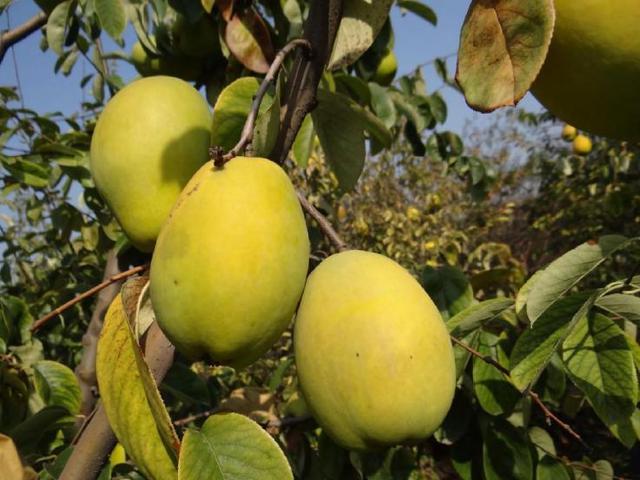
Its greening and beautification effects are distinctive, making it one of the ideal colorful-leaf tree species for gardens. In spring, it either flowers before leaves or flowers and leaves appear together. Flower colors include red, pink, and white, etc., colorful and splendid. The papaya fruit skin is smooth and delicate. Young fruits are emerald green and have a fresh fragrance. After autumn, the fruits gradually mature (Figure 1), becoming golden and shiny. The fruits are large and dignified, with an elegant, rich, and unique natural aroma. They can release fragrance continuously for more than 5 months, making people feel refreshed and joyful. The bark peels off in flakes, and the trunk is smooth and mottled. It can both decorate the environment and purify the air, making it a rare fruit-and-fragrance ornamental tree species in gardens. Historically, Caozhou smooth-skinned papaya fruit was mainly used in traditional Chinese medicine, with functions of relaxing meridians and activating collaterals, stimulating appetite and strengthening the spleen, soothing the liver and relieving pain, and dispelling wind and dampness. Caozhou smooth-skinned papaya is rich in nutrients. The ripe fruit has a refreshing fragrance. The fruit can be made into jelly, jam, candied fruit, preserved fruit, dried fruit, fruit tea, fruit wine, fruit syrup, etc. It is excellent in color, aroma, and taste, suitable for all ages, and nourishing and beautifying. In addition, it can also be used to produce health care and cosmetic products.
Figure 1 Nearly mature Caozhou smooth-skinned papaya
2 Smooth-Skinned Papaya Seedling Cultivation Techniques
2.1 Seed Treatment
After the papaya fruits mature in October, pick the fruits and allow them to after-ripen for a period. By mid-to-late November, cut the papaya lengthwise with a knife, take out the seeds, soak them in 0.3% (mass fraction, same below) neutral laundry detergent solution for 1-2 hours, and rub and wash them continuously 2-3 times to wash off the mucilage on the seed surface. Then soak in clean water, rinse 3 times to wash off the laundry detergent, drain, and dry for later use. They can be sown directly in November, or the seeds can be stratified and sown in early March of the following spring.
2.2 Sand Storage Treatment of Seeds
Caozhou smooth-skinned papaya seedlings are mostly cultivated by grafting. Locally, sand storage of seeds is generally carried out in mid-December. Remove impurities, insect-damaged seeds, shriveled seeds, and moldy seeds from the papaya seeds, then sun-dry them for 3-5 days. Soak the seeds in 3% potassium permanganate solution for 30 minutes for disinfection, rinse with clean water 2-3 times, and soak in clean water for 24 hours so the seeds absorb enough water, then remove and drain. Mix the soaked wet seeds with wet sand. Before mixing, sieve the sand and wash it clean with water. The moisture of the sand should be such that it forms a ball when squeezed in the hand and disperses when the hand is opened. The mass ratio of seeds to sand is 1:5. After mixing the seeds and wet sand well, put them into woven bags. Dig a storage trench 40 cm deep. First spread a 15 cm thick layer of wet sand at the bottom of the trench, then place the bags containing the sand into the trench. About every 1 m, place a straw bundle made of sorghum stalks vertically between two bags, extending to 20 cm above the ground as a ventilation hole. Then cover the seed bags with 20 cm thick wet sand, and finally seal the top in a roof-ridge shape. During the seed stratification process, inspect frequently and pay attention to the temperature and humidity of the seeds and sand. If dryness or uneven moisture is found, add water appropriately or take out the bags and turn them over. If moldy seeds are found during inspection, remove them promptly. After the Spring Festival, as temperatures rise, increase the frequency of inspection. If seeds begin to sprout and it is still too early for sowing, move the seeds to a cooler place to inhibit germination, and immediately prepare the land for sowing. When 30% of the seeds begin to show white, they can be sown.
2.3 Land Preparation and Sowing
Choose a plot with high, dry terrain and good drainage for planting. A pH of 6.5-7.5 is required, and fertile, loose sandy loam is better. Locally in Heze, sowing can generally begin in early March. Before land preparation, if soil moisture is poor, water should be applied in February to build moisture. Carry out land preparation in early March. Apply 5,000 kg of decomposed farmyard manure and 50 kg of compound fertilizer per mu. Apply 50 kg of ferrous sulfate, 15 kg of phoxim granules, and 5 kg of soil fungicide per mu as soil insecticides and fungicides. Deep plow, harrow finely, and level the land, then make raised beds. Bed height is 20-30 cm, bed width is 120 cm, and length should not exceed 30 m. Leave a 30 cm walkway between two beds. North-south drilling is better. Use wide and narrow rows: wide rows 40 cm, narrow rows 20 cm. Open furrows according to row spacing, with furrow depth 2-3 cm. Evenly scatter the seeds together with the wet sand into the furrows, then cover with 1.5-2 cm of fine soil, and then cover with agricultural plastic film and press it down. Use 5 kg of seed per mu.
2.4 Seedling Stage Management
When 10%-20% of seedlings emerge, remove the plastic film promptly. When 50% have emerged, spray 0.1%-0.125% Bordeaux mixture once every 7-10 days to control damping-off of seedlings. When seedlings have all emerged, spray 0.1%-0.125% Bordeaux mixture (mass fraction, same below) or 0.13% 50% carbendazim solution once every 7 days, spraying twice consecutively. When leaf pests occur, spray 0.07% 4.5% beta-cypermethrin emulsifiable concentrate for control. When underground pests are damaging plants, use 0.1% 50% phoxim emulsifiable concentrate solution for drenching control. When seedlings show 2-3 true leaves, begin thinning. When they have 4-5 true leaves, thin to a final spacing of 10 cm between plants. It is appropriate to retain 8,000-10,000 seedlings per mu. After final thinning, when seedlings grow to 5-6 true leaves, apply 0.1% urea as foliar topdressing 2-3 times. When seedlings grow to 8-10 true leaves, apply a small amount of diammonium phosphate to the roots, about 15 kg per mu, and after 30 days apply another 20-30 kg of urea per mu. Water after fertilizing. After late August, generally no more topdressing is applied, to prevent excessive autumn shoot growth and delay of leaf fall. In winter and spring, shoot tips are prone to freezing, so timely intertillage and weeding should be carried out. When the rootstock diameter reaches more than 0.5 cm, grafting can be carried out.
2.5 Grafting
2.5.1 "T"-shaped Budding. Select fully developed and vigorous current-year branches as scions, cut off the leaves on the branches, and retain the petioles. Hold the scion in the left hand and the budding knife in the right hand. At 0.3-0.4 cm above the bud, make a horizontal cut with the budding knife, reaching the xylem, then make an upward slanting cut 1 cm below the bud, reaching the xylem and meeting the cut above the bud. Then gently remove the shield-shaped bud piece with the right hand, with a little xylem attached inside the bud piece. On the rootstock at 5-6 cm above the root crown, choose a smooth part of the stem and make a horizontal cut, deep enough to cut through the rootstock cortex. Then from the middle of the horizontal cut, make a vertical downward cut 1.3-1.5 cm long, thus forming a "T"-shaped incision. Use the budding knife to lift the rootstock cortex, then immediately insert the bud piece into the rootstock incision. Note that the upper cortex of the bud piece should be closely against the horizontal cut of the rootstock, and use the previously lifted rootstock cortex to cover the bud. Bind from top to bottom with a plastic strip, gradually wrapping downward, exposing the bud and petiole, leaving no gaps elsewhere, and finally tie a knot. The binding should be moderately tight, and the bud piece should not be crushed.
2.5.2 Cleft Grafting. For those that did not survive budding, cleft grafting can be carried out before germination in March of the second year. Select 1-year-old vigorous and excellent-variety Caozhou smooth-skinned branches as scions. For rootstocks with a diameter greater than 0.5 cm, cut off the rootstock at 5-10 cm above the ground, trim the cut surface flat, and make a vertical cut on the cut surface, with the incision about 2.5 cm long. Select a scion with a diameter comparable to the rootstock. The scion length is 10-12 cm, and each section retains 2 plump buds. Make two symmetrical slanting cuts at the lower end of the scion, making one side thinner and forming a wedge shape. The cuts should be smooth, with a cut length of about 2 cm. Then insert the prepared scion into the rootstock, aligning the cambium layers of both (this is the key to whether the graft survives). Then bind the wound well with plastic strips, and finally bind the cut end at the upper part of the scion.
3 Checking Survival, Removing Binding Materials, and Cutting the Rootstock
For "T"-shaped budding, check survival after 15 days. Gently touch the petiole with the hand. If it falls off at a touch, it indicates survival. As long as the bud opening remains fresh green afterward, there is hope of survival. If it does not fall off and the bud piece dries up, it indicates grafting failure. For Caozhou smooth-skinned papaya cleft-grafted in spring, remove the binding material around June. For budding in autumn, do not untie it in the same year; untie it in early spring of the second year when cutting the rootstock.
4 Bud Removal and Sucker Removal
For successfully grafted plants, promptly remove buds and root suckers growing on the rootstock to reduce nutrient consumption and promote bud germination and growth. Bud removal and sucker removal must be carried out multiple times to completely clean them out. For budded plants, before spring germination, cut the rootstock 1-1.5 cm above the bud, and the cut surface should slant toward the side opposite the bud [Jishan Huayao].
5 Fertilizer and Water Management and Pest and Disease Control
Water once about 7 days before grafting, which makes grafting easier to succeed. Before germination in early spring, apply 30 kg of compound fertilizer per mu, water after fertilizing, carry out timely intertillage and weeding, and do a good job in pest and disease control to ensure vigorous seedling growth (Figure 2, Figure 3).
Figure 2 Caozhou smooth-skinned papaya nursery
Figure 3 A 4-year-old Caozhou smooth-skinned papaya orchard