Detailed Explanation of Soilless Cultivation Technology for Colored Bell Peppers in Multi-Span Greenhouses
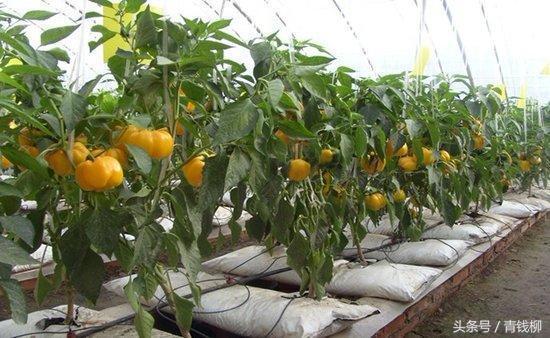
Soilless Cultivation Technology for Colored Bell Peppers in Multi-Span Greenhouses
1 Greenhouse Facilities
The greenhouse for growing fruit-type sweet peppers can be either single-span or multi-span. The production base's greenhouse for growing fruit-type sweet peppers is a 12-span plastic greenhouse, with a total ground area inside the greenhouse of 4860 sq m. Each span has a width of 9 m, a shoulder height of 3.4 m, a top height of 5.5 m, and a length of 45 m. The top of the greenhouse is equipped with a shade net system and a ventilation system, insect-proof nets are installed around the greenhouse, and a complete drip irrigation pipe system is laid inside the greenhouse. The cultivation troughs used for soilless cultivation are made of reinforced concrete, 100 cm long, 20 cm wide, and 20 cm high. Plastic PVC cultivation troughs or plastic foam boxes of the same specifications can also be used as substitutes. The bottom of the cultivation trough (box) is designed with 2 drainage holes with a diameter of about 1 cm to drain excess water from the root-zone substrate during drip irrigation.
2 Substrate and Nutrient Solution
2.1 Planting Substrate Preparation
Substrate cultivation is the most commonly used method for soilless crop cultivation and is also a good model for growing fruit-type sweet peppers, as the products are of good quality, yields are high, it is clean and hygienic, root diseases and pests are fewer, no intertillage or weeding is needed, and the labor intensity of cultivation management is relatively low. The substrate formula used by the author for soilless cultivation of fruit-type sweet peppers consists of 3 raw materials: coconut coir, decomposed sawdust, and decomposed sheep manure, in a volume ratio of 1:1:1. They are mixed evenly using a mixer or by hand. After mixing, the substrate is drenched with a 50-fold dilution of "formalin" (40% formaldehyde solution) for disinfection. At the same time, a 500-1000 fold dilution of carbosulfan (trade name "Goodyear Winter") insecticidal solution is used together to drench the substrate, enhancing the bactericidal and insecticidal effect. After being thoroughly drenched with the disinfectant solution, the substrate is sealed and covered with plastic film under open-air conditions for 15-20 d. 10-15 d before planting seedlings, the covering plastic film is removed to let the substrate be exposed to wind and sun. After the substrate is loaded into the cultivation troughs, seedlings can be planted.
2.2 Nutrient Solution Preparation and Use
For substrate cultivation of fruit-type sweet peppers in greenhouses, it is recommended to use a drip irrigation system for integrated water and fertilizer management, which saves labor, fertilizer, and water, and is efficient and environmentally friendly. The nutrient solution formula used for fertilization is mainly formulated based on the nutrient uptake of fruit-type sweet peppers combined with the water quality of the irrigation water source. The author has used the following formula for many years to prepare nutrient stock solutions, separately preparing stock solution A and stock solution B for later use. The raw materials and quantities required for preparing stock solution A and stock solution B are shown in Table 1. The volume of each of the 2 stock solution tanks is preferably 1000 L. When preparing stock solution A, weigh the required raw materials according to the data in the stock solution A formula in Table 1, dissolve each completely in a small amount of water, pour into tank A, then add water to the tank to dilute to 1000 L. Similarly, weigh the required raw materials according to the data in the stock solution B formula in Table 1, dissolve each in water, pour into tank B, then add water to dilute to 1000 L. Each time sweet peppers are fertilized, measure 3 L of each of the 2 nutrient stock solutions A and B, mix them, add water to dilute 1000 times, and preferably adjust the pH of the nutrient solution to 6.5-7.5; if the pH can be adjusted to 7.0, that is optimal. To raise the pH of the nutrient solution, a dilute alkali solution such as sodium hydroxide or potassium hydroxide can be added to neutralize it; to lower the pH of the nutrient solution, a dilute sulfuric acid or dilute nitric acid solution can be added to neutralize it. Then the diluted nutrient solution is applied through the drip tubes of the irrigation system into the cultivation trough substrate to supply the nutrients and water needed by the crop plants. The EC value, the concentration of soluble salts in the fertilizer solution, is measured with a conductivity meter, and the pH value is measured with a pH meter. When this nutrient solution formula is used for soilless cultivation of fruit-type sweet peppers in greenhouses, the plant branches and leaves grow robustly, fruit yield is high, and the appearance and flavor quality are good.
The production base's integrated water and fertilizer management uses the Israeli NETAFIM drip fertigation system and the Eldar-shany automatic irrigation and fertilization system, extracting the nutrient stock solution and diluting it into a solution of the required concentration, then setting the drip irrigation and fertilization time or fertilizer solution amount on the computer, and fertilizing and irrigating the crop at fixed times or in fixed amounts.
Table 1 Nutrient stock solution formula for soilless cultivation of fruit-type sweet peppers in greenhouses
Note: The data in the table are the amounts used to prepare 1000 L of stock solution.
3 Elite Varieties and Seedling Raising
3.1 Elite Varieties
The varieties selected by the author for many years of fruit-type sweet pepper production are all varieties produced by the Dutch seed company RIJK ZWAAN. These varieties have good product quality, high yield, uniformly large fruit shape, and bright fruit color. The specific main varieties are as follows.
3.1.1 Mandy
The plant has medium vigor, short internodes, and a high fruit-setting rate. The fruit is lantern-shaped and turns red when mature. The fruit is 8-10 cm long and 9-10 cm in diameter, with a single fruit weight of 200-260 g. The fruit wall is thick, the surface glossiness is good, and the color is bright. It can be harvested as either green or red fruit. It is storage-tolerant and resistant to Tobacco mosaic virus. It is suitable for planting in plastic greenhouses in autumn-winter and early spring.
3.1.2 Taranto
The plant has strong vigor and short internodes. The fruit is square-shaped and turns yellow after maturity. The fruit is 10-12 cm long and 9-10 cm in diameter, with a single fruit weight of 250-300 g. The surface is glossy. It can be harvested as either green or yellow fruit. It is storage-tolerant and resistant to Tobacco mosaic virus, Tomato spotted wilt virus, and Potato virus Y. It is suitable for planting in greenhouses in early spring and spring-summer.
3.1.3 Sun Red
The plant has medium vigor, short internodes, and a high fruit-setting rate. The fruit is lantern-shaped and turns red after maturity. The fruit is 8-10 cm long and 9-10 cm in diameter, with a single fruit weight of 200-250 g. The fruit wall is thick, the surface glossiness is good, and the color is bright. It can be harvested as either green or red fruit. It is storage-tolerant, resistant to Tobacco mosaic virus and Potato virus Y, and heat-tolerant. It is suitable for planting in plastic greenhouses in spring-summer.
Among the fruit-type sweet peppers bred by this company, the varieties with mature fruit turning red also include Fukang, Niri, Red Taiji, and Safiro; the varieties turning yellow also include Jinguan, Jiali, Yellow Taiji, and Jindai; and the variety turning orange is Simpson. All can be planted for commercial production.
3.2 Sowing and Seedling Raising
Wrap the seeds used for sowing and seedling raising in gauze, place them in hot water at 50-55°C and scald them for 30 min, then soak the seeds in water at a constant temperature of 28-30°C for 4 h. After removing the seeds, shake off the water, soak the seeds in a 1% potassium permanganate solution or 10% trisodium phosphate for 20 min for sterilization, and finally rinse the seeds with tap water until the medicinal solution is completely washed off. Spread the seeds flat on a moist gauze in a tray, cover with another layer of moist gauze, and place in a constant-temperature chamber at 25°C for germination. Seeds germinate in about 6-7 d. Sow the germinated seeds into seedling trays already filled with nutrient soil, sowing the first germinated seeds first. For seedling raising, 50-cell or 72-cell plug trays can be used. The seedling substrate is prepared by evenly mixing peat soil, perlite, and vermiculite in a volume ratio of 6:3:1. After filling the plug trays with substrate, spray clean water above the trays with a sprayer so that the substrate in the cells is completely soaked, then sow. The sowing depth is 1 cm, sow 1 seed per cell, and after sowing cover with a layer of perlite and vermiculite about 0.5 cm thick. The optimal temperature for seedling raising is 25-30°C; if the temperature is higher than 30°C, the seedlings are prone to leggy growth. Counting from the start of seed germination, at 35-40 d, seedlings with 5-6 true leaves and a height of about 10 cm can be raised. Seedlings of this specification can be used for transplanting. During the seedling raising process, temperature and moisture must be well controlled. Only a small sprayer may be used to spray clean water to supplement the moisture of the substrate in the seedling trays. 3 d before transplanting the seedlings, stop supplementing water to the substrate to harden the seedlings.
3.3 Production Period
For growing fruit-type sweet peppers in greenhouses, because the top of the facility greenhouse is equipped with a shade net system and a ventilation system, the shade net can be stretched and the ventilation system opened during high-temperature weather in summer and autumn to cool down. Therefore, seedling raising can begin in late June each year, transplanting is done in mid-to-late July, the harvest period begins in early October, and the harvest period can last until late April to mid-May of the following year. If the greenhouse has no shade net system or ventilation system, the seedling raising time can be delayed until late July.
4 Fine Transplanting
The transplanting depth for sweet pepper seedlings should be just enough to bury the root area of the seedlings with nutrient soil, and must not bury past the cotyledons. The row spacing for arranging the cultivation troughs is 150 cm. Seedlings in the cultivation troughs are planted in a single row, with a planting spacing of 30-35 cm. After transplanting, water thoroughly to settle the roots. After transplanting and seedling recovery, drench the roots with a 5000-fold dilution of agricultural streptomycin to prevent root diseases. The root-drenching solution is on average 200 mL per plant each time, for a total of 2 times, with an interval of 15 d.
5 Water and Fertilizer Management
Sweet peppers begin to resume growth 4 d after transplanting, and drip irrigation of nutrient solution begins, 2-3 times per day, 5 min each time, and the substrate moisture can best be controlled at about 80%. Nutrient solution applied in the early growth stage of sweet peppersconcentration EC value at 1.8-2.2is preferable; nutrient solution applied during the flowering and fruiting stageconcentration EC value should preferably be 2.1-2.5; applied during the fruit ripening stagenutrient solution concentration EC value should preferably be 2.4-2.8; throughout the entire growth process, the pH value of the nutrient solution is adjusted to 6.5-7.5. Foliar topdressing has an obvious yield-increasing effect on fruit-type sweet peppers. Foliar topdressing should be done once every 7-10 d. Each time, pesticide solution is sprayed to control diseases and pests while foliar topdressing is carried out simultaneously. Common foliar fertilizers include urea (concentration 0.2%), monopotassium phosphate (concentration 0.2%), or compound foliar fertilizers sold in the agricultural materials market such as brassinolide (diluted 100000 times), rare earth foliar fertilizer (diluted 800-1000 times), etc. Weeds growing in the cultivation troughs should be removed promptly to avoid weeds competing for fertilizer and water.
6 Plant Management
6.1 Pruning
Sweet pepper pruning adopts double-main-vine pruning. From the branches of the main stem, select and retain 2 robust branches to train as the double main vines, and cut off all other side branches. Use nylon ropes hung from above to train the vines. About 2.5 m above the cultivation troughs, at intervals of about 50 cm along the direction of the planting row of the cultivation troughs, set up 2 no. 10 iron wires. Use 2 nylon ropes with a diameter of 5 mm, tie one end of each near the ground on the main stem, then wind the 2 nylon ropes separately clockwise around the 2 main vines, pulling the ropes upward in a "Y" shape, with an angle of about 30 degrees between the 2 ropes, hang the main vines diagonally upward, and train the vines to grow upward, so that the 2 main vines can naturally stand upright and grow upward without drooping, but do not pull the main vines excessively. The other end of the nylon rope is fixed to the iron wire above. During plant growth, use the nylon ropes hanging the main vines to coil around and wind the extending growing main vines, so that the 2 main vines can grow more upright and extend upward to bear fruit. Except for the 2 main vines, all side branches and side buds growing on the plant throughout the growth period are removed.
6.2 Pollination
The ventilation and lighting conditions in plastic greenhouses are relatively poorer than in open fields, and there is a lack of pollination by insects such as bees. Therefore, after sweet pepper production enters the flowering stage, artificial supplementary pollination is needed. Artificial pollination uses a diluted solution of the plant growth regulator "p-chlorophenoxyacetic acid" (trade name "Tomato Spirit") at a concentration of 30-40 mg/L. Dip a brush in the solution and gently dot it onto the pistil of fully opened flowers.
6.3 Removing Old Leaves
To reduce waste of nutrients, leaves growing below the first pepper on the sweet pepper plant should be removed promptly. In the middle and late fruiting stages, cut off the old and yellow leaves on the lower part of the plant to improve light conditions, ventilation, and light penetration, and increase photosynthetic efficiency and fruit appearance quality.
6.4 Fruit Thinning
Fruit-type sweet peppers begin to set fruit from the 2nd node. When the plant is robust (main stem diameter above 1.5 cm, diameter of the middle part of the 1st node of the main vine above 1.0 cm), retain 1 fruit every other node; in the middle and late stages of plant growth, retain 1 fruit every 2 nodes. Fruit thinning is best done when the fruit has grown to the size of an egg (transverse diameter about 3.5 cm). Remove diseased, pest-damaged, and deformed fruits, and select and retain fruits with a uniform shape and good development so that they obtain sufficient nutrients.
7 Main Diseases and Pests and Their Control
Common diseases of fruit-type sweet peppers grown in greenhouses include Phytophthora blight, bacterial wilt, leaf spot, and root rot, and pests include tobacco cutworm, leafminer, whitefly, aphid, thrips, and diamondback moth. The author uses a combination of pesticide control and physical control methods such as yellow sticky boards and insect-attracting lamps to control diseases and pests. Yellow sticky boards and abamectin (such as "Aifuding"), thiamethoxam (such as "Actara"), imidacloprid (such as "Dagongchen"), Bacillus thuringiensis, and acetamiprid are used to control American serpentine leafminer, whitefly, aphid, thrips, and diamondback moth. Chlorfenapyr (such as "Chujin") is used to control tobacco cutworm, cabbage caterpillar, leafminer, thrips, and mites. For Phytophthora blight, leaf spot, Fusarium wilt, and root rot, thiophanate-methyl, carbendazim, chlorothalonil, iprodione, propamocarb hydrochloride (such as "Previcur"), and agricultural streptomycin can be used in rotation for control. For Phytophthora blight, a diluted metalaxyl solution can be used to drench the roots or a diluted mancozeb solution can be sprayed for control. The concentration of the sprayed pesticide solution is prepared according to the concentration recommended on the package instructions.
8 Harvesting
Sweet pepper fruits can mature and be harvested about 60 d after fruit set. When picking the fruits, cut the peppers off with scissors, and no fruit stalk should be left at the leaf axil. The cut fruit should retain a fruit stalk length of about 1.5 cm, and the cut should be smooth to prevent the peppers from being injured. Handle them gently, and the harvest boxes for holding the peppers should be clean, hygienic, and dry inside.