The rubber plant looks awful as a single bare trunk. How do you shape it? Try the "three forks, nine tops" method
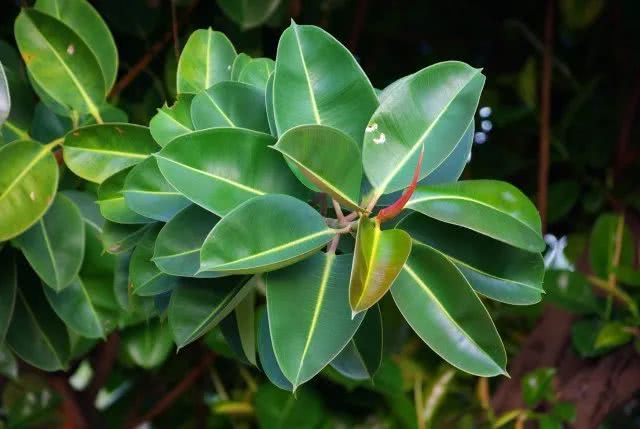
How to prevent the rubber plant's main trunk from growing too tall
It must be said, the rubber plant has an extremely strong apical dominance!
If it is not pruned, the apical buds of the rubber plant will keep sprouting in succession, the main trunk will grow taller and taller, while its axillary buds remain dormant for a long time, turning the main trunk into a single bare "lone trunk."
Oh, it is hideous beyond measure, truly unbearable.
To keep the rubber plant from growing too tall, if you are growing it at home, do not start it off in a large pot. Then when repotting, just trim the roots a little and replant it in the original pot, to avoid the plant growing too large.
If you propagate by cuttings, once the cutting grows to a certain height, it should be cut back according to your personal preference.
After cutting the trunk, 3 to 5 side branches can sprout at the same time. If too many side branches sprout, you can remove some as appropriate, keeping about 3 scaffold branches.
When they grow to a certain height, they should be cut back again. After sprouting, keep 3 branches on each scaffold branch, thus forming the so-called "three forks, nine tops" basic tree shape.
After that, pruning should still be done every year in early to mid-May.
Pruning method: remove overly dense branches, diseased and pest-infested branches, crossing branches, parallel branches and aged branches, and cut back overly long branches, to maintain a round, upright and beautiful canopy and tree shape.
When growing a rubber plant, besides the ugly "lone trunk," yellow leaves are ugly too.
So why do the rubber plant's leaves turn yellow?
When the rubber plant is still a young seedling, it needs repotting every spring, with the pot diameter getting larger year by year. Once it is a mature plant, it can be repotted once every 2 to 3 years.
If it is not repotted for a long time, the potting soil will become severely compacted, hindering soil aeration, causing the rubber plant's fibrous roots to suffocate and die, and resulting in the plant's leaves turning yellow and dropping off.
Fellow garden friends, please remember: generally, once a potted rubber plant is a mature plant, it is best to repot it once every spring before the new buds grow.
When repotting, appropriately cut off curled roots and some dead roots, add new potting soil and base fertilizer, and loosen the potting soil once every 15 to 20 days until the rubber plant returns to normal growth.
Finally, the chief editor will also explain the rubber plant's growing essentials all at once. If I do not, I always worry that a basic link is missing.
The rubber plant's growing requirements
[Light]
It likes a warm, humid and brightly lit environment, and dislikes direct sunlight.
[Temperature]
The suitable growing temperature is 20 to 25 degrees C.
[Soil]
It likes fertile, loose, slightly acidic soil.
The potting soil should preferably be made up of 4 parts leaf mold, peat soil plus about 1 part river sand and a small amount of base fertilizer.
[Watering]
In the hot summer season, the rubber plant grows relatively fast, so it should be given plenty of fertilizer and water, but avoid waterlogging in the pot.
After autumn begins, gradually reduce watering to promote solid plant growth, which helps it overwinter.
[Fertilizing]
For young plants in the growing season, apply once every 20 days a mix of well-rotted liquid fertilizer diluted 10 times with an equal amount of 500-times potassium dihydrogen phosphate solution. For established plants in the growing season, apply the mixed liquid fertilizer once every 2 months.
[Propagation]
Mostly by cuttings, and in late spring and early summer, it can be done together with pruning.
Propagation method:
1. For cuttings, mostly choose one-year-old semi-lignified middle branches.
2. After cutting the cuttings, seal the cut with clay or plant ash.
3. The length of the cutting is based on keeping 3 buds. Cut off the lower 1 leaf, fold the upper 2 leaves together, tie them with thin plastic string, and insert the cutting into a cutting bed with plain sand or vermiculite as the medium.
4. After inserting, keep the cutting bed at relatively high humidity, but do not let it waterlog. The suitable temperature is 18 to 25 degrees C. Frequently sprinkle water on the ground to increase air humidity, and do good work on shading and ventilation. It will root in 2 to 3 weeks.
OK, the supplement is complete, and this article will end here. I do not know whether the chief editor has explained it clearly and in detail? For fellow garden friends who did not understand, the chief editor has specially written an acrostic poem for you. It may not be well written, but it can help you find the chief editor.
More wonderful and brilliant articles are all in an acrostic poem:
A light breeze gently strokes, flowers stay forever
Strolling in spirit, wandering to the sunny south of the mountain
Searching for wonders and seeking clever finds at Bronze Sparrow Terrace
Planting red and growing green, up in the blue clouds
--Come take the challenge: a four-line acrostic-and-tail poem. Connect the first characters plus connect the last characters, and you can get an eight-character motto to summon the chief editor's true self! When you come, remember to say: "Chief editor, your secret has been cracked by me!"