Aimu Bonsai | A straight-trunk larch only shines when you play it this way. Stop saying you don't have good material.
Larch is distributed in the Greater Khingan and Lesser Khingan mountain ranges of China, at altitudes of 300-1200 m. It can grow in various different environments (such as mountain foothills, marshes, peat bogs, meadows, moist shady slopes with humus-rich soil and dry sunny slopes, moist river valleys and mountain tops, etc.), often forming large pure forests, or forming mixed forests dominated by larch together with coniferous and broadleaf trees such as white birch, black birch, shrub birch, David poplar, Scots pine, red-barked spruce, and fish-scale spruce. It is also distributed in the Far East region of the Soviet Union. The type specimen was collected from Siberia, Soviet Union.
Larch is strongly light-demanding and has relatively high water requirements, growing most vigorously on north-facing gentle slopes and hilly areas with deep, fertile, moist, well-drained soil. Larch grows best under moist, well-drained, well-aerated, deep and fertile soil conditions; it can also grow on dry, barren sunny mountain slopes or in waterlogged wetlands or low-lying areas that are flooded year-round, but its growth is poor. Larch is tolerant of low temperatures and cold, and generally can grow normally even at a minimum temperature of -50°C.
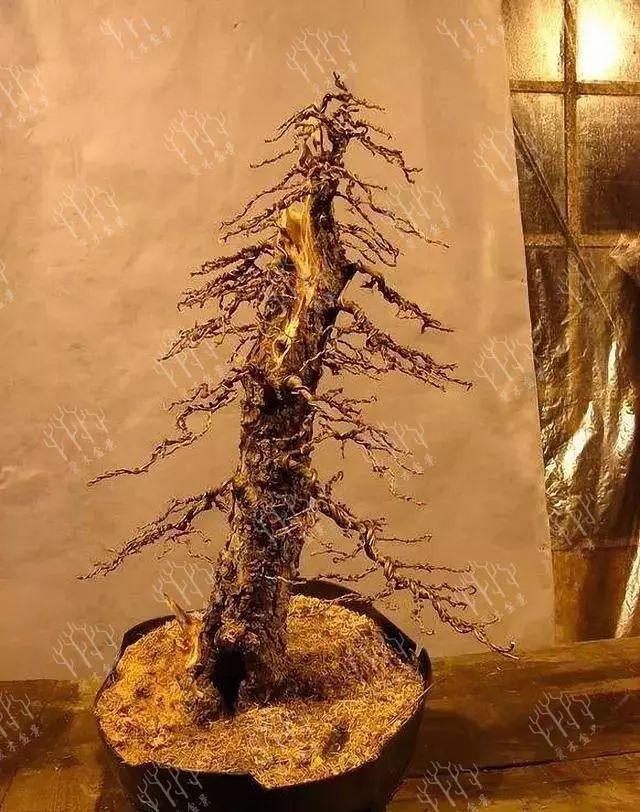
A very ordinary straight-trunk larch stump. There are two points that can be considered advantages:
1. The stump has overall taper, and the base of the stump is relatively thick.
2. The bark is completely cracked and peeling, making it look rather aged.
In order to have variation in the later styling, the stump was planted at an angle in the early cultivation stage, striving for a certain degree of variation.
The first overhaul of the stump, adjusting the angle of the branch pads and combining it with the creation of deadwood. There are mainly three purposes:
1. Press the branch pads down to form the posture of an old tree.
2. Make the upper part into deadwood, which is beneficial both for tapering the tip and for echoing the deadwood at the bottom.
3. Make reasonable use of the broken top at the bottom, turning it into a deadwood head to increase the sense of age and weathering.
The larch bonsai has basically taken shape; repotting it into a square pot further highlights the upright, imposing air of a straight-trunk bonsai.
After several years of care, the branch pads gradually became fuller, and the bonsai approached maturity.
The pot was further changed to a shallower one, revealing a powerful root base; the full branch pads are well spaced with a sense of density and openness, and the green leaves, deadwood, pot, and stand complement one another beautifully. An utterly ordinary stump, through the polishing of time and a master's hand, transformed into a classic landscape.
The best way to approve of Aimu Bonsai - share,
The best way to support Aimu Bonsai - follow,
Follow Aimu Bonsai, and play with bonsai together with Aimu.