How to grow grapes? A detailed guide to grape cultivation techniques in Xifeng County, Guizhou Province
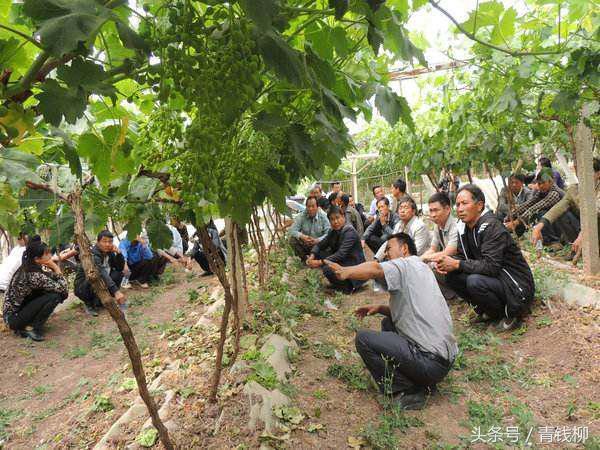
Grape cultivation techniques in Xifeng County, Guizhou Province
1 Orchard establishment
1.1 Site selection
The site should preferably be a relatively flat loam or sandy loam plot; if the terrain is a limiting factor, the land can be leveled into relatively flat terraces for grape planting.
1.2 Orchard planning and design
Vineyards mostly use trellis (pergola) cultivation, with a few using fence training. Planting rows are mostly oriented east-west, with a plant spacing of 2 m and a row spacing of 2 m, and irrigation channels and drainage ditches are set up, with 3-5 m of corn planted around the planting plot as a buffer zone.
1.3 Preparation of the planting site and seedlings
Before planting, the whole orchard soil should be deeply plowed. Remove stones, weeds and other debris; dig planting holes. Depth 80 cm. Width 60 cm. And apply farmyard manure at 2500 kg/667 sq m along with it. After applying the fertilizer, shape the planting holes into a dish to facilitate grape planting. For the young grape plants, use one-year-old cuttings. The seedling thickness should be more than 0.4 cm. They are required to have 4-5 relatively strong root systems and 3-5 plump buds. Before planting, soak the roots in a 50% carbendazim solution for 30 min to disinfect the roots and reduce the occurrence of pests and diseases.
1.4 Trellis type and trellis materials
At present, most farmers in Xifeng County use pergola-style cultivation, which gives relatively high yields and good air circulation under the trellis. Concrete posts use square posts with a side length of 12 cm x 12 cm and a height of 2.5 m. The aboveground part is 2.0 m, and the underground part is 0.5 m.
1.5 Planting period and method
The planting time is generally from late November to mid-March of the following year. When planting, dig holes in the planting dish; the depth varies slightly according to the size of the seedling, but it is best if the roots can spread out completely. The roots must not cross or overlap. Backfill the soil and firm it, then hold the root crown and gently lift it upward a little so that the roots can spread out better, and finally water with settling water.
2 Training and pruning
Training refers to the technique of using pruning and other auxiliary measures to organize the scaffold branches and canopy of a fruit tree into a certain structure and shape, so as to achieve a reasonable distribution of branches and leaves and a strong tree vigor, for the purpose of early fruiting, high yield and high quality.
Pruning refers to thinning out or cutting off a certain part of the organs of a fruit tree, so as to regulate the tree's growth vigor and achieve renewal and rejuvenation. Pruning is divided into winter pruning and summer pruning. Winter pruning mainly focuses on restoring tree vigor and training; summer pruning mainly focuses on regulating nutrients and growth.
2.1 Training and pruning in the first year after planting
In the first year after planting, the primary task is mainly to cultivate the trunk. When the shoots just sprout, select and keep 2-3 plump buds and remove the rest; when they grow to about 15 cm, keep 2 small branches and thin out the rest; when they grow to about 50 cm, keep one strong-growing, relatively thick branch as the trunk for training. Insert a small bamboo pole to help it grow upright, and thin out the remaining branches. For seedlings that grow well, after one year of growth they can basically reach the trellis by winter, but during winter pruning, leave 80 cm, with a thickness of more than 0.7 cm, and cut off the rest.
2.2 Training and pruning in the second year after planting
In the second year after planting, the main focus is cultivating the main canes. From the buds sprouting in spring, select and keep 3-4 robust ones for training, and guide them in different directions for the cultivation of main canes. When the branches grow to 2-2.5 m, pinch the tips. After pinching, keep only the top 1 secondary shoot, retain 3-5 leaves and repeatedly pinch the tips. For the other secondary shoots, retain 1-2 leaves and repeatedly pinch the tips. During the growing season, if tendrils grow, remove them in time to avoid consuming nutrients and causing nutrient loss. During winter pruning, leave branches 1.8-2 m, and the cut diameter should be more than 1 cm.
2.3 Training and pruning in the third year after planting
In the third year, after budding, select and keep 2-3 side canes on each main cane and remove all the other buds. The fruit clusters on the side canes may be kept sparsely or not at all, so as to concentrate nutrients and promote rapid plant growth. When the extension shoot of the main cane grows to 1.8-2 m and the side canes extend to 1.5-2 m, pinch the tips. After pinching, keep only the top 1 secondary shoot, retain 3-5 leaves and repeatedly pinch the tips. During winter pruning, cut the extension shoot of the main cane to leave 1.5-1.8 m, and the side canes 1.2-1.5 m, with the cut diameter all above 1 cm. When nutrients are sufficient, some fruit trees will bear fruit, but to ensure tree nutrition and later yield, the fruit trees must not bear too much fruit, and flower clusters should be thinned in time. During summer pruning, promptly remove new buds and tendrils sprouting from the base and trunk to ensure nutrients are not lost, and carry out vine tying in time.
2.4 Training and pruning in the fourth year after planting
In the fourth year, leave another 2-3 side canes on the extension canes, and select and keep 1-2 fruiting mother branches on each side cane. Fruiting branches can be selected and kept at a branch spacing of 20-25 cm, and the rest are removed. When the fruiting mother branches selected and kept on the side canes grow to 80-100 cm, pinch the tips. After pinching, the handling of secondary shoots and the pinching of the main and side canes are all carried out as in the previous year. On the fruiting branches, start pinching from the flower cluster and begin pinching at the 8th leaf upward. From 7 d before flowering to the beginning of flowering, remove all secondary shoots below the fruit cluster, and for secondary shoots above the fruit cluster, retain 2-3 leaves and repeatedly pinch the tips. During winter pruning, the reserved lengths of the extension branches of the main and side branches are 1.8-2 m and 1.5-1.8 m respectively, with the cut diameter all above 1 cm. The fruiting mother canes are cut to leave a length of 60-80 cm, with a cut diameter above 0.7 cm, and the remaining fruiting branches can be pruned reasonably according to tree vigor and tree shape.
From the 4th year onward, the fruit trees begin to bear fruit. In summer, in addition to routine work such as bud removal, tying, tendril removal and pinching, flower clusters and fruit clusters also need thinning. This is especially true for fruit clusters, because when the load on the fruit tree is too large, it affects the growth of the whole tree vigor and also affects yield and fruit quality. Therefore, flower and fruit thinning is indispensable, but in actual production some growers are unwilling to do it; therefore, under the unified standards of the cooperative, this work has also been carried out relatively well. After entering the fruiting stage, the yield per 667 sq m is generally controlled at about 1250 kg.
3 Soil, fertilizer and water management
3.1 Soil management
(1) Deep plowing to improve the soil: after fruit harvest each autumn, combine autumn application of base fertilizer with deep plowing to improve the soil, improving the soil's physical and chemical properties.
(2) Intertillage: after rainfall or irrigation during the orchard growing season, carry out intertillage and loosening of the soil in time; the depth of intertillage is 5 cm-10 cm.
(3) Planting green manure and growing grass between rows: planting green manure between grape rows can effectively use the land and increase the source of organic fertilizer.
3.2 Fertilization
(1) Applying base fertilizer: base fertilizer is applied every autumn and winter, combined with deep plowing to improve the soil. Apply farmyard manure at a rate of 2500-3000 kg/667 sq m. Generally, a ditch 40-60 cm deep and 40-60 cm wide can be dug at a distance of 0.5-0.8 m from the plant to apply the base fertilizer. Base fertilizer must not be lacking; if the base fertilizer is insufficient, it will affect tree vigor growth and fruit tree yield.
(2) Topdressing: for young trees, apply small amounts multiple times. Generally, in the year of planting, starting from the emergence of new leaves in March, use decomposed clear manure water for topdressing. Apply once every 20-30 days. Stop application at the end of September. In the second year, before budding, use decomposed clear manure water for topdressing. During the branch growth period, appropriately add phosphorus and potassium fertilizer to the decomposed clear manure water for topdressing, which can help the branches grow plumply. Apply once every 30 days. When the fruit trees can bear fruit, 10 days before flowering, apply an additional pre-flowering fertilizer to help flowering and fruit setting. The fertilizer should be mainly phosphorus and potassium fertilizer, with a small amount of nitrogen fertilizer. Topdressing cannot replace base fertilizer. It is only a supplement to base fertilizer. For good fruit tree growth, high yield and good quality, farmyard base fertilizer must still be the main component.
(3) Foliar topdressing: in recent years, many areas have proposed using foliar topdressing to replace topdressing. This practice fundamentally cannot solve the fertilizer demand problem of fruit trees. It is merely a remedy when fruit trees show severe fertilizer deficiency, and it cannot replace topdressing, let alone base fertilizer. When using foliar topdressing, the fertilizer concentration generally must not exceed 0.5%, otherwise it will cause phytotoxicity to the leaves of the fruit trees and damage the fruit trees.
3.3 Water management
Generally, irrigation in mature vineyards is carried out during 4 periods of grape growth: the budding stage, before and after flowering, the berry swelling stage and after harvest, with 3-5 irrigations. Attention should also be paid to increasing or decreasing the number of irrigations according to the amount of rainfall in that year.
(1) Bud-promoting water: irrigate from the time the grapes are uncovered until before sprouting and shoot growth. After applying bud-promoting fertilizer, strong bud-promoting water (applied continuously) gives a better effect. In areas with dry springs and little rain, 1 thorough irrigation is also needed to meet the needs of grape budding and shoot growth.
(2) About 10 days before flowering, irrigate once. After that, irrigation should be controlled during the flowering period. If rainfall occurs, attention should be paid to drainage. This has a clear effect on improving pollination, fertilization and fruit setting rate.
(3) When the berries grow to the size of soybean grains, combine fertilization with fruit-promoting irrigation and apply fruit-promoting water. At this time, new shoots are also growing vigorously, and the temperature is constantly rising. Leaf water evaporation is increasing, and nutrients and water are urgently needed. When there is little rainfall at this stage, irrigate thoroughly once every 15-20 days to meet the needs of new shoot and berry growth.
(4) After fruit harvest, prepare for autumn fertilization. At this time, combine the application of base fertilizer with irrigation. This can promote the accumulation of nutrients in the tree and plays an important role in the next year's growth and fruiting. In dry winter and spring areas, irrigate once more with overwintering freezing water before cold protection. This reduces freezing injury and drought injury.
4 Pest and disease control
Pest and disease control should be carried out mainly through prevention and integrated management. First, clean the whole orchard every winter, centrally dispose of pruned diseased and pest-infested branches by burning or deep burial, and disinfect the soil, trunk and roots, using lime sulfur mixture. In summer, pay attention to ventilation and light transmission, drainage, etc., to reduce the spread of pathogens and the occurrence of diseases.
The diseases that occur more frequently on grapes include gray mold, downy mildew, white rot and black pox. For these several diseases, common methods are used for control, such as: 50% carbendazim powder 600-fold solution spray; 50% thiophanate-methyl wettable powder 800-1000-fold solution spray; 75% chlorothalonil wettable powder 500-fold solution spray; 58% metalaxyl-mancozeb wettable powder 600-fold solution.
5 Harvesting and packaging
(1) Harvesting: when the berries are slightly transparent, the flesh becomes soft and elastic, the base of the cluster stem is lignified and yellowish-brown, the top of the cluster axis is slightly lignified and turns brown, and the main cluster axis becomes lighter in color or yellow-green, harvesting can be carried out. The general harvest time is from the end of July to the end of August.
(2) Packaging: generally there is basically no packaging for local sales, while products for external sale are generally packaged in cardboard boxes. Generally one box can hold 25 kg. Large ones can hold 5 kg. Do not pack too much, otherwise the grapes at the bottom of the box will be crushed, affecting fruit quality.