A wild grass whose roots look like ginseng was once a healing herb in mountainous areas, and now at 35 yuan per jin it has become a cash crop.
Warm reminder
Hemu Report aims to share and popularize information about various plants and their uses, for reference only. If medicinal use is needed, it is recommended to consult a professional physician to avoid problems!
Friends who have lived in rural areas surely know that in the rural wild, the most abundant thing is wild grass, and some wild grasses look unremarkable but actually have great uses. For example, some wild grasses can be eaten as wild vegetables, and some can be used as medicinal herbs, and thus they are valued.
With the improvement of farmers' living standards and the improvement of agricultural production levels, many farmers have gradually given up growing traditional crops such as wheat, rice, and corn, and have begun to grow other cash crops, such as medicinal herbs, fruits, and so on. Some wild grasses that farmers previously did not pay attention to have become cash crops that these farmers value.
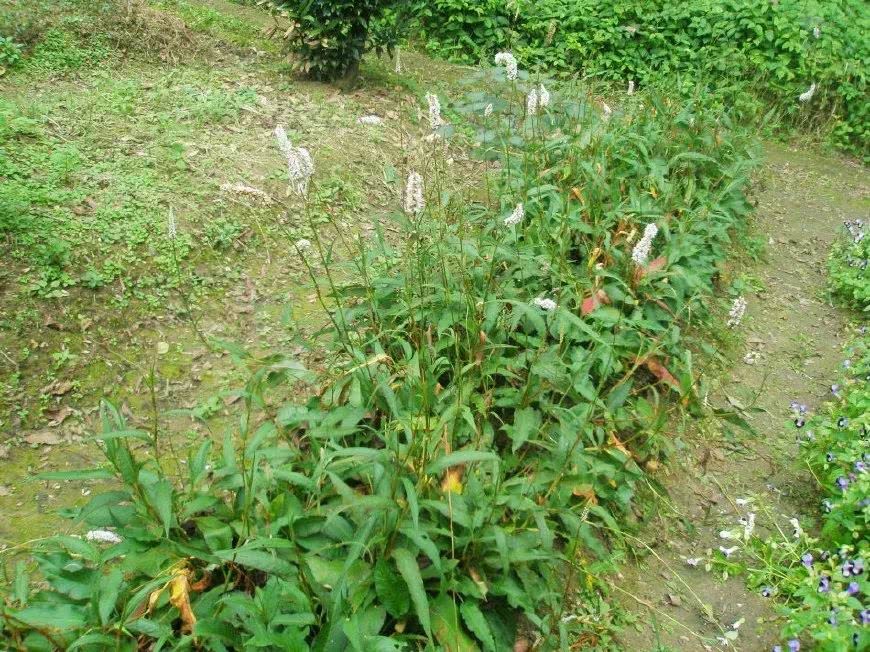
In the morning, the author followed an old farmer friend named Lao Liu from the village to his farmland. In Lao Liu's farmland, what the author saw was not traditional crops such as corn and soybeans, but some "special" crops like wild grasses. One of them attracted the author's attention. This wild grass can be said to be relatively common in rural mountains, and the author had even used it as a child. This wild grass is "quanliao" (Bistorta), but because its root resembles ginseng, it is also called "quanshen" (Bistorta officinalis).
Speaking of the wild grass quanshen, in fact, in rural areas of Gansu, Shandong, Henan, Jiangsu, Zhejiang, Jiangxi, Hunan, Hubei, and Anhui, quite a few old farmers in mountainous areas should be very familiar with it. Quanshen likes to grow in mountain slope grasslands and mountaintop meadows at altitudes of 800 m to 3000 m.
Lao Liu said that in the past, when poor people in mountainous areas got sick, they basically would not go to the hospital for treatment, but would dig up some wild grasses in the mountains to use, and quanshen was among them. Therefore, many older farmers also loved it very much and treated it as a free healing herb. Now that living conditions are better, many farmers in the mountains have also begun to cultivate it, treating it as a wild grass that brings wealth.
So what exactly are all its uses? The author also consulted relevant materials. According to "Chinese Materia Medica," the root of quanshen, which resembles ginseng, can be used as medicine. It has the effects of clearing heat and promoting diuresis, cooling blood and stopping bleeding, and removing toxin and dissipating masses. It can be used to treat symptoms such as lung-heat cough, febrile disease with convulsions, dysentery with bloody stool, heat diarrhea, hematemesis, epistaxis, hemorrhoid bleeding, and carbuncle swelling and sores.
It is precisely because quanshen has these uses that it is loved by farmers in mountainous areas, and now many farmers have also begun to specially cultivate quanshen.
Lao Liu told the author that quanshen is generally planted in early April. Compared with ordinary crops such as corn and rice, quanshen is still relatively easy to manage. As long as attention is paid to its requirements for temperature, moisture, light, air, and nutrients at different growth stages, production can basically be maintained. Moreover, quanshen is also a perennial wild grass, and generally one planting can be harvested for several years. At present, the market price of quanshen is also relatively good. Its price is generally 25 to 35 yuan per jin, which can also be considered a wealth-bringing grass for farmers in mountainous areas.
Dear friends, do you know about "quanshen"? You are welcome to leave a message and share your experience.
Text/Hemu Report, Images/Internet
If you like Hemu's articles, you are welcome to follow.