Which plants don't need soil? Soilless cultivation makes growing more flexible
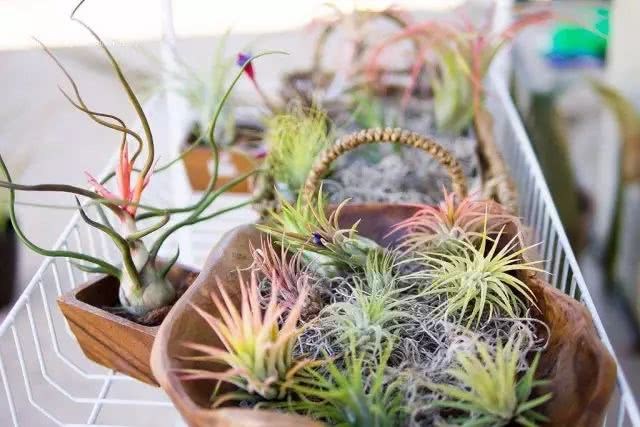
Source | Environment and Future
Nowadays there are more and more ways to grow plants, and everyone wants to show off something distinctive and grow their own style. Big Bear's friend also strongly requested that we write about the distinctive plants in her shop, so in this issue we recommend some epiphytic plants that can be grown without soil or with only a little soil.
First we need to distinguish one concept: epiphytes are not parasitic plants. Epiphytes can survive through their own photosynthesis, while parasitic plants cannot obtain enough nutrients for their systems through photosynthesis and need to absorb nutrients from other plants in order to survive, such as the common dodder and mistletoe.
Mistletoe
Epiphytes can grow in soil, and can also grow attached to rocks, walls or the surfaces of other plants. For example, the bryophytes and bird's-nest ferns we wrote about before are typical epiphytes. Among seed plants, epiphytes are mainly concentrated in the Orchidaceae and Bromeliaceae (pineapple family). In this issue we recommend some for you.
Epiphytic plants of the Orchidaceae
Orchidaceae
There are many epiphytic orchids. In this issue we recommend several that are relatively common and very easy to buy. If you want to dig them up yourself, please first learn about the plants' distribution regions and living environments. Since this issue is not a pictorial guide series, we will not go into detail about these things.
Dendrobium genus Dendrobium
Wild Dendrobium
Dendrobium is a famous medicinal plant and also a very good ornamental flowering plant. The flowers of plants in the Dendrobium genus are all very brightly colored, and the flowering period is generally in late spring and early summer. The Dendrobium at Big Bear's home has already produced buds but has not yet fully opened.
Potted Dendrobium
Dendrobium likes shady and humid environments and does not need too much light, so it is very suitable for indoor growing. The downside is that it needs frequent watering and misting. You can choose to grow it in soil, or tie it to a tree trunk. Friends who are interested can try growing it together with bryophytes.
The characteristic of Dendrobium is its pink-and-white flowers.
In addition, there are many species in the Dendrobium genus. Besides the Dendrobium mentioned above, those commonly seen on the market also include Dendrobium fimbriatum and Dendrobium officinale.
Wild Dendrobium fimbriatum
Yellow flowers
Artificially tied to a tree
Potted
Dendrobium fimbriatum plants are relatively large and need to be grown in a large pot.
Wild Dendrobium officinale
What Big Bear keeps at home is Dendrobium officinale. The flower color is not very vivid, a pale yellow-green, but the flower shape is very distinctive and somewhat similar to the Cymbidium ensifolium 'Chenguang'.
In addition, there are many other species of Dendrobium. Due to limited space, we cannot list them all, so please understand. The growing environment for Dendrobium can refer to that of bryophytes. Since seed plants are not as fragile as bryophytes, a certain amount of light can be given. In winter in northern cities, it must be moved indoors to avoid cold damage.
Bromeliaceae (pineapple family)
Bromeliaceae
Common epiphytes
Some friends may not be able to tell the difference between pineapple and pineapple. Here Big Bear wants to point out specifically (previously some friends argued with Big Bear until they were half dead, because some friends have never been exposed to taxonomy and have no concept of family, genus, species, variety, subspecies and cultivar in their minds, so explaining it is very laborious).
From a botanical perspective, pineapple = pineapple. Both pineapple and pineapple refer to a category of plants, not a specific species. What is sold on the market, and what we usually call "pineapple" and "pineapple", are the same plant, just different cultivars, equivalent to the difference between Red Fuji apples and Golden Delicious apples.
This is getting off topic. The epiphytes of the Bromeliaceae are mainly concentrated in the "Tillandsia genus (air plant genus)", such as the common air grass and Spanish moss.
All Bromeliaceae are introduced exotic plants, with no native distribution in China, so many references do not record them.
Tillandsia genus (air plant genus) Tillandsia
Many plants in the Tillandsia genus have no formal Chinese names, only the common names people usually use, such as air grass and air tillandsia. But names are not important; it is enough for everyone to recognize this type of plant. If you want to be precise, please refer to the Latin scientific names.
First let's talk about Tillandsia usneoides (Spanish moss).
Tillandsia usneoides
Note: The spelling of the scientific name on a certain encyclopedia website is incorrect. Please refer to the scientific name above.
Spanish moss is a plant that truly does not need soil at all. Hang it somewhere with light and mist it frequently and it can survive. If it is in a humid valley environment, it needs very little maintenance to grow. Because of this characteristic, Spanish moss is widely used in plant landscaping.
It can also grow normally indoors
Spanish moss has weak cold tolerance and can only be grown in southern cities. In the Yangtze River basin and north of it, indoor growing is recommended. If outdoors, it basically needs no care in spring and summer. Indoors, misting every few days is enough. If you want abundant flowering, you can add an appropriate amount of phosphorus fertilizer to the water and spray it.
Indoor creative ideas are also quite good
Air grass
Air grass is only a general term. There are many species with roughly similar appearances. Below, Big Bear will go through them one by one.
Tillandsia stricta
This species may be the most common air grass.
Tillandsia juncea
This plant can be seen in the first image of the article.
Tillandsia magnusiana
The characteristic of this species is the obvious white powder on the surface of the plant.
Tillandsia capitata
It is popular because of its red leaves.
Ericaceae
Ericaceae
Common epiphytes
Agapetes genus Agapetes
Finally, let's recommend one more plant, Agapetes, which has very distinctive flower shapes and high ornamental value. Agapetes is mainly distributed in the high-altitude areas of southern China. At present, most Agapetes commonly seen in horticulture are cultivars or hybrids, and some are also native species. Plants of this genus have relatively high light requirements and are not recommended for indoor growing.
Agapetes serpens
Agapetes serpens
Wild Agapetes serpens
Agapetes serpens in horticulture
If you also like growing flowers, then follow us!