How to Prevent the Fruiting Position of Chestnut from Shifting Outward
How do you prevent the fruiting position of chestnut from shifting outward?
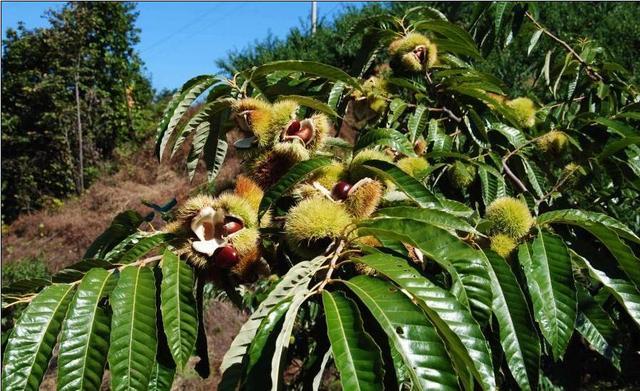
Chestnut has the habit of bearing fruit on strong branches, and the strong branches of a normal tree are all on the outer part of the canopy, thus forming fruit on the periphery. Young trees have few fruiting branches and low yields; as adult trees increase their branching, the branches become thinner and thinner and lose the ability to bear fruit, which is an important reason for the low yield of chestnut trees. To encourage strong branches to grow on the outer part of the chestnut tree, the Jizhou area of Tianjin formerly used clear-cavity pruning, which instead caused the fruiting position to shift even further outward, with all the fruit at the tips of the tree and the rear part bare. After many years of production practice, the following solutions are now proposed.
Bending branches and heavy heading back. In combination with perennial fruiting branch groups that have shifted outward in fruiting position, bare bases, weakened growth and few fruits, prune back from better branches to cultivate new branch groups and induce vigorous fruiting mother branches. Bending branches can also play a role in producing new branches, achieving three-dimensional fruiting.
Bud removal. On each fruiting mother branch, select and retain 3 to 4 plump buds on the upper part and 1 to 2 on the lower part. Remove small buds and keep large buds; if still too dense, remove inner buds and keep outer buds. Master the principle of "remove small, keep large; remove dense, keep sparse; more outside, fewer inside; more on top, fewer below." After bud removal, nutrients are concentrated, growth is good, and flowering and fruit set are favored.
Male flower thinning. Chestnut male flowers outnumber female flowers several times over and consume large amounts of nutrients, so excess male flowers should be thinned out; the best effect is achieved when the chestnut male flower catkins are 1 to 2 cm long. They should be removed as they grow. After more than 10 days, mixed male and female inflorescences can grow, with male flowers above and female flowers below; retain 2 to 3 male flowers below for pollination and thin out the rest.
Pinching the pre-fruit shoot. After the mixed flower buds grow out, the new shoots that continue to grow in front are the pre-fruit shoots; pinch them leaving 3 to 4 leaves, which can increase the fruit-setting rate and reduce empty burrs.
Hand pollination. Select varieties with large nuts, good quality, early maturity and high compatibility as pollinator trees; pick male flowers when the male catkins change from green to yellow, preferably before 8 a.m. Spread the collected male catkins on glossy paper and place them in a dry, ventilated, dust-free place, turning them several times a day; after 24 hours pollen is shed, and the pollen is collected. When the female flower stigmas begin to fork, point pollination can be used; because the middle of a female flower stigma matures first, it should be pollinated several times. Point pollination with a writing brush gives a better effect.
Burr thinning. Too many chestnut burrs not only affects tree development but also causes alternate bearing. When the chestnut burrs reach 0.5 cm in diameter and the stigmas dry up (roughly in late July), thin out the excess chestnut burrs and concentrate nutrients, which helps reduce empty burrs. The standard for retaining burrs is: strong branches (30 to 35 cm) retain 2 to 3 burrs per single branch; medium branches (20 to 30 cm long) retain 1 to 2; weak branches (under 20 cm) retain a single burr. Regardless of strong, medium or weak branches, only one burr is retained at the same node. When thinning burrs, thin less on young vigorous trees and more on mature weak branches; thin less on the periphery and upper part, and more in the inner canopy and lower part of the crown.