Key Technical Points for Direct-Seeding Orchard Establishment of Wild Jujube (Ziziphus jujuba var. spinosa) and Wide-Row, Close-Spacing Planting
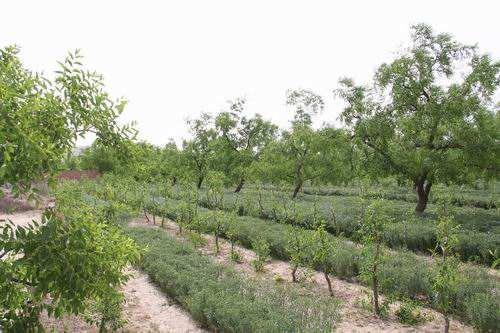
Wide-Row, Close-Spacing Planting Technique for Direct-Seeded Wild Jujube Orchards
Compared with sparse planting and large-canopy cultivation, the integrated management technique increases yield by nearly 20%, reduces labor by 30%, reduces chemical fertilizer application by nearly 35% and pesticide use by 20%, and increases net benefit per 666.7 sq m by 40%-50%.
1 Nursery Stock Cultivation
Direct seeding and seedling raising are carried out on the orchard establishment site, changing the model of raising seedlings in a nursery and then transplanting them to the orchard site. This avoids the shortcomings of extensive root breakage during lifting, severe water loss during transport, low survival rate after planting, and slow growth. Seedlings raised by direct seeding have a high survival rate after grafting and large growth, resulting in a uniform orchard.
In spring of the 1st year, sow wild jujube seeds at a plant-row spacing of 1.0-1.5 m x 4-4.5 m, with 3-5 seeds per hole. After sowing, cover with plastic film to promote seed germination. Thin seedlings at the appropriate time after emergence, leaving 1 plant per hole. Strengthen seedling tending, weeding, topdressing, and watering to promote strong growth of the rootstock seedlings; by autumn the rootstock seedlings can grow to about 1 m. In spring of the 2nd year, from early April to late May, carry out grafting. Collect scions in winter, seal them with wax, and store them under refrigeration. Use the cut grafting method. After the graft survives, promptly apply topdressing, watering, and foliar fertilizer. When the seedling grows to 1.5 m, pinch the growing tip to promote branch maturation and lignification, forming mature large seedlings with secondary branches.
2 Trellis Cultivation
In the winter of the 2nd year or spring of the 3rd year, bury a post every 15-20 m along the row. The posts are 3.5 m high (0.5 m buried underground, 3 m above ground). Stretch a wire every 50 cm on the posts, for a total of 6 wires, forming a support frame for jujube tree growth.
3 Hedge Wall Pruning and Training
In spring before the jujube trees bud, bend all jujube seedlings along the row and tie them to the first wire. On each bent plant, select 1 secondary branch on the upper side at 40 cm above ground, either remove it from the base or cut it back leaving 1-2 nodes, and make a notch 1 cm in front of it, deep into the xylem, to promote sprouting of the main bud below the notch and produce a vigorous jujube head branch. Increase fertilizer and water management and promptly spray foliar fertilizer; this jujube head branch can grow to more than 1 m in the same year. For the bent portion, retain all secondary branches, pinch the tips of the secondary branches, and spray gibberellin, borax, etc. at flowering to make them bear fruit in the same year. The following year, use the same method to bend the new jujube head branches in the opposite direction and make notches, etc. Repeat this treatment each year thereafter; the shaping task can be completed in 6 years. The bent jujube head branches serve as permanent fruiting branch groups and can be used for many years without renewal.
4 Orchard Sod Culture
Implementing sod culture between rows and mulching under the trees in the jujube orchard can greatly reduce soil tillage and manual weeding workload and increase soil organic matter content. Orchard sod culture can use artificial sowing or natural sod. For artificial sowing, ryegrass, bluegrass, white clover, and Vulpia myuros can be selected. For natural sod, during management, retain natural annual or biennial weeds between fruit tree rows and remove perennial weeds and vicious weeds such as Humulus scandens; remove weeds within 60 cm around the fruit tree trunks.
4.1 Artificial Sod Culture
Before sowing, first clear weeds and agricultural and forestry waste in the jujube orchard, level the soil, apply 3000 kg of high-quality organic fertilizer per 666.7 sq m, and plow 20-25 cm deep, mixing soil and fertilizer evenly and raking level. To avoid orchard soil moisture deficit caused by drought, the sowing period for orchard grass species can be determined according to the requirements of different grass species, generally mainly from June to September, which can ensure sowing emergence uniformity and safe overwintering. Adjust the sowing rate according to seed size to 6-30 g per sq m. Do not sow grass within 1 m around the tree trunks. Sowing is mainly by broadcast or drilling. Before sowing, lightly rake the surface soil 2-3 cm between orchard rows with a short-tooth rake, broadcast the grass seed evenly on the soil surface, then lightly rake with a short-tooth rake so that the seed is covered with 2-3 cm of soil, and press lightly.
4.2 Orchard Sod Management
Control grass and prevent excessive growth. Control the growth of grass; when weeds grow beyond 20 cm, mow promptly, generally 2-4 times per year; leave stubble above 15 cm for leguminous grass and about 10 cm for gramineous grass. Spread or place the mowed grass in place or around the tree.
Fertilize to nourish grass. After mowing, broadcast 3-5 kg of nitrogen fertilizer per 666.7 sq m to supplement nitrogen content on the soil surface, provide nitrogen needed by microorganisms to decompose the mulched grass, and promote straw decomposition.
5 Water and Fertilizer Management
Water and fertilizer management has an important impact on jujube tree growth, yield, quality, and the occurrence of pests and diseases. It is a key link in jujube tree management and also a task that requires a lot of labor. Implementing integrated water and fertilizer management can greatly save irrigation water and fertilizer, reduce water and fertilizer inputs and labor, stabilize yield, and improve quality. According to calculations, it can save 80-100 m3 of water per 666.7 sq m and increase income by more than 200 yuan after cost savings. When establishing the orchard, lay drip irrigation and micro-sprinkler irrigation equipment along each row. While irrigating, mix fertilizer into a nutrient solution and deliver it together to the soil at the jujube tree roots, ensuring uniform, accurate, timed, and quantitative supply of water and nutrients for jujube tree growth. Fertilizers generally can include urea, ammonium sulfate, potassium sulfate, potassium chloride, etc. that meet national or industry standards. Fertilizers must be soluble fertilizers with high purity and few impurities, and will not produce sediment after dissolving in water. To supplement phosphorus, potassium dihydrogen phosphate, etc. is generally used. Topdressing to supplement trace elements generally cannot be used at the same time as phosphorus topdressing, to avoid forming insoluble phosphate sediment that clogs drippers or sprinklers.
6 Green Plant Protection
Pest and disease control adopts integrated control measures, including ecological management, agricultural control, biological control, and physical trapping, to control jujube tree pests and diseases, produce "green fruit products," and ensure product quality and safety. Physical methods such as physical insect-killing lamps and applying sticky insect glue to trunks can be used to kill insects. By balancing fertilizer and water, improving ventilation and light penetration, controlling yield, and improving tree vigor, disease occurrence can be reduced. When insect population density is too high and disease is severe, try to use biological pesticides and mineral pesticides (Bordeaux mixture, lime sulfur mixture, etc.) for control, and only when necessary use high-efficiency, low-toxicity, low-residue chemical pesticides, and ensure that chemical pesticide spraying stops within the safety period before jujube fruit harvest. Implement tractor-towed automated spraying to improve pesticide efficacy and spraying effect.
7 Mechanical Operations
In all operations of fruit tree cultivation and management, replacing manual operation with machinery is the general trend. Implementing wide-row, close-spacing cultivation and maintaining a 2-3 m wide operation path between rows facilitates mechanical operations such as soil tillage, fertilization, tree pruning, irrigation, pest and disease control, inter-row weeding, and jujube fruit harvesting.