Detailed Explanation of Key Techniques for High-Density Cultivation of Niitaka Pear
High-Density Cultivation Techniques for Niitaka Pear
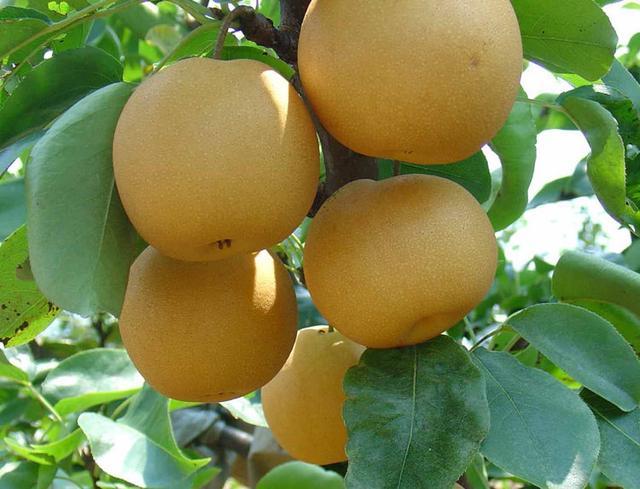
Niitaka pear originated in Japan and belongs to the sand pear group. In March 2010, Niitaka pear was introduced from Jiyang County, Shandong Province, and trial-planted in Zhangjia Village, Sunzhen, Zouping County, where the soil layer is thicker than 80cm and the soil pH is 7.1-7.2. The average annual temperature is 13.8°C, and the day-night temperature difference in autumn is greater than 10°C. After 8 years of cultivation observations, Niitaka pear shows a semi-spreading tree habit, vigorous growth, relatively upright form, and thick, sturdy branches. It has high bud-breaking ability, slightly weak branching ability, and readily forms short fruit spurs. Young trees bear fruit well on long, medium, and short fruit spurs, while mature trees bear fruit mainly on short fruit spurs [1,2]. Flower buds swell in mid-March, with little pollen, so pollinizer trees must be planted. The fruit ripens in mid-September, is nearly round, and golden yellow (Figure 1).
Figure 1 Fruit-bearing state of Niitaka pear
Single fruit mass is 500-1500g. The skin is thin and the core is small; the flesh is fine, tender, and juicy; the fructose content is 15%-17%; and the edible rate of the flesh is 95%. There are very few stone cells, the taste is excellent, and yields are high and stable. The fruit has extremely high antioxidant capacity; the cut surface does not discolor or deteriorate for ten days. It stores well: under natural indoor conditions it can be kept for 3 months, in cellars for 6 months, and in constant-temperature storage it can be refrigerated for one year [3]. At present, a modern high-density planting, trellis, and labor-saving cultivation model is used, with a planting area of 53.3hm2 (more than 800 mu) and an annual output of 2 million kg. The Niitaka pears produced are sold to more than twenty provinces, municipalities, and autonomous regions across the country. The cultivation techniques are introduced as follows.
1 Orchard Establishment and Planting
High-density planting, trellis (V-shaped), and labor-saving cultivation model, with a spacing of 0.65m x 3m and a designed plant height of 2.5m (Figure 2). Spring planting is suitable for orchard establishment, with deep plowing carried out the previous autumn. Dig planting holes 1m long, wide, and deep, or planting trenches 0.6m wide and 0.6m deep. Keep the excavated topsoil and subsoil separate; when backfilling, apply 15-25kg of farmyard manure and 3-5kg of special fruit tree fertilizer per plant. Select high-quality nursery stock for planting. Plant Yuanhuang pollinizer trees, with a planting ratio of main cultivar to pollinizer of 5:1.
Figure 2 V-shaped trellis in the pear orchard
2 Soil, Fertilizer, and Water Management
Apply base fertilizer in autumn: 1500kg per 666.7m2 for trees in the initial fruiting stage, and about 4500kg for trees in full fruiting stage. The base fertilizer is generally organic fertilizer such as chicken manure, crop straw, and human manure.
Topdressing is carried out 4 times each year: before flower bud break (mid-to-late March to early April), during flower bud differentiation (June-August), during fruit expansion (July-August), and after fruit harvest (September-October). When topdressing, pay attention to applying phosphorus and potassium fertilizer according to the fertilizer requirements of pear trees; nitrogen fertilizer should be supplemented before wheat harvest (June); phosphorus and potassium fertilizer should be used in the middle growth stage of pear trees; potassium fertilizer should be applied before fruit harvest; and nitrogen fertilizer and basal fertilizer should be applied after harvest to ensure tree nutrition and lay a foundation for a good harvest the following year (Figure 3). Each year, water once before flowering as antifreeze water, and water during flower bud differentiation before the end of June to maintain the moisture needed for fruit expansion and prevent fruit drop. After fruit harvest, water promptly with wintering water. Each watering should be sufficient and thorough; if continuous drought occurs, water again.
Figure 3 Fertilization and watering in a Niitaka pear orchard
3 Training and Pruning
Young trees should adopt the free spindle shape and improved spindle shape. After trunk heading, pinch the new shoots (late May to early June) to promote fruiting branches. In the young tree stage, retain more main branches and use more heading to promote shoot growth; in autumn, bend branches to open the angle. Prune less by thinning and more by heading; pull upright vigorous branches flat for use, bending them to 70°-80° before the end of June. During winter pruning, remove competing branches, water sprouts, back branches, and crossing branches; properly head the central leader, and prune the remaining branches as lightly as possible or leave them unpruned to increase leaf and branch volume. For developing fruiting branch groups, adopt the method of first leaving them unpruned and then shortening them. Once trees enter full fruiting stage, pay attention to timely renewal of branch groups and use young fruiting branches to bear fruit so as to maintain vigorous tree vigor. On backbone branches at all levels, short fruit spur groups should be developed and renewed and rejuvenated each year, removing weak branches and weak buds within them and retaining more fruiting branches. Pruning should focus on the growing season, mainly summer pruning; dormant-season pruning is supplementary, mainly thinning branches to adjust tree shape. Protect shoots sprouting from latent buds in the canopy and develop and use them.
4 Flower and Fruit Management
Flower and fruit management follows the principle of "protect first, then thin." Niitaka pear is self-unfruitful. On the basis of planting pollinizer trees, artificial pollination can be adopted, spraying 0.2% borax solution at flowering, and after petal fall spraying a mixture of 20mg/L gibberellin plus 0.1% urea plus 0.2%-0.3% monopotassium phosphate, or placing bees in the pear orchard. After pollination, thin flowers 2-3 weeks after bloom, manually removing overly dense flowers, weak flowers, deformed fruit, diseased and insect-damaged fruit, and small young fruit, adjusting fruit spacing to 15-20cm (Figure 4).
Figure 4 Flowers of Niitaka pear
5 Disease and Pest Control
The main diseases of Niitaka pear are scab, pear rust, black spot, and ring rot; pests include pear psylla, pear stem sawfly, and pear yellow aphid, among other diseases and pests. Disease and pest control should be prevention-oriented and integrated, with emphasis on physical control and biological control [4,5]. 1) Use physical and biological techniques such as sticky insect boards, sticky insect glue, and release of horned mason bees to produce safe, high-quality premium pears. 2) Bag the fruit to control diseases and pests that damage the fruit. Each year in early spring before buds break, scrape off diseased bark, then spray 100-150 times carbendazim solution or 4-5°Be lime sulfur mixture to eliminate sources of disease and pests. In rainy years, from May to July, when conidia spread and infect in large numbers, spray carbendazim or 70% thiophanate-methyl 700-800 times solution once every half month, and lime excess Bordeaux mixture 200-240 times solution may also be sprayed. Control should also be carried out according to rainfall and the occurrence of diseases and pests, focusing on before flowering, after flowering, before fruit bagging, and during the rainy season.