Problems in Training and Pruning Apple Trees to the Tall Spindle Shape and Their Solutions
Problems in Training and Pruning Apple Trees to the Tall Spindle Shape and Their Solutions
Apple planting in Fengxiang County is mainly based on dwarfing interstocks and double-dwarf cultivation. Both of these apple cultivation types use the dwarfing high-density planting method, generally with a row spacing of (1.0-2.0) m x (3.5-4.0) m, and 83-190 trees planted per mu. At present, most high-density apple orchards use the tall spindle shape; some are trained starting from heading back at planting, while others are converted from old tree shapes (small canopy delayed-open central leader shape, free spindle shape, slender spindle shape, etc.). The tall spindle shape plays a major role in high-density orchards by preventing and slowing canopy closure, promoting early fruiting and high yields, and simplifying management. However, many problems still exist in the application of the tall spindle shape. To make the tall spindle shape play a better role in production, the main issues are: nursery stock too weak and the heading cut too low; scaffold branches too thick and the central leader too thin; narrow branching angle and scaffold branches left too sparse; branch thinning too light and renewal too late. The author conducted investigations and studies on this and proposes solutions.
1 Training objectives of the tall spindle shape
For mature trees, 70,000-80,000 branches per mu, with a ratio of long, medium and short branches of 1:3:6, a leaf area index of 2.5-3.0, a branch-to-fruit ratio of 4:1, a leaf-to-fruit ratio of 30-40:1, a flower bud-to-leaf bud ratio of 1:3-4, 14,000-15,000 fruits per mu, and an orchard canopy coverage of about 70%.
2 Technical parameters of the tall spindle shape
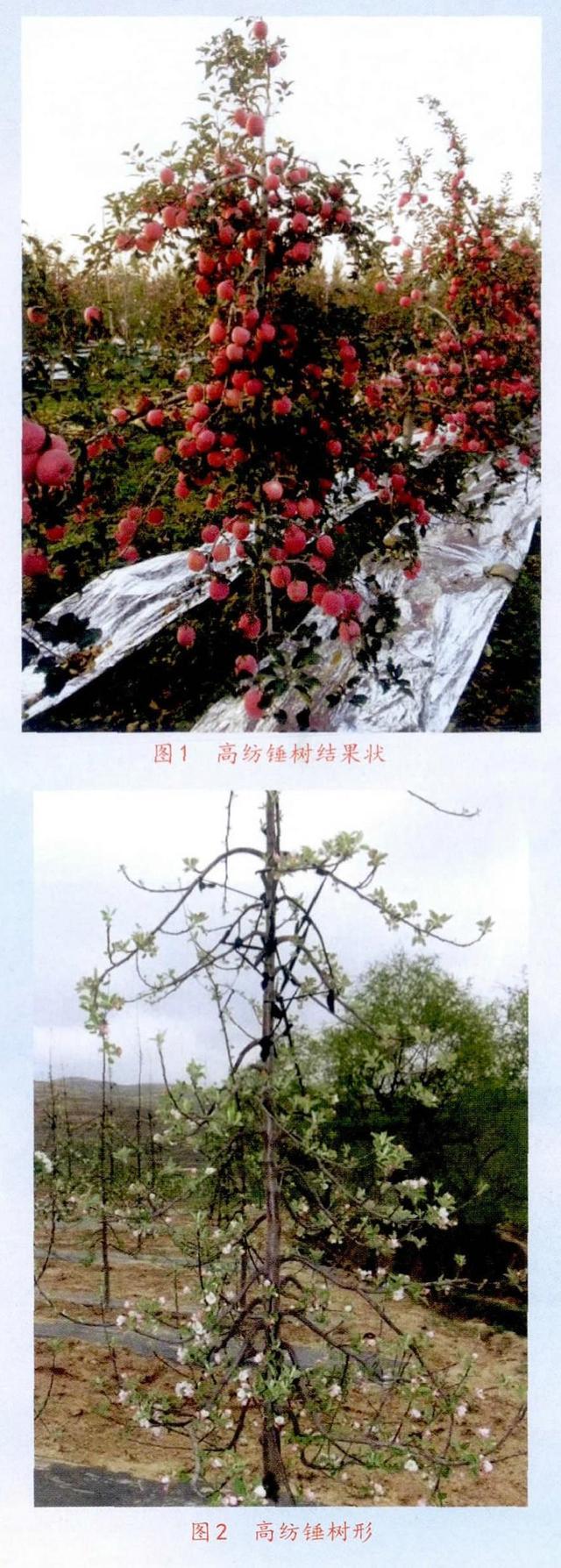
Tree height 3.2-3.5 m, trunk height 0.9-1 m, thickness ratio of the central leader to scaffold branches 5-6:1 (2:1 in the first year of training; 3:1 in the second year; 4:1 in the third year; 5-6:1 after the shape is formed), the maximum basal thickness of the scaffold branches not exceeding 3 cm, with overly thick scaffold branches rotated out year by year; 30-40 small scaffold branches arranged on the central leader, with the horizontal length of the scaffold branches not exceeding half the in-row spacing (0.5-1.0 m), the upper and lower scaffold branches slightly shorter and the middle ones slightly longer; the angle between scaffold branches and the central leader about 110o, determined mainly by the vigor of the cultivar, with vigorous cultivars having an angle greater than 110o and weak cultivars less than 110o; fruiting branches and small fruiting branch groups borne directly on the scaffold branches, with the whole tree form appearing spindle-shaped. After maturity, the canopy is small, the number of branches is sufficient, the fruiting capacity is strong, there are no large scaffold branches, light is abundant, and light use efficiency is high (Figure 1, Figure 2).
3 Existing problems and solutions
3.1 Nursery stock too weak and heading cut too low
Judging from the actual situation and current state of nursery stock production in China, domestic apple nursery stock is basically two-year fast-grown stock or three-year-old stock, which is too small and too weak compared with foreign apple nursery stock, with no branches, some above 1.5 m and some less than 1 m, which inevitably leads to a low heading cut. It is recommended that nursery enterprises, cooperatives, nursery-growing farmers and family farms cultivate large apple nursery stock with branches (Figure 3).
Figure 3 Large nursery stock on dwarfing rootstock
3.2 Trunk too thick and central leader too thin
This phenomenon is mainly seen in orchards converted to the tall spindle shape, and also in a few orchards that are particularly reluctant to give up branches. The main reason is being reluctant to remove large branches and reluctant to lose fruit, unwilling to remove branches with fruit, and failing to renew in time. The solution is that for orchards converted to the tall spindle shape, scaffold branches thicker than 2.5 cm, or small fruiting branch groups thicker than 2 cm and longer than 35 cm, should be renewed in time, keeping some slender scaffold branches and small fruiting branch groups, and not too many of them. Renewal should be carried out year by year, not all at once. Methods for renewing scaffold branches: (1) directly remove overly dense and overly large scaffold branches, without letting the cut damage the central leader, leaving a stub of 1-1.5 cm (Figure 4); (2) for overly large scaffold branches with space around them, first wound the scaffold branch, and remove it after new branches emerge (Figure 5), treating each case according to the specific situation. During the conversion process, wound protection must be done well, smearing wounds with Guokangbao, propiconazole, Kairun, Letu No. 2, etc., and pasting small plastic film over the wounds to promote wound healing.
Figure 4 Renewing scaffold branches Figure 5 Renewal after wounding and new branch emergence
3.3 Narrow branching angle and scaffold branches left too sparse
Although trained and converted according to the tall spindle shape, the scaffold branch angle is too small and does not meet the standard of the tall spindle shape, and some trees have too few scaffold branches left (Figure 6), with gaps in the canopy and abundant light, but yields are too low. Solutions: increase the scaffold branch angle by forceful bending or by the method of three saw cuts in succession to open the angle (Figure 7); for gaps in the canopy, use the method of notching buds, or at 5 mm above the bud eye use a hacksaw blade to make one saw cut deep into the xylem to wound and induce new branches.
Figure 6 Too few scaffold branches in the canopy
Figure 7 Tall spindle shape after conversion
3.4 Branch thinning too light and renewal too late
Branch thinning too light and renewal too late, being reluctant to remove branches and fruit, causes scaffold branches to grow too thick and too large; some lose their fruiting capacity, and some have their fruiting parts moved outward, resulting in low yield and poor quality. Solution: renew in time when the basal thickness of scaffold branches reaches 2.5-3 cm, replacing old with new, stabilizing yield, and achieving the goal of high quality and high yield.