Trellis Pear Tree Structure Construction and Trellis Pear Tree Training Techniques
Trellis Pear Tree Structure Construction and Trellis Pear Tree Training Techniques
The trellis pear originated in Japan, and is also used in Korea and China. This tree form is mainly used on pears of the sand pear system, such as Hosui, Niitaka, Huangjin, Shiji, etc. Sand pears generally flower easily, but after bearing fruit for many years the branch groups weaken, easily forming chicken-claw branches, and after the fruiting branches bear fruit continuously, both fruit size and quality deteriorate. Cultivation using the trellis tree form makes it very easy to train new fruiting branches, effectively overcoming the above problems. Therefore it is widely used in Japan. At the same time, this tree form can reduce typhoon damage and labor intensity, and is convenient to operate, so it is worth our study and promotion. Many fruit growers in China, because they do not understand the tree form training process for trellis pears, have built many trellises but have not trained many trellis pear trees, seriously affecting the role the trellis can play. This article briefly introduces the structure and tree form training of trellis pears.
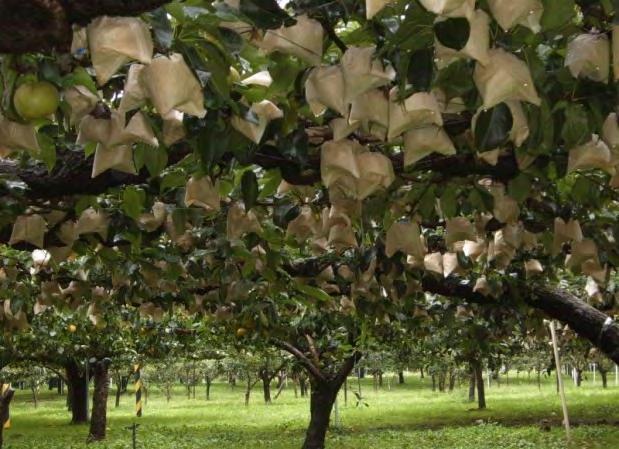
Figure 1 Fruiting situation of trellis pear trees
1 Trellis pear tree structure
All the main branches and branch groups of the trellis pear are fixed on the trellis surface built from steel wires; the entire canopy is a single layer. The advantages are good ventilation and light penetration, stable fruiting (Figure 1, Figure 2), and it is conducive to training new fruiting branches. The growth vigor of the branch groups is highly consistent with the trellis surface, operation is convenient, and labor intensity can be effectively reduced. Generally, trellis pears can be divided into two tree forms: three main branches and four main branches. On the main branches of the three-main-branch tree form, each main branch has three large side branches (called sub-main branches in Japan); on the four-main-branch tree form, each main branch has two large side branches (Figure 3, Figure 4).
Figure 2 Trellis pear tree structure
Figure 3 Three-main-branch tree form structure
Figure 4 Four-main-branch tree form structure
Every tree has 12 scaffold branches, and fruiting branch groups are then trained from the scaffold branches to bear fruit; the fruiting branch groups are continuously renewed, generally once every three to four years. The planting spacing for trellis pears is 8 m x 8 m. The distance from the first large side branch to the trunk is 80-100 cm. For trellis pear trees with four main branches, the spacing from the first large side branch to the second large side branch is 80 cm. For trellis pears with three main branches, the spacing between the second and third large side branches is 50-60 cm, the distance from the second scaffold branch to the first scaffold branch is 80 cm, and the distance between two parallel scaffold branches is 2 m. A sufficiently large planting spacing and sufficient distance between scaffold branches can provide enough space for the growth of fruiting branch groups (Figure 5).
Figure 5 Structure and arrangement of scaffold branches
2 Trellis construction
Some trellis pear orchards in China are trained by top-grafting onto large trees, some are converted from existing tiered or spindle-shaped large trees, and some are trained after planting young trees (when cultivating young trees, trellises do not need to be built in the first and second years). The sources of trellis pear trees are diverse, and the trained trellis tree forms are even more diverse, but there are few standardized, scientific trellis tree forms. The main types of trellis production in China are: horizontal trellis, trapezoidal trellis, arched trellis, etc. In Japan, most trellis models use steel pipes as supports, and 4-5 m suspension posts are set up in the center of the orchard. Suspension wires are also configured to relieve the pressure on the trellis surface. This kind of trellis has a high cost. In China, cement posts are generally used instead of steel pipes, and suspension posts and suspension wires may not be used. Pear trees have a long economic life, and using galvanized metal pipes to build the trellis gives a long service life and good results. The trellis consists of posts and a net surface woven from metal wire. The posts are divided into three types: corner posts, side posts, and suspension posts (Figure 6). Corner posts: erected at the four corners of the trellis, using cement posts of 12 cm x 12 cm x 330 cm. Side posts: erected around the perimeter of the trellis, one every 3 m, using cement posts of 10 cm x 10 cm x 285 cm. When the corner posts and side posts are prefabricated, small iron rings must be embedded at the top to facilitate threading the steel strand and iron wire to form the net surface. Suspension posts: evenly distributed in the trellis, using cement posts about 8 cm in diameter and 4 m long. Their function is to suspend and pull the net surface. At the top of the suspension post, a disc drilled with 9 small holes is welded, and the iron wire pulling the net surface passes through the small holes and is fixed at the top of the suspension post. The net surface is woven by interweaving steel strand and No. 8 galvanized iron wire. To save costs, 16 mm steel strand can also be used. Steel strand: one steel strand is stretched every 3 m around the top of the trellis and in the middle lengthwise and crosswise, and the grid formed is the skeleton of the entire net surface. Iron wire: after the steel strand skeleton is formed, one strand of No. 8 or No. 10 iron wire is added every 50 cm, forming a net surface with a grid of 50 cm square.
Figure 6 Structural diagram of trellis construction
3 Trellis tree form training
To train the tree form, first choose robust, large nursery stock. At planting, the trunk should be headed at 80-100 cm. Generally, by June of the same year, 3-4 robust new shoots can emerge (Figure 7). These branches are the future main branches and must be treated carefully. In late June, use bamboo poles to tie the new shoots, so as to fix the branch angle; generally the angle of the bamboo pole is 45° to the ground. In the spring of the second year, upright bamboo poles should also be used to fix the corresponding main branches, so as to improve the growth vigor of the main branches and train the tree form as quickly as possible (Figure 8).
Figure 7 Tree form training in the year of planting
Figure 8 Fixing the main branches in the spring of the second year after planting
Generally, the corresponding trellis is built in the third or fourth year after planting, and in the third year the main branches still need to be fixed with bamboo poles. The bamboo pole forms a 45° angle with the ground, and at the same time the main branches are fixed on the trellis surface; the distance between the first fixing points of two main branches is 1.6-1.8 m (Figure 9, Figure 10). However, the extension branch of the main branch must not be fixed; it must maintain a certain angle with the trellis surface (45°) to help improve the growth vigor of the main branch. The third and fourth years after planting are the key period for training the main branches. They must be tied and fixed in time, and attention must also be paid to strengthening fertilizer and water, reducing fruit set, and maintaining the angle of the main branch extension branch; improve the growth vigor of the main branches so as to form the tree as quickly as possible. In China, many fruit growers, because they have not mastered this technique, train the trellis tree form into a funnel tree form. During the training process of the trellis tree form, the branches of the first large side branch can be pulled backward to form a turned-back branch for fruiting, so as to fill the gap at the trunk.
Figure 9 Fixing of main branches
Figure 10 Fixing of main branches
4 Scaffold branch training
The tree form structure is mainly determined by the scaffold branches. When training the scaffold branches of trellis pears, select 2-3 well-growing new shoots from the extension branches at the tips of the main branches or large side branches and cut them back short (generally leaving 20-30 cm, about 1/3-1/6 of the length of a long new shoot), with the upper bud left at the cut. In the second year, select the robust one as the extension branch. When the new shoot growth vigor of the extension branch of the main branch or large side branch is weak, it can be heavily cut back leaving 2-3 buds, with the upper bud left at the cut, to improve tree vigor. Maintaining a certain angle of the extension tip of the main branch and large side branch is the key to improving their growth vigor. Generally an upward angle of 40° is more suitable (Figure 11); the extension tip can be supported with a bamboo pole on the trellis surface. In this way, the scaffold branches are trained in two or three years, and fruit can be borne in the third year. Five to six years after planting, the trellis pear tree is basically formed, and the fruit tree also begins to enter the full fruiting period (Figure 12).
Figure 11 Treatment of the tips of scaffold branches
Figure 12 Trellis pear trees initially entering the full fruiting period