Key Technical Points for Applying "Revival Fertilizer" to Citrus Trees in Autumn
Key Techniques for Applying "Revival Fertilizer" to Citrus Trees in Autumn
In autumn, fruit trees shift from aboveground growth to underground root growth, and citrus trees have consumed a large amount of nutrients through sprouting, shoot growth, flowering and fruiting. Applying "revival fertilizer" promptly before and after harvest plays an important role in tree recovery, overwintering and cold protection, and high-quality, high-yield production the following year.
1 Fertilization timing should be "early"
Citrus roots have two growth peaks in a year, in spring and autumn. Autumn basal fertilizer application should be done as early as possible, with the most suitable time for citrus trees being from mid-to-late October to the end of November. Reasons: (1) Soil temperature is suitable and soil moisture is good, which favors fertilizer decomposition and makes it easily absorbed and utilized by roots. (2) Damaged roots heal easily and can grow new roots 1-2 cm long, greatly improving fertilizer efficiency. (3) Early basal fertilizer application can provide fruit trees with various nutrients over a longer period, enhancing autumn leaf function, increasing the amount of stored nutrients in the tree, promoting full and plump branches and buds, and improving tree stress resistance.
2 Types of basal fertilizer should be "many"
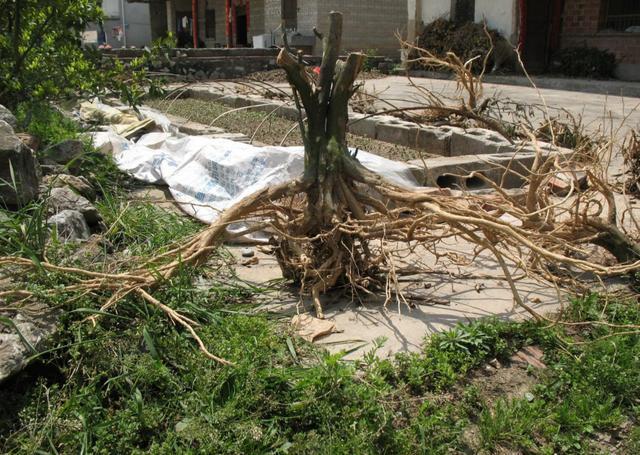
The ideal soil organic matter content should be 5%-7%. Currently, the organic matter content in Chenggu citrus orchards is mostly around 1%, resulting in soil compaction and underdeveloped fine roots (Figure 1). Organic fertilizer mainly regulates and nourishes roots and is generally applied as basal fertilizer. This fertilization should focus on organic fertilizer and slow-release fertilizer, such as decomposed farmyard manure or commercial organic fertilizer, appropriately combined with quick-acting nitrogen, phosphorus and potassium compound fertilizer. The application rate of organic fertilizer should account for more than 50% of the total annual fertilizer application. Combined with the use of high-efficiency, compound foliar fertilizer, or 0.5% urea + 0.3% potassium dihydrogen phosphate as a foliar supplement, the effect is even better.
Figure 1 Low soil organic matter content, underdeveloped fine roots
3 Quantity should be "satisfying"
Sufficient basal fertilizer is the foundation for robust, high-yield and stable-yield citrus trees. For trees in the early fruiting stage, the application rate is 2000-3000 kg of high-quality farmyard manure per mu, mixed with 20-30 kg of compound fertilizer; for trees in the full fruiting stage, the application rate is 4000-5000 kg of high-quality farmyard manure per mu, mixed with 40-50 kg of compound fertilizer.
4 The depth of autumn basal fertilizer application should be "appropriate"
The absorbing roots of fruit trees are mostly concentrated in soil 10-60 cm deep (Figure 2), and the most suitable fertilization depth should be 20-30 cm. Fruit growers are accustomed to shallow fertilization, which causes most mineral nutrients such as nitrogen, phosphorus and potassium to remain in the surface soil, making roots float up into the surface soil, highly susceptible to damage from freezing, drought and waterlogging, and prone to root injury during plowing, leading to reduced stress resistance of fruit trees and poor fruit quality. By combining deep plowing with deep application of organic fertilizer, the fertilizer can be mixed into the middle and lower layers, facilitating root absorption and utilization.
5 Pay attention to application methods
Fertilizer should be applied to the layer where roots are concentrated, that is, 20-40 cm deep beyond the outer extension of the branch spread (Figure 3).
Figure 2 Good root growth and distribution range
Figure 3 Fertilization depth range
For young trees, combined with expanding the planting hole and trench, use ring-shaped trench application or strip trench application, expanding outward each year until the entire orchard is turned over. For fruiting trees, hole application or trench application is suitable (Figure 4), and broadcast application over the entire orchard can also be used. This method is alternated every other year.
Figure 4 Ring-shaped hole application
6 Fertilization should be combined with watering
Watering immediately after fertilization will cause a large loss of nutrients, and roots are prone to fertilizer damage, affecting normal growth of fruit trees, so it is not advisable to water immediately after fertilization. However, after basal fertilizer is applied, it needs to continue decomposing, first being adsorbed by the soil, then slowly released when roots absorb it, which requires a certain amount of water. Therefore, it is recommended to water before fertilization, or water half a month after fertilization. Fertilization and watering should be combined.