Flower and Fruit Management Techniques for Seeded Cultivation of Tetraploid Kyoho-Series Grapes
Flower and Fruit Management Techniques for Seeded Cultivation of Tetraploid Kyoho-Series Grapes
1 Overview of Kyoho-Series Grapes
Kyoho grape was bred in 1937 by Japanese breeder Yasushi Oi (Ohi Inoue), using the American grape species Ishihara Wase (large-berry Campbell, a tetraploid mutant of diploid Campbell Early) as the female parent and the European grape species Centennial (a tetraploid mutant of diploid Muscat of Alexandria) as the male parent, and was officially named and registered in 1945. In 1956, a visiting delegation from Okayama University of Japan presented 4 Kyoho cuttings to Beijing Agricultural University (now China Agricultural University). Domestic propagation and planting began in the 1960s, after which research institutions across the country introduced nearly 100 Kyoho-series grape varieties from Japan, and some Kyoho-series varieties were also successively selected and bred domestically. At present, there are more than 200 Kyoho-series grape varieties introduced from abroad and bred domestically. From the 1970s to the early 1990s, both northern and southern China saw a wave of large-scale development of Kyoho-series grape varieties such as Kyoho, Fujiminori, and Jingya, which drove the first major expansion of the national grape industry. Currently, Kyoho-series grape varieties are planted on more than 300,000 hectares in China, making them the largest grape strain in the country.
2 Characteristics of Tetraploid Kyoho-Series Grape Varieties
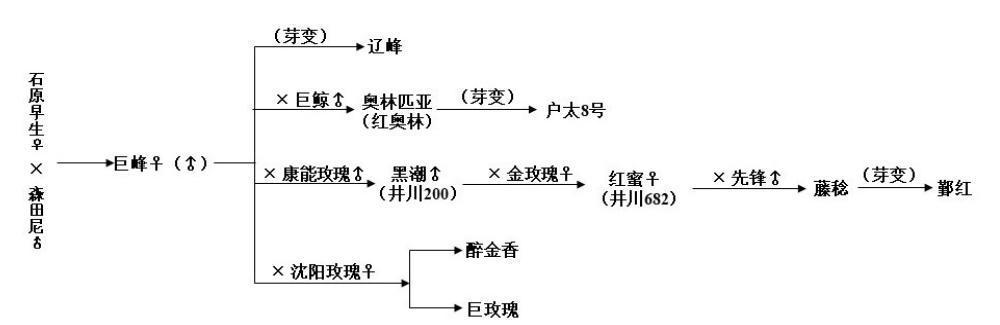
Tetraploid Kyoho-series grapes refer to tetraploid Euro-American varieties bred from Kyoho as a parent, including Kyoho, Kyoho seedling progeny, Kyoho bud-sport varieties, and tetraploid varieties bred by crossing with Kyoho as either male or female parent. In addition to tetraploids, Kyoho-series grape varieties also include triploid seedless grape varieties and the rare diploid variety Red (Empress) Queen. Kyoho-series triploid grape varieties include Summer Black, Early Summer Seedless, 8611, 8612, etc. The pedigrees of tetraploid Kyoho-series grape varieties such as Kyoho, Jumeigui, Zuijinxiang, Hutai No. 8, Yinhong, and Liaofeng (Figure 1)
Figure 1 Pedigrees of varieties such as Kyoho, Liaofeng, Yinhong, Jumeigui, Zuijinxiang, and Hutai No. 8
Most tetraploid Kyoho-series grape varieties have dense fuzz on the leaf underside and relatively strong resistance; good flower bud differentiation, high fruiting shoot rate and fruit-bearing coefficient, and good productivity and yield stability; relatively large berries and attractive appearance; thick and plump flesh, relatively soft texture, sweet with abundant juice, and a strawberry-like aroma, with astringent taste in fruit that is not fully ripe; relatively thick skin that peels easily, with skin and flesh separating; a relatively short brush, many lenticels on the pedicel with large pore diameter, and easy stem drying and berry shattering after harvest; some varieties crack; and relatively high sensitivity to plant growth regulators such as gibberellin.
In most tetraploid Kyoho-series grapes, due to the genetic factors of the parent Centennial, the ovule abnormality rate is high, affecting normal pollination and fertilization; the fertilization period is relatively long, and during pollination and fertilization, insufficient nutrition, excessive vigor, or adverse environmental conditions often cause fertilization to fail midway, leading to flower and fruit drop, poor fruit set, loose clusters, and the production of small seedless berries, resulting in uneven berry size.
3 Key Technical Points for Flower and Fruit Management in Seeded Cultivation of Tetraploid Kyoho-Series Grapes
Tetraploid Kyoho-series grape varieties such as Kyoho, Jumeigui, Zuijinxiang, Hutai No. 8, Yinhong, and Liaofeng generally have relatively vigorous growth, and the natural fruit set rate is often low, failing to meet ideal cluster requirements. In production, attention should be paid to cultivating a moderate and healthy tree vigor to improve fruit set and ensure high and stable yields. In addition, such varieties are sensitive to plant growth regulators such as gibberellic acid, thidiazuron, and forchlorfenuron. The use of gibberellic acid, thidiazuron, and forchlorfenuron can increase fruit set and promote seedlessness, but the use of thidiazuron and forchlorfenuron for seedlessness and fruit retention in production can easily cause astringent skin and affect taste. The author's view on the use of plant growth regulators such as gibberellic acid, thidiazuron, and forchlorfenuron on such grapes is: do not use them if possible, use them as little as possible, do not use them twice when one application meets production requirements, and do not use high concentrations when low concentrations achieve the goal. The following are the key management technical points for seeded cultivation of such grapes, and each orchard should apply them flexibly according to actual conditions.
3.1 Control Nitrogen Fertilizer, Increase Phosphorus, Potassium, and Organic Fertilizer, and Cultivate Moderate and Healthy Tree Vigor
Control nitrogen fertilizer before flowering and in the late growth stage, and increase phosphorus, potassium, and organic fertilizer in autumn, to prevent excessive tree vigor, cultivate healthy and moderate tree vigor, and keep the basal cane diameter at 0.8-1.2 cm, reducing nutrient consumption and improving fruit set.
3.2 Timely Pinching Before Flowering
When new shoots grow to 6-8 leaves, pinch the tips, and afterward, when each apical secondary shoot grows to 3-5 leaves, pinch again. Control vegetative growth so that nutrients are concentrated in the clusters and fruit set is promoted. If tree vigor is excessively strong, it is not suitable to pinch too severely or too much; it is recommended to delay and let it grow. Too severe or too much pinching will instead disrupt the hormone balance within the plant, causing problems such as severe uneven berry size and irregular cluster shape.
3.3 Spraying Mepiquat Chloride Before Flowering to Improve Fruit Set
During the vigorous growth period of new shoots before flowering, spraying new shoots 1-2 times with 500-750 mg/L mepiquat chloride or 300-500 mg/L chlormequat chloride can control excessive shoot growth, improve fruit set, and increase yield. For example, in Fu'an, Fujian, for Kyoho grapes cultivated on a horizontal trellis, spraying new shoots once with chlormequat chloride 3-5 days before flowering can significantly improve fruit set and meet the requirements for high Kyoho fruit set.
3.4 Prevent and Control Gray Mold and Rachis Blight
Spray the whole plant (with emphasis on the clusters) once with boscalid, pyrimethanil, or procymidone 2-3 days before flowering to prevent and control gray mold and rachis blight and lay a foundation for high yield.
3.5 Cluster Trimming
Flower cluster shaping is an important part of grape flower and fruit management and a key measure for achieving high quality and simplified production.
3.5.1 Timing of Cluster Trimming Cluster trimming is generally carried out when flowers are visible. If the orchard area is large and labor is scarce, it can be done from 2-3 days before flowering to 2-3 days after flowers are visible (before the beginning of bloom).
Figure 2 Tip-keeping cluster trimming
3.5.2 Cluster Trimming Methods According to market demand, the following two methods can be used for cluster trimming. (1) Tip-keeping cluster trimming (Figure 2). Remove the secondary cluster and most branches on the upper part of the cluster, retaining only the 7-8 cm tip, with a target mature cluster weight of 600-800 g. (2) Short-branch pinching cluster trimming (Figure 3). Remove the secondary cluster and 1-2 large branches on the upper part of the cluster, cut the other small branchlets to 1.5-2.0 cm, and do not pinch the tip short at this time; when setting clusters and thinning berries, then cut overly long tips short, shaping the inflorescence into a cylindrical or tubular form to concentrate nutrients and promote fruit set. The target mature cluster weight is 700-900 g.
Figure 3 Short-branch pinching cluster trimming
3.6 Fruit Retention and Berry Enlargement with Regulators
In production, if such grapes are found to have strong vigorous growth (basal diameter of fruiting shoots greater than 1 cm at flowering, internode length at the cluster position much larger than an adult fist, leaves on the two nodes above and below the cluster much larger than an adult palm, leaves dark green and relatively thick, new shoot tips strongly curved, and many glandular beads on the canes) or encounter adverse weather during flowering and fruit set, poor fruit set often results, and the clusters cannot meet the requirements for attractive appearance and target yield. In such cases, thidiazuron or gibberellic acid can be used at the early stage of physiological fruit drop for fruit retention (Figure 4).
Figure 4 Effects of regulators on fruit retention and berry enlargement (left: Kyoho; right: Hutai No. 8)
(1) Fruit retention and berry enlargement with thidiazuron: Use Nongshuo brand thidiazuron, 1 packet (15 g) diluted in 7.5 kg water, and 3-4 days after flower drop (10-14 days after flowers are visible, early stage of physiological fruit drop, when berries just begin to drop after tapping the rachis with a finger), evenly dip or spray the clusters once, which can improve fruit set, enlarge berries, and improve fruit quality. (2) Fruit retention and berry enlargement with gibberellic acid: Use Nongshuo brand 4% (mass fraction) gibberellic acid, 1 packet (5 mL) diluted in 15 kg water, with the same method of use as (1). During treatment, it can be mixed with boscalid, procymidone, Kaisai, pyrimethanil, and other agents to control gray mold and rachis blight.
3.7 Cluster Setting and Cluster Trimming
After fruit set (18-20 days after flowers are visible), carry out cluster setting. Generally, the number of clusters retained per mu should not exceed 2,500, with 2 clusters selected and retained from 3 canes, and cluster setting determined by plant. Remove clusters with poor shape, late flowering, or pale yellow berries. After cluster setting, set cluster length. According to a cluster length of 16-18 cm, cut off overly long tips (tip-keeping cluster trimming generally does not require cutting the tips again). At maturity, commercial clusters are 20-25 cm long and 11-13 cm wide, with a cluster weight of 600-800 g (tip-keeping cluster trimming) or 700-900 g (short-branch pinching cluster trimming) [Jishan Huayao].
3.8 Berry Thinning
After berry size becomes distinct (about 22 days after flowers are visible), carry out berry thinning in a timely manner, removing small berries, deformed berries, diseased and insect-damaged berries, and overly dense berries. Generally, 50-80 berries are retained per cluster, and mature clusters are moderately firm, with a cluster weight of 600-900 g.
3.9 Berry Enlargement
When adopting seeded fruit-retention cultivation, if berry enlargement treatment is carried out again, it easily causes poor coloring, delayed ripening, and astringent taste. In production, in pursuit of fruit quality, the use of regulators for further berry enlargement is not recommended; however, in seedless cultivation, because berries are often smaller after seedless treatment, thidiazuron can be used once more at the early stage of berry enlargement, and the concentration should be low rather than high, with 1 packet (15 g) diluted in 7.5 kg water.
3.10 Preventing Berry Cracking
If a cluster has many berries or berry thinning is not timely, the berries will be squeezed and cracked during the berry enlargement process. After entering the coloring stage, if soil moisture is imbalanced, berry cracking will occur and continue until fruit maturity and harvest. Fruit infected with powdery mildew, or the use of excessively high doses of gibberellic acid, thidiazuron, and forchlorfenuron, or overly large berries, will aggravate the occurrence of berry cracking. In production, clusters should be trimmed and berries thinned, yield should be controlled, sufficient organic fertilizer should be applied deeply, the buffering capacity of root-zone soil should be increased, attention should be paid to the application of phosphorus, potassium, and calcium fertilizers to improve fruit resistance and skin toughness, and during the berry-cracking period the soil should be kept moist (orchard grass growing, mulching the tree disk with film, and laying rice straw or crop straw), avoiding alternating dry and wet conditions in the rhizosphere soil, which can effectively prevent berry cracking.