How to train and prune early-bearing walnut? Detailed technical points
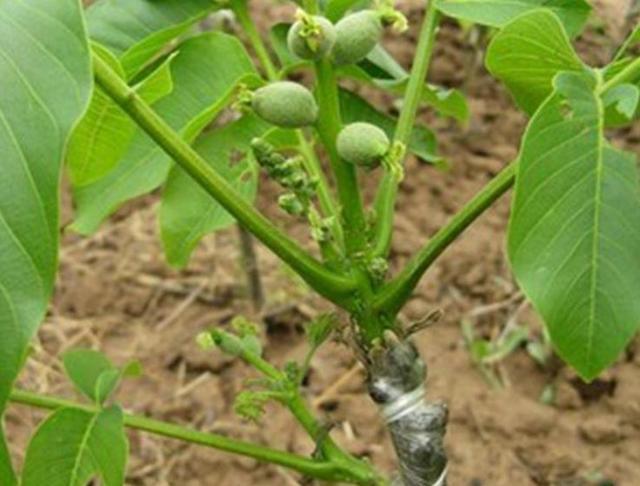
Training and pruning techniques for early-bearing walnut
The tree shape of walnut should be chosen according to soil conditions and planting density. The open-center layered shape and the natural open-center shape are commonly used, and free spindle and slender spindle shapes can be used in dense orchards. The open-center layered shape has an obvious central leader, with 6 to 7 main branches on the whole tree, arranged in 2 to 3 tiers, generally 3 in the 1st tier, 2 in the 2nd tier, and 1 to 2 in the 3rd tier; the canopy is semicircular or conical, suitable for widely spaced trees on fertile soil. The training and pruning techniques for the open-center layered tree shape are as follows.
Training and pruning of young trees. ① Determining trunk height. The trunk height is determined according to cultivar characteristics, soil depth, fertility level, etc. Early-bearing walnut trees are smaller than late-bearing walnut trees, so the trunk can be shorter, with trunk height 0.8 to 1.2 m, and 1 to 1.2 m where site conditions are good. ② Selecting and retaining main branches. Early-bearing walnut has many branches, and the selection and retention of the 1st tier of main branches is completed after 1 to 2 years. The three basal main branches are inserted close together to avoid a "choking" effect caused by whorled arrangement, with an in-tier spacing of 20 to 30 cm. After 3 to 4 years of planting, the 2nd tier of main branches is selected and retained, with a tier spacing of 1 m. The 2nd tier spacing is 0.8 m. The main branches of each tier are staggered above and below, selected and retained in the gaps to avoid overlapping. The horizontal angle between the three basal main branches is about 120 degrees, the basal angle of the main branches is 55 to 65 degrees, the waist angle is 70 to 80 degrees, and the tip angle is 60 to 70 degrees. ③ Selecting and retaining lateral branches. Each main branch in the 1st tier retains 2 lateral branches, the main branches in the 2nd tier retain 1 to 2, and the main branches in the 3rd tier retain no lateral branches. Lateral branches of the same order should be selected and retained on the same side of the main branch to avoid mutual interference. The 1st lateral branch is 80 to 100 cm from the central leader, and the 2nd lateral branch is 40 to 60 cm from the 1st lateral branch. Lateral branches are best borne on the oblique side of the main branch, with a horizontal angle of 45 to 50 degrees to the main branch. Avoid retaining downward-facing branches as lateral branches.
Training and pruning of trees in the initial fruiting stage. Continue to develop main branches, lateral branches and fruiting branch groups, use auxiliary branches for early fruiting, and expand the fruiting area. ① Controlling secondary branches. When 1 vigorous fruiting branch produces more than 3 secondary branches, select and retain 1 to 2 stronger ones and pinch them in summer; when 1 to 2 relatively vigorous secondary branches are produced, lightly short-cut them in summer and train them into fruiting branch groups. When the secondary branches of vegetative branches have not lignified, remove those that are excessively vigorous and affect the growth of other branches. ② Utilizing water sprouts. The latent buds at the base of early-bearing walnut branches readily sprout water sprouts, which can produce more than 7 fruiting branches the 2nd year; their growth vigor gradually weakens from top to bottom, and in the 3rd year many small fruiting branches in the middle and lower parts dry up and fall off, producing bare nodes and causing the fruiting area to move outward. Therefore, to utilize water sprouts, the method of suppressing the front and promoting the rear can be adopted: after bud break in spring, short-cut or pinch; for branches about 3 cm in diameter, bend them to a horizontal position before and after bud break to slow their growth vigor and form fruiting branches. ③ Removing overly dense branches. Because early-bearing walnut has many branches and a large branch volume, it readily causes overly dense branches inside the canopy, resulting in poor ventilation and light penetration, so thin and weak overly dense branches should be removed in time. ④ Properly handling downward-facing branches. Downward-facing branches on main branches sprout early, grow vigorously and are highly competitive, and can easily weaken the original branch tip or even cause it to die, so they should be cut off early. If the original branch tip becomes weak or the branching angle is too small, cut off the original branch tip or train it into a fruiting branch group, and use the downward-facing branch to replace the original branch tip. If the downward-facing branch has moderate vigor and has already formed axillary flower buds, it can be retained for fruiting, and after fruiting it should be headed back at a suitable branching point and trained into a small fruiting branch group.
Training and pruning of trees in the full fruiting stage. In the full fruiting stage, the vegetative growth of walnut trees gradually weakens, the canopy opens up, peripheral branches increase, ventilation and light penetration inside the canopy become poor, small branches readily dry up, the fruiting area begins to decrease, and alternate bearing readily occurs. At this time, pruning aims to preserve fruit, increase yield, and prolong the full fruiting stage; remove dense thin and weak branches, dried branches, overlapping branches, drooping branches, and diseased and pest-infested branches, increase canopy ventilation and light penetration, improve light conditions, and promote the growth of plump and robust fruiting mother branches and vegetative branches. Vigorous branches sprouted inside the canopy should be retained as much as possible. Overly dense large branches should be removed year by year, and pruning and saw cuts should be smoothed flat.