The formal and stable styling of the formal upright bonsai
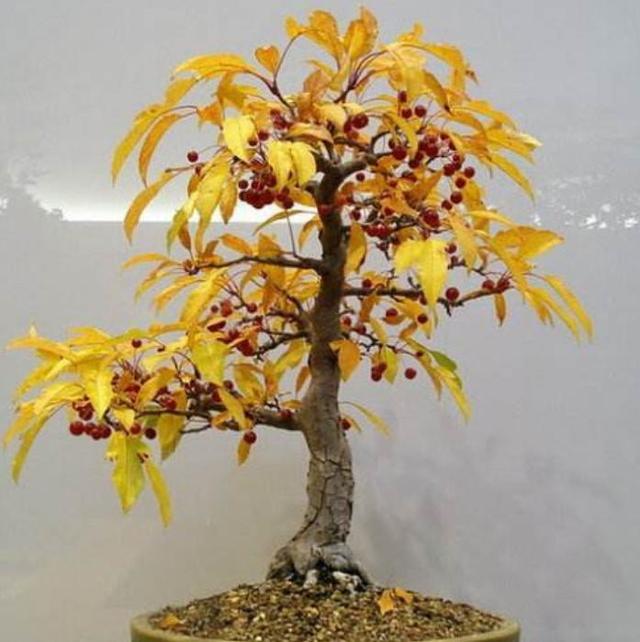
Formal and stable formal upright bonsai
The best state for the roots of a tree in a formal upright bonsai is for thick roots to extend in all directions, fully displaying a formal and stable appearance with a spirit of standing firm between heaven and earth. Branches extend in all directions, with rich layers and strong branch momentum. Branches should preferably emerge at about 1/3 or 2/3 of the trunk height. There should not be too many branches and leaves, so as to avoid blocking the trunk. The trunk should be left more exposed to display the uprightness and rugged strength of the bonsai tree.
The pot for a formal upright tree bonsai should be shallow, and the planting position depends on the tree's shape. There should be an asymmetrical balance between the tree and the pot. If the crown is an isosceles triangle, the planting position should preferably be centered but slightly toward the back. If the crown is slightly scalene triangular, the planting position should preferably be slightly toward the shorter side of the triangle.
The trunk of the stump is upright or basically upright, presenting the momentum of a towering ancient tree. Common tree species for making formal upright bonsai include red maple, ginkgo, dawn redwood, golden larch, trident maple, elm, and others. Formal upright tree bonsai can be divided into single-trunk, double-trunk, and multi-trunk forms.
1. Single-trunk bonsai
Single-trunk bonsai (figure): an old stump can be selected for shaping and pruning. According to the stump's own upright trunk form, its side branches should be reasonably distributed. The front side branches and back side branches should both be allocated in greater or lesser numbers around the posture of the main trunk. Only when the branches in each part are reasonably distributed can the bonsai fully display its elegance and fresh beauty.
Single-trunk bonsai
2. Double-trunk bonsai
Double-trunk bonsai (figure) is a bonsai composed of two plants. The two plants should be of the same tree species but of different heights and thicknesses.
Double-trunk bonsai
For double-trunk bonsai, it is advisable to choose a round pot, rectangular pot, or oval pot for planting. When selecting plants, choose the main trunk to be somewhat thicker and taller, and the secondary trunk to be shorter and slightly thinner. The two plants can be planted with one upright and one slanting to show a clear distinction between primary and secondary, so as not to be rigid. They can be sparse or dense, but they must be coordinated. They must not be too close together or too spread out, and the distribution of branches must be reasonable and even.
The production of double-trunk bonsai must pay attention to the following key points [Jishan Huayao].
(1) The two trees used as material must have a distinction between primary and secondary. The main tree should be taller and larger, and the secondary tree should be shorter and smaller.
(2) The posture of the bonsai should be dominated by the main tree, and the trunk posture of the secondary tree should be broadly similar to the trunk posture of the main tree, so as to form a certain tacit harmony. If the trunk postures of the two trees are completely different, such as one upright and one curved, it is difficult to produce a coordinated beauty, and this should be avoided.
(3) The two planted trees must have a front and back arrangement and must not be parallel. Which is in front and which is behind depends on the specific situation. When planting, the bases of the trunks of the two trees should be close together, and the direction of the tree roots should be basically consistent. The angle between the extending directions of the two trunks should not be too large. If the angle is too large, the two trunks may lose their mutual echo and rapport.
(4) The selection and adjustment of branches in double-trunk bonsai are relatively complex. The two trees must be treated as a unified whole in order to achieve overall balance and stability, coordination of emptiness and solidity, and orderly contention and yielding. The large lower branches of the two trees should each extend outward. Relatively thick branches between the two trunks should be pruned away to avoid thick branches crossing the trunks. The space between the two trunks should be filled by branches from the front and back sides to avoid straight, direct lines. In addition, the main tree should preferably have higher branches, while the secondary tree may have slightly lower branches, so as to avoid the main tree's branches affecting the growth of the secondary tree.