Don't Be Afraid of Rose Downy Mildew: Timely Treatment Restores Health
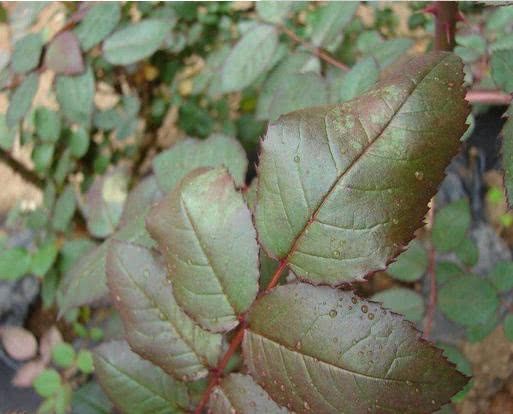
When hearing the words "downy mildew," many gardeners who grow roses at home probably turn pale at the mention of it. Downy mildew is considered a disease that is quite harmful to roses, and it develops rapidly. If it is not discovered in time and effective measures are not taken, the consequences could be disastrous. The rose being "disfigured" is an inevitable result, and in severe cases the entire plant will die.
The severity of downy mildew can be judged by the color of the leaves. When this disease first appears, it generally shows some light green spots. In other words, at this point you will notice that the color of the rose's leaves has already begun to change. This is a sign that something is wrong!
As the disease progresses, the range of these spots gradually expands, and the color slowly deepens, turning yellow-brown, then purplish-brown, and finally dark brown. As the color deepens step by step, it shows that the disease is becoming more and more serious. The affected parts are not limited to the leaves; newly grown tender shoots, flower buds, and flower stalks are all extremely susceptible parts.
Leaves infected with downy mildew will turn yellow and then fall off, and new shoots and flower buds will also shrivel, rot, and die. If it is during rainy weather, a layer of downy mildew resembling white frost can be observed on the underside of infected leaves.
The severe period of downy mildew often occurs in spring and autumn, especially in the rainy spring, when there is a lot of rain and the air is humid. If the plant is kept indoors, it is also easy for disease to develop in the stuffy conditions. High air humidity combined with poor ventilation are the main causes of the disease. Of course, if the branches and leaves are too dense, poor ventilation is also likely. There is also one more point: too much nitrogen fertilizer can also make the plant prone to disease (what exactly did nitrogen fertilizer do wrong?!).
It is recommended to carry out a major pruning once in winter, because the pathogens of downy mildew tend to lie dormant starting in winter. Proper pruning can reduce the beds where the pathogens lie dormant, and secondly, it can also conserve strength for the coming spring. When placing roses indoors to avoid rain in spring, pay attention to opening windows for ventilation, and once the weather is clear, move them to a ventilated place outdoors.
Fertilization should be balanced, and the ratio of nitrogen, phosphorus, and potassium fertilizers should be balanced. Phosphorus and potassium fertilizers can greatly improve the plant's disease resistance, while too much nitrogen fertilizer makes it prone to disease. When fertilizing, never spray directly onto the branches and leaves. After a plant is infected with downy mildew, a commonly used treatment method is to spray the infected parts and surrounding areas of the plant with a 70% chlorothalonil 800-fold solution or an 80% zineb 800-fold solution, spraying once a week for 3-5 consecutive treatments.