How to prevent and control grape gray mold? Detailed explanation of its occurrence pattern and green control techniques
Occurrence pattern of grape gray mold and green control techniques
Grape gray mold, commonly known as "rotten flower cluster," is one of the most common and seriously damaging diseases in grape production, mainly caused by Botrytis cinerea. In recent years, whether under protected cultivation or open-field cultivation, the occurrence of grape gray mold has shown an upward trend year by year, especially causing severe damage in old grape-producing regions. This disease is difficult to control, has a high recurrence rate, and in severe cases can cause total crop failure, bringing serious economic losses to grape production. Fruit growers should attach great importance to this disease.
1 Damage symptoms
Grape gray mold mainly damages inflorescences, young fruit and already ripened fruit, and sometimes also damages new shoots, leaves and fruit stalks. Flower clusters mostly develop the disease before flowering. In the early stage of infection, the inflorescence appears as if scalded by hot water, turning dark brown, with the diseased tissue soft-rotting and densely covered with a gray mold layer on the surface. The affected inflorescence wilts, and young fruit easily drops off. After the fruit stalk is infected, it turns dark brown, and sometimes black block-shaped sclerotia form on the lesions. After flowering in grapes, infected clusters initially appear light brown and water-soaked, then quickly turn dark brown, and the entire cluster soft-rots. If rainy weather occurs during this period, a layer of light gray mold grows on the cluster 2 to 3 days later. When fruit is infected near maturity, light brown sunken lesions first appear, then quickly spread over the whole fruit, causing it to rot. In severe cases, the whole cluster or part of the cluster rots, and mouse-gray mold grows on it. After infection, the fruit stalk turns black, and later black block-shaped sclerotia grow on the diseased parts. After further spread, the entire cluster is covered with mold and all the fruit rots. New shoots and leaves can also be infected, producing irregular brown lesions, sometimes with irregular concentric rings. When humid, irregular gray mold layers form. Generally, each leaf has 2 to 5 lesions. In severe cases, mouse-gray mold can also grow on the diseased parts, and finally the leaves dry up.
2 Occurrence pattern
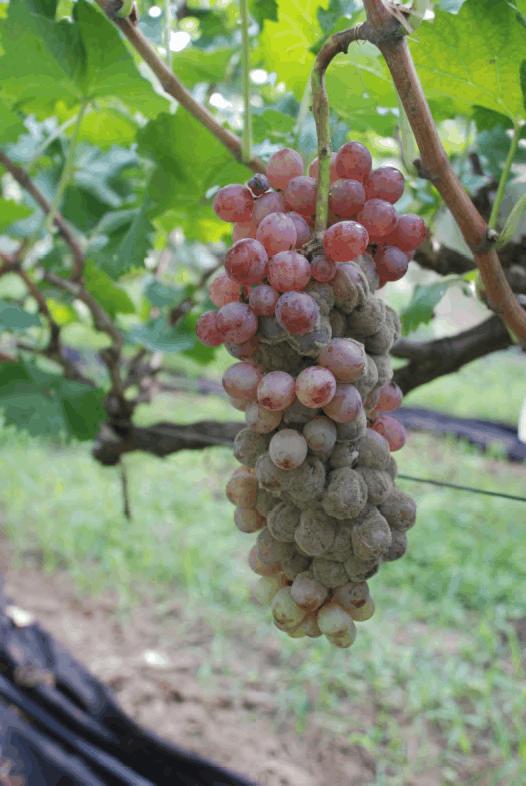
The pathogen of grape gray mold overwinters as conidia and sclerotia in diseased branches, bark and mummified fruit. In the following spring, conidia form and infect inflorescences and young leaves. Conidia are spread by wind and rain and even by air movement to flower clusters and young fruit clusters. After the pathogen invades, it often remains latent without causing disease, and infects when conditions are suitable, causing a major epidemic. However, in midsummer, with the arrival of the hot season, the disease stops spreading again, until the temperature turns cooler and it occurs again. Gray mold has 3 peak periods of occurrence in a year. The 1st is around flowering, from mid-May to early June, mainly damaging flowers and young fruit, often causing inflorescence rot, drying and dropping, and further infecting clusters and rachis. The 2nd occurs from fruit veraison to maturity, when the pathogen most easily invades through wounds. Sunken lesions appear on berries and rachis, and the cluster quickly soft-rots, the fruit stalk turns black, and a mouse-gray mold layer forms (Figure 1). The 3rd occurs during post-harvest storage. If management is improper, gray mold can occur, with obvious mouse-gray mold, causing cluster rot and extremely large losses. The disease occurs at temperatures of 5 to 31 °C, with the most suitable temperature for occurrence being 20 to 23 °C, and air relative humidity above 85%. When humidity is above 90%, the disease is severe.
In addition, vineyards with extensive management, large nitrogen fertilizer application, insufficient phosphorus and potassium fertilizer, more mechanical wounds and insect wounds, and relatively weak tree vigor are prone to the disease. Low-lying terrain, more water accumulation after rain, excessive and shading shoot growth, and poor ventilation and light transmission all favor the occurrence of gray mold.
Figure 1 Symptoms of fruit damage at veraison
3 Green control techniques
Green control techniques refer to actions that aim to promote safe crop production and reduce the use of chemical pesticides, and adopt environmentally friendly measures such as ecological control, biological control and physical control to manage harmful organisms. Starting from the farmland ecosystem as a whole, based on agricultural control, actively protecting and utilizing natural enemies, improving crop resistance to diseases and pests, and rationally using chemical pesticides when necessary, the losses caused by diseases and pests are reduced to the lowest limit.
3.1 Cultivation technique control
3.1.1 Strengthen water and fertilizer management. Increase the application of bio-organic fertilizer and potassium fertilizer, and reduce the use of chemical fertilizers. Use 500 kg of bio-organic fertilizer, 15 to 20 kg of potassium fertilizer, 10 to 15 kg of compound fertilizer, and 2 to 5 kg of urea per mu. During the first fruit enlargement stage (when the fruit is the size of a red bean), water thoroughly once, and water thoroughly again at an interval of 7 to 10 days, so that the young grape fruit can fully expand. During the fruit coloring stage, even if the rainy season is encountered, fruit enlargement will slow down, reducing fruit cracking, thereby reducing the occurrence of grape gray mold and other fruit diseases. This has a relatively good control effect. During the rainy season, lay white transparent plastic film on the ground before rain, dig recessed drainage ditches under the film, and drain water promptly after rain to reduce vineyard humidity (Figure 2), which can effectively inhibit infection and spread of the disease.
Figure 2 Laying plastic film on the ground can reduce humidity and increase fruit sugar content
3.1.2 Pinching and cluster thinning to control yield. In the early stage of grape pruning and cluster setting, when one functional leaf is retained above the cluster on the fruiting shoot, carry out the first pinching of the shoot, so that nutrients are concentrated to supply the cluster, which can naturally elongate the cluster and increase cluster length by 10% to 20%, with cluster length reaching about 12 cm. For cluster setting and flower thinning, retain small cluster branches 3 to 5 cm long, and retain about 15 small cluster branches per whole cluster before pinching the cluster (Figure 3). When lateral shoots grow to 15 leaves, carry out the second shoot pinching, which can save labor and effort. For the Ruby variety, set 150 to 180 berries per cluster, which can effectively reduce the appearance of large and small berries. The cluster is cylindrical, with a mass of 500 to 800 g per cluster, and the yield per mu is controlled at 1,500 to 2,000 kg. In this way, a relatively good control effect on the occurrence of grape gray mold can be achieved.
Figure 3 Retaining one functional leaf above the cluster for pinching
3.2 Agricultural measure control
3.2.1 Do a good job of clearing the orchard. After fruit harvest, promptly remove diseased residues and weeds, prune diseased branches and leaves, and burn or deeply bury them in a centralized manner to reduce overwintering inoculum sources. Combined with orchard clearing, spray the whole vineyard trees and ground surface once in early spring with 3 to 5 degrees Baumé lime sulfur mixture or 45% (mass fraction, hereafter the same) Shenaning 200-fold solution to eliminate overwintering inoculum sources.
3.2.2 Increase trunk setting height. Raise grape trunk setting to about 1.5 m, so that the tree body has good ventilation and light transmission, and prevent ground residues and soil-borne pathogens from splashing onto the fruit, thereby reducing the occurrence of the disease.
3.2.3 Avoid intercropping with other crops. Because Botrytis cinerea has a wide host range, in addition to damaging grapes, it also damages more than 470 kinds of plants such as strawberry, tomato, eggplant and cucumber. If intercropped with other crops, it is easy to cause cross and repeated infection, resulting in a major epidemic of the disease, while also increasing control costs.
3.3 Combination of biological control and chemical control
The biocontrol preparation Lüdikang No. 3 is a beneficial endophytic Bacillus isolated from healthy grape branches, leaves and fruit. After indoor resistance screening against pathogens, field disease control trials were carried out. The effective strains with better performance were fermented and formulated using modern microbial fermentation engineering technology into a liquid microbial preparation with disease prevention, yield increase and quality improvement functions.
The mixed use of biocontrol preparations and chemical agents plays a role in making up for each other's shortcomings. The Bacillus selected in the biocontrol preparation can colonize and multiply on grape fruit and inhibit pathogen infection. After mixing with chemical fungicides (except bactericides and copper preparations) and insecticides, Bacillus exists in the form of dormant bodies. When sprayed onto grape plants or clusters, the chemical agents first kill a large number of pathogenic fungi. After the effective period of the fungicide passes, Bacillus multiplies in large numbers on the grape plants, thereby inhibiting the invasion of pathogens and achieving a good control effect.
In 2016, grape gray mold occurred severely in the Ruby grape at the grape base of Lüyuan Fruit Industry Professional Cooperative in Shangshui County, Henan. In mid-July, the average incidence rate of clusters reached 65.6%, causing serious losses. In 2017, a 15-mu demonstration for control of Ruby grape gray mold was carried out, using Lüdikang No. 3 mixed with chemical agents, sprayed once each at the grape bud break stage, after flower drop, at the young fruit stage and before bagging, mixed and used immediately, and evenly sprayed onto grape trees with a motorized sprayer. According to a survey on August 30, the control effect of the test area using Lüdikang No. 3 alone on grape gray mold was 44.4%, while the control effect of the demonstration area using Lüdikang No. 3 mixed with fungicides was as high as 96.7%, with a significant control effect [Jishan Huayao].
This green control technique was tested and demonstrated in the vineyard of Zhengzhou Agricultural Expo Park in Henan, the New Century Vineyard in Huailai County, Hebei, and the vineyard in Yuanbaoshan District, Chifeng City, and achieved relatively good control effects on grape gray mold.