Development Prospects and Technical Countermeasures for Cantaloupe-Type Muskmelons in South China
Development Prospects and Technical Countermeasures for Cantaloupe-Type Muskmelons in South China
Fund project: Guangxi Academy of Agricultural Sciences Science and Technology Development Fund (Guinongke 2015JZ84, Guinongke 2017JM14)
South China (mainly the Guangxi Zhuang Autonomous Region, Guangdong Province and Hainan Province) lies in the tropical and subtropical zones and enjoys unique climatic advantages. It is the main off-season production area for watermelon and melon in China, with an annual cultivation area of about 193,400 hm2. With the development of the industry and changes in market demand, the watermelon and melon industry structure in South China is also being adjusted, moving toward a distinctive and high-efficiency direction [Jishan Huayao].The Xinjiang cantaloupe-type muskmelonis one of these new development targets. The author analyzed the climatic, locational, production, market and industrial development foundation advantages of developing cantaloupe-type muskmelons in South China, and based on years of production cultivation comparisons and experiments, put forward technical countermeasures for cantaloupe-type muskmelon production in South China, providing decision-making reference and technical basis for industry development.
1 Advantages of developing the cantaloupe-type muskmelon industry in South China
1.1 Climatic advantages
South China is located in the southern border of the motherland and belongs to the tropical and subtropical monsoon climate, with an annual average temperature of 20-24 °C, annual precipitation of 1,400-2,500 mm, and annual sunshine hours of 1,600-2,500 h. The climate is warm, rainfall is abundant, and it is evergreen all year round. During the year, spring warmth comes early and cold autumn arrives late. Guangxi and Guangdong can carry out 2 staggered-season crops in spring and autumn, while Hainan can carry out 3 crops in winter, spring and autumn, achieving balanced year-round supply of melons across the country.
1.2 Locational advantages
South China is located along the coast and border, adjacent and close to ASEAN countries. Guangxi is the main venue and exchange center of the China-ASEAN Expo and a bridgehead for economic trade between China and ASEAN countries, enjoying the business opportunity of being favorably placed. It has great advantages for the Belt and Road Initiative in radiating and promoting ASEAN industry and market development. In addition, Guangxi is also a transportation hub for the major corridor between southwestern China and neighboring ASEAN countries, with very convenient land, water and air transportation and a trade foundation for cantaloupe exports. Guangdong Province is the most developed area of the Pearl River Delta, with even more convenient sea, land and air transportation, allowing products to be quickly delivered to domestic and international markets. Guangdong's domestic demand consumption ranks first in the country. With the opportunity of business negotiations at the Canton Fair held annually, it is even more conducive to expanding domestic and overseas product sales markets. Hainan Province is a typical tropical region, and its unique climatic conditions allow year-round production to supply the market, playing an important role in making up for market product shortages and regulating the off-season market. Hainan is also a world-famous tourist destination with a large floating population and large local demand and consumption. Through tourism advertising and information dissemination, it is conducive to promoting the development of the cantaloupe-type muskmelon industry in Hainan.
1.3 Advantages for sustainable production development
Guangxi and Guangdong are rich in sugarcane, cassava, mulberry and banana, while Hainan Island is rich in coconuts. The waste materials after processing these crops can provide the organic nutrients and cultivation substrate raw materials needed for greenhouse cultivation of cantaloupe-type muskmelons. Using these raw materials to formulate cultivation substrate for greenhouse cantaloupe-type muskmelons can not only effectively overcome the harm of soil root-knot nematodes and Fusarium wilt [5], help improve yield and quality, but also has the sustainable development effect of being environmentally friendly and safe and promoting the reuse of agricultural production materials.
1.4 Market advantages
South China has climatic advantages and can carry out staggered-season production by advancing spring and delaying autumn, filling the gaps in cantaloupe product market supply seasons at home and abroad. Product sales are not impacted by similar domestic products from Xinjiang and other places. For example, the spring crop can be planted in January and harvested and marketed in May; the autumn crop can be planted in August or September and harvested and marketed in October and December. The marketing seasons of these 2 crops can avoid the peak cantaloupe marketing period of Xinjiang and other northwestern regions, giving good market sales and high selling prices. According to the author's market survey results: during the 4 months of May-June in summer and October-November in winter each year, the average lowest wholesale price per kg of cantaloupe-type muskmelons produced in Guangxi was 5.0 yuan, and the highest wholesale price was 8.0 yuan, more than 2.5 yuan higher per kg than the wholesale price of cantaloupes from Xinjiang and other northwestern regions in July-September. It can thus be seen that developing cantaloupe-type muskmelon production in South China has great market advantages and broad prospects.
1.5 Good foundation for industrial development
South China has a history of more than 10 years in developing cantaloupe-type muskmelon production. Large-scale production bases have been established successively in Sanya, Dongfang, Ledong and Danzhou in Hainan; Foshan, Huizhou, Zhuhai and Zhanjiang in Guangdong; and Nanning, Beihai, Baise, Liuzhou, Laibin and Guilin in Guangxi. Planting can be carried out in 3 crops each year in winter (Hainan Island), spring and autumn. Cantaloupe-type muskmelon production has become a highlight industry in high-efficiency agriculture in South China. Cantaloupe-type muskmelon production in South China initially only involved introduced variety trials and demonstration promotion. Later, targeting the climatic characteristics of South China, breeding began and main varieties suitable for local production and cultivation were promoted. For example, the Horticulture Research Institute of the Guangxi Academy of Agricultural Sciences has successively bred a series of cantaloupe-type muskmelon varieties since 2005. When planted in Guangxi and South China, these varieties show heat tolerance, moisture tolerance and strong disease resistance, and their comprehensive traits such as yield, quality, appearance and storability all reach the level of local Xinjiang cantaloupe cultivation varieties.
While breeding varieties, according to the production environment and climatic characteristics of South China, integrated innovation research on key production and cultivation technologies was carried out, exploring the best cultivation model suitable for cantaloupe-type muskmelon production in South China. At the same time, a large number of professional talents and farmer technicians were trained, providing technical and talent guarantees for the development of cantaloupe-type muskmelon production in South China and laying a good foundation for industry development.
2 Technical countermeasures for cantaloupe-type muskmelon production in South China
2.1 Select good production and cultivation varieties
Cantaloupe-type muskmelons have strict requirements for environmental and climatic conditions. During plant growth, sufficient light, high heat, low air humidity and large day-night temperature differences are needed to ensure yield and quality. Due to differences in ecological environment and climatic conditions, cantaloupe-type muskmelon varieties introduced directly from arid northwestern regions such as Xinjiang generally suffer from problems such as severe disease and decreased fruit quality when cultivated in South China. Therefore, it is particularly important to select cultivation varieties that are heat tolerant, moisture tolerant, strongly disease resistant, good at fruit setting, high yielding and excellent in quality, and suitable for the ecological environment and climatic conditions of South China. The cantaloupe-type muskmelon series varieties such as 'Haoyun 52’‘Haoyun No. 8’‘Haoyun No. 11' bred and improved by the Horticulture Research Institute of the Guangxi Academy of Agricultural Sciences are disease resistant, heat and moisture tolerant, high yielding, excellent in quality and good in storage and transportation, and have been widely applied and promoted in South China and Yunnan Province in southwestern China.
2.2 Adopt full greenhouse protected cultivation mode
One of the climatic characteristics of South China is frequent rainy seasons and large precipitation. If cantaloupe-type muskmelons are planted in open fields, diseases occur severely, and the phenomenon often appears that the vines die before the fruit matures, making production difficult to succeed. Therefore, full greenhouse protected cultivation is the guarantee for successful cultivation of cantaloupe-type muskmelons in South China. The ideal production effect is achieved with greenhouses of length 25-30 m, width 6.0-6.5 m, middle height 3.0-3.2 m, shoulder height 1.6-2.0 m, and spacing between greenhouses of more than 1.2 m. Fruit shape, appearance, yield and quality are then the best.
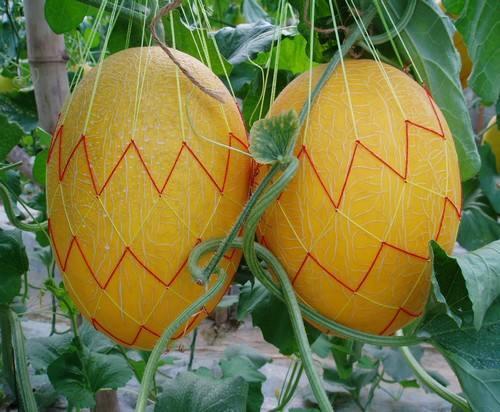
Haoyun 52 (cantaloupe type)
2.3 Use substrate cultivation instead of soil cultivation
Soil cultivation has varying degrees of continuous cropping obstacles, such as the occurrence of soil-borne diseases and damage from root-knot nematodes. South China has much rain, humid air and high soil water content, which easily causes high fruit moisture, low sugar content and decreased quality. Using substrate cultivation is an effective way to solve the above problems. The cultivation substrate in South China is mostly formulated using bagasse, cassava residue, crushed tree bark, sawdust and coconut coir as raw materials. For each m3 of raw material, add 1/3 m3 of sugar mill filter mud or peat or coal ash or rock soil, 1 kg of decomposed poultry and livestock manure, 0.5 kg of phosphate fertilizer, and 0.5 kg of ternary compound fertilizer (mN:mP:mK=15:15:15), and mix them into cultivation substrate. With this substrate formula, plants grow robustly, flower and set fruit early, fruits are well formed and uniform, the external netted pattern structure is good, and single fruit mass, yield and quality are all relatively good.
2.4 Optimize reasonable planting density
When planting cantaloupe-type muskmelons in greenhouses in South China, where summer and autumn are hot and humid, winter and spring have little light, and air convection is poor, the planting specifications and density directly affect plant growth, disease severity, and the formation of yield and quality. Low planting density wastes land resources and results in low yield; high planting density leads to poor air flow in the greenhouse, severe disease occurrence, small single fruit mass, and instead decreased yield and fruit quality. Using full hanging-vine vertical cultivation, with plant spacing of 0.5-0.6 m, row spacing of 0.8-1.0 m, and a density of 1,000-1,200 plants per 667 m2 for cantaloupe-type muskmelons, the plant population grows robustly and uniformly, there is little disease, flowering and fruit setting are easy, fruits are well formed and uniform, the external netted pattern forms well, single fruit mass is large, and yield and quality improve simultaneously.
2.5 Adopt a reasonable pruning method
Adopt single-plant single-vine pruning. Prune after hanging the vines. Fruit is set on lateral vines, with 1 fruit retained per plant and the fruit-setting node at nodes 15-18. Apart from retaining the fruit-bearing lateral vine, other lateral buds are removed promptly when they just sprout. After fruit setting is stable, remove the top bud when the fruiting branch reaches 50 cm, and then allow free growth. This pruning method provides good ventilation and light transmission, high light utilization, low plant disease incidence, easy flowering and fruit setting, well-formed fruit shape, good external coloration and netted pattern traits, large single fruit mass, and effective guarantee of yield per unit area and fruit quality.
2.6 Select advanced integrated water and fertilizer drip irrigation technology and apply fertilizer scientifically to improve quality
Because greenhouse cultivation of cantaloupe-type muskmelons has high planting density, only uniform supply of water and fertilizer can make plant growth uniform and consistent and maximize population effects. Different water and fertilizer management techniques produce different effects. Through years of multi-crop cultivation comparisons and production experiments, the author considers the drip irrigation technique of "micro-sprinkler irrigation plus small arch film mulching" to have the best effect. This technique supplies water and fertilizer uniformly, has a wide wetting surface, makes the plant population grow uniformly, results in consistent flowering and fruit setting, well-formed and uniformly sized fruits, a high fruit commodity rate, high overall yield, and significant comprehensive benefits.
In areas with relatively little light, high air humidity and small day-night temperature differences, scientific fertilization is crucial for improving yield and fruit quality when planting cantaloupe-type muskmelons. During the plant growth period, a fertilization method that places equal emphasis on organic and inorganic fertilizers is the basis for making plants grow quickly, keeping leaves dark green and full, improving disease resistance, preventing senescence and increasing yield; after flowering and fruit setting, gradually increase the amount of fertilizers containing potassium and calcium elements to promote the formation and accumulation of fruit sugars and improve fruit quality.