Detailed Explanation of Key Technical Points for the Prevention and Control of Walnut Bacterial Blight
Techniques for the Prevention and Control of Walnut Bacterial Blight
With the adjustment of the agricultural structure and to promote increases in farmers' income, Taocheng District, Hengshui City, Hebei Province, has developed walnut cultivation on a large scale, and in 2014 was the first to introduce Lvling walnut. Now the walnut trees have successively entered the fruiting stage, but it has been found in production that this variety is rather seriously affected by bacterial blight. Walnut bacterial blight, also called black rot, is a bacterial disease that mainly damages walnut fruit and leaves; at the boundary between diseased and healthy tissue at the edge of fresh lesions there is bacterial ooze.
1 Symptoms of Damage
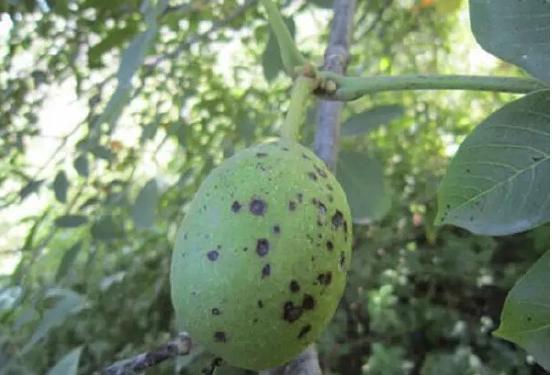
The disease mainly damages walnut fruit, leaves, young shoots, buds and female inflorescences. Among these, damage to the fruit is the most serious, and in severe cases can reach 80%. After the fruit is infected, small, slightly raised brown soft spots appear on the surface of the fruit. The soft spots then gradually enlarge, sink in and turn black, with a water-soaked halo on the outer edge (Figure 1). When young fruit become diseased, the pathogen invades the kernel, causing the kernel to rot. If the fruit becomes infected after growing to medium size, the lesion is limited to the outer pericarp, but kernel growth is obstructed, and after harvest the fruit is shriveled. The fruit rots from the outside inward, and this is often called "walnut black." When leaves are infected, brown dots first appear along the veins and at the forks of the veins; after they expand, the lesions are mostly square or polygonal, and later the center of the lesion turns gray or perforates. In severe cases the lesions join and expand, the center falls out to form perforations, or the whole leaf withers and falls off (Figure 2). On petioles, young shoots and branches, the lesions are spindle-shaped or irregular, black and slightly sunken; in severe cases they encircle the shoot, causing the branch to die. [Jishan Huayao]
Figure 1 Damage symptoms on walnut fruit
Figure 2 Damage symptoms on walnut leaves
2 Occurrence Pattern
The pathogen overwinters in diseased branches, within canker lesions, in bud scales and in tissues such as remaining diseased fruit. In the following spring, through rain or insects, contaminated pollen is spread to leaves, fruit and young shoots, and multiple reinfections occur. The pathogen can infect pollen, so pollen can also spread the pathogen. The bacteria invade through wounds, stomata or the stigma. The incubation period of the pathogen is generally 10-15 days. The timing and severity of the disease are closely related to rainfall. In rainy years and seasons, the disease occurs early and severely. In Taocheng District, Hengshui, Hebei, it generally begins to occur in mid-to-late May, with the peak period from June to July; where walnut planting density is high and the canopy is dense, with poor ventilation and light penetration, the disease is severe. In general, the weaker the tree vigor, the more severe the disease.
3 Control Methods
(1) Select disease-resistant varieties, choose a reasonable planting density, and carry out timely shaping and pruning so that the tree structure is reasonable and good ventilation and light penetration conditions are maintained.
When pruning, mainly thin out overlapping branches, crossing branches, dead branches, diseased and insect-damaged branches and some male flower branches, to improve ventilation and light penetration in the canopy and woodland and reduce disease occurrence.
(2) Strengthen underground management, apply more organic fertilizer or special fertilizer for fruit trees, and increase foliar spraying to achieve the goal of strengthening tree vigor. Promptly prune and remove diseased branches, diseased leaves and diseased fruit, and the fruit peels removed after walnut harvest, and burn or deeply bury them in a centralized manner to reduce the base number of pathogenic bacteria.
(3) Promptly control pests such as the walnut shoot-girdler moth, and when harvesting fruit use sticks to strike as little as possible, avoiding damage to branches, reducing wounds and reducing opportunities for pathogen infection.
(4) Chemical control: in mid-to-early March before sprouting, carefully spray once with 3-5 degrees Baume lime sulfur mixture; after sprouting and at flowering and after flowering, spray 1:2:200 Bordeaux mixture or 70% (mass fraction, hereafter the same) thiophanate-methyl wettable powder 800-1,000 times dilution or 50% Tuzet wettable powder 600-800 times dilution or agricultural streptomycin 50 mg/kg solution, 70% thiophanate-methyl + agricultural streptomycin sulfate. From May to July, spray once every 15 days, for 2-3 consecutive sprays, and use them alternately to prevent the development of resistance.