How to grow loquat in the south for high and stable yields
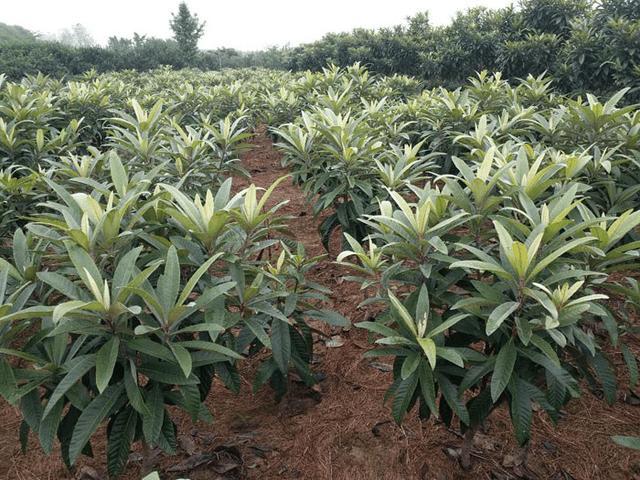
High-yield and stable-yield cultivation techniques for loquat in the south
Loquat can grow normally in environments with an annual average temperature above 12 °C, but for commercial cultivation the annual average temperature should be 15-17 °C, with no severe cold weather. At -6 °C, flowering is affected; at -3 °C, young fruit suffers frost damage; around 20 °C is most suitable for pollen germination. Excessively high temperatures are also unsuitable for loquat growth: above 35 °C, seedling growth and fruit development are affected, and sunscald is likely to occur.
Loquat grows rapidly and bears early. Grafted seedlings begin bearing fruit 2-3 years after planting, and seedling-raised trees after 4-5 years; they enter full bearing at 8-10 years, yields gradually decline after 30 years, and they enter old age after 40-50 years. With good management, their economic life can be greatly extended, and trees over 100 years old can still bear abundant fruit.
1 Orchard site selection
Loquat prefers an environment with moist air, ample water, and sufficient but not too intense light. The orchard should be sited on gentle south-facing and southeast-facing slopes; in areas without frost damage, north slopes are also suitable. If cultivated on flat land, waterlogging and root rot must be prevented; before planting, mounds should be raised or deep furrows dug, and drainage done well. Loquat is not demanding about soil and can generally grow and fruit normally, but deep, loose, fertile gravelly soil rich in organic matter is best.
2 Planting
Loquat is mainly propagated by sowing seed and by grafting. Seed propagation is simple, but trees bear late after field planting and vary greatly. In production, grafted seedlings are advocated (Figure 1).
。
2.1 Planting spacing
The plant-row spacing for loquat is generally 3 m x 3.5 m, with 64 plants per mu; on flat land, wider spacing is appropriate, 3 m x 4 m, with 56 plants per mu.
2.2 Planting time
Loquat can be planted in both spring and autumn. Spring planting is best before the spring shoots sprout, that is, planting from December to February of the following year is better; after the spring shoots have filled out and before the summer shoots sprout, that is, March-April, is also suitable. On mountain land lacking water sources, spring planting is preferable. In autumn, planting is generally done in October.
2.3 Planting method
Two to three months before planting, dig planting holes 60 cm deep, 80 cm wide at the top, and 70 cm wide at the bottom, and pile the topsoil and subsoil separately. At the bottom of each planting hole, spread a layer of green manure and
Figure 1 Loquat tree 2 years after grafting (planted at the base)
straw; for the middle layer, mix topsoil with 30 kg of farmyard manure + 0.7 kg of calcium magnesium phosphate per hole and fill evenly into the planting hole, then backfill all the original subsoil. The backfilling must be completed 2 months before planting, so that the base fertilizer fully decomposes and the filled soil settles. Two months after backfilling the hole, plant on a cloudy day or a sunny day after rain. Use mature soil for the planting layer; the seedlings for field planting should carry plenty of fibrous roots and attached soil to aid survival; the roots must not touch the fertilizer, and planting should not be deep; covering soil up to the root crown is appropriate; compact the soil, raise a mound, and shape the tree basin well. The planting seedlings should have some leaves and tender shoots pruned to reduce evaporation. Water thoroughly to settle the roots, and after the water seeps down, cover with a layer of fine soil.
3 Water and fertilizer management
3.1 Water management
Loquat most dislikes waterlogging in the orchard, especially during fruit ripening; if there is too much rain, it easily causes fruit cracking and fruit rot, so drainage should be timely. If it is excessively dry and the sun is strong, the fruit is easily sunburned, and at this time irrigation or sprinkling should be done. Moderate drought in summer favors flower bud differentiation. Drought in autumn and winter, however, easily causes leaf drop, affecting tree vigor, making flower clusters smaller, and causing earlier flowering, so attention should be paid to irrigation or covering the tree basin to retain moisture.
3.2 Fertilization
Loquat has luxuriant leaves and abundant flowers and grows in all four seasons, and its root system and shoot growth peaks alternate; generally the roots grow about 2 weeks earlier than the shoots, with 3-4 growth peaks per year. It has a high fertilizer requirement. Fertilization should be carried out according to the growth characteristics of the roots and shoots.
3.2.1 Fertilizer amounts and methods for the juvenile stage. Young orchards should follow the principle of light and frequent applications, mainly nitrogen and phosphorus, to promote vegetative shoot growth and rapidly expand the canopy.
Apply the first fertilizer from after field planting until the shoots are 2-3 cm long: 4-11 g of urea, 6 g of diammonium phosphate, and 4-6 kg of decomposed human excrement per plant. Apply once every 15-20 days to promote spring and summer shoots. After 4 applications, pause topdressing and control water to promote flower bud differentiation. Apply topdressing once more in September-November. In the second year, apply topdressing once each in February, March, May, September, and November, with 50 g of urea and 6-12 kg of decomposed human excrement per plant each time; apply 100 g of superphosphate each in February and November, and 60 g of potassium sulfate as topdressing in March. In the third year, 4 applications are enough, once each in early March, late May, late September, and late November, with 70 g of urea and 8-15 kg of decomposed human excrement per plant each time; apply 65 g of potassium sulfate in early March and 110 g of superphosphate in late November.
3.2.2 Fertilizer amounts and methods for the mature stage
Loquat shoots have 4 sprouting peaks per year, mainly the spring, summer, and autumn shoots, and the summer and spring shoots are the main fruiting mother branches, so cultivating excellent summer and spring shoots is the key to high yield. Therefore, mature orchards (after 3 years) need only 3 applications per year.
The first is the spring shoot fertilizer, applied in early to mid-February, when the root system is at its first growth peak, making nutrient absorption easy; fertilization can promote spring shoots and enlarge the fruit. The second is the summer shoot fertilizer,
applied after harvest from mid-May to early June (for late-maturing varieties, applied before harvest), when the root system is at its second growth peak, mainly to promote summer shoots and promote flower bud differentiation in July-August. The third is the autumn fertilizer (pre-flowering fertilizer), mostly applied from September to early October, after heading and before flowering, mainly to promote good flowering, improve fruit set, and increase cold resistance and overwintering ability.
4 Flower and fruit thinning
Loquat has many flowers and many fruits (Figures 2 and 3). Flower and fruit thinning can reduce nutrient consumption, adjust the ratio of vegetative branches to flower-cluster branches, help achieve high yields year after year, enlarge the fruit, improve fruit quality, and make the ripening period uniform.
Figure 2 Loquat flowers
Figure 3 Bagged ripe loquat
4.1 Flower thinning
The best time for thinning loquat flower clusters is generally when the flower clusters are clearly visible but have not yet bloomed. If thinning is too early, secondary flower clusters are likely to appear and a second thinning is needed. In areas with frost damage in winter, it can be done together with fruit thinning in spring.
Number and method of flower cluster thinning: it varies with tree age, tree vigor, and variety. First remove flower clusters with few leaves, poor development, or pest and disease damage, according to the principles of removing outer ones and keeping inner ones, removing late ones and keeping early ones, and removing weak ones and keeping strong ones. Generally, thin more on young and weak trees, and less on vigorous trees and trees in full bearing; if a branch has 4 clusters, thin 1-2 clusters; if 5 clusters, thin 2 clusters; for large-fruited varieties, thin appropriately more. In addition, keep more flower clusters on central branches that head early, and fewer on extended branches that head late, so that the fruit ripening period is uniform.
4.2 Fruit thinning
The time for thinning loquat fruit should usually be when the remaining flowers of the inflorescence have all fallen and the young fruit is the size of a broad bean. In areas with frost damage, it is best to wait until frost-damaged fruit can be identified.
Fruit thinning method and number: first thin out some excessive fruit clusters, then thin the fruit grains, removing pest- and disease-damaged fruit, frost-damaged fruit, deformed fruit, small fruit, and overly crowded fruit. The number of fruits retained per cluster depends on the variety, tree age, growth vigor, and number of leaves. Keep more on vigorous trees, strong branches, and fruiting branches with many leaves; conversely, keep fewer or none. Generally, keep 7-8 on large clusters and 4-5 on small clusters, and for large-fruited varieties reduce appropriately by 1/3. In addition, pay attention to selecting and keeping young fruit that are uniform in size and located in the middle section of the cluster; the fruits should not be crowded together, nor should they touch the shoots; as far as possible keep fruits hidden among the leaves, which can prevent sunscald and facilitate bagging (Figure 3) and harvesting.
5 Pest and disease control
5.1 Disease control
Common loquat diseases include physiological diseases
(mainly: sunscald, leaf tip scorch, fruit cracking, purple spot, etc.) and infectious diseases (mainly: trunk rot, olive-colored leaf spot, leaf spot, white root rot, anthracnose, etc.).
5.1.1 Control measures for physiological diseases. Physiological diseases can be prevented by breeding resistant varieties, strengthening water and fertilizer management, bagging, and other measures. For fruit cracking, foliar topdressing can also be used, such as spraying 0.2% (mass fraction, same below) urea, borax, or monopotassium phosphate; spray 0.1% ethephon at the fruit color-turning stage [Jishan Huayao].
5.1.2 Control measures for infectious diseases
The main measures for controlling infectious diseases: (1) strengthen water, fertilizer, and soil management to enhance tree vigor and improve disease resistance; (2) prune, clean the orchard, promptly cut off diseased leaves, scrape off diseased bark, and dig out diseased plants to reduce sources of infection; (3) after disease is found, apply medication promptly for treatment. For trunk rot, scrape off the diseased bark promptly, then wash with 1:4 soda ash water, and apply Bordeaux mixture to help the wound heal; for olive-colored leaf spot, spray 2-3 times with 70% thiophanate-methyl 800-1,000 times solution; for leaf spot, use 50% carbendazim 800-1,000 times solution; around the main trunk of each diseased tree, drench with 320 g of 70% thiophanate-methyl to control white root rot; for anthracnose, use thiophanate-methyl 1,000 times solution.
5.2 Insect pest control
The main insect pests of loquat are: loquat yellow caterpillar, pear fruit borer, boat-shaped caterpillar, leopard moth, etc. Control methods: besides manual capture and light-trap killing, pesticides can also be used to control various insect pests. Use 40% dimethoate 1,000 times, or 80% dichlorvos 800-1,000 times solution to control loquat yellow caterpillar; in March, spray imidacloprid 800 times solution to kill pear fruit borer; choose 50% dichlorvos 800 times or 90% trichlorfon 1,000 times solution to spray and kill boat-shaped caterpillar; use 80% trichlorfon 10-30 times solution injected into the insect holes, with yellow mud applied outside, to control leopard moth.