Effects of Different Ages of Seedling Polygonatum cyrtonema on Agronomic Traits and Yield
Effects of Different Ages of Seedling Polygonatum cyrtonema on Their Agronomic Traits and Yield
Fund project: National Basic Drug Needed Chinese Medicinal Material Seed and Seedling Breeding Base Construction Project (2015SZ0034);
Sichuan Provincial Public Welfare Research Institutes Basic Research Project (A2015N6);
Sichuan Provincial Department of Science and Technology Seedling Engineering Project (2016RZ0061);
Sub-project of Sichuan Provincial Traditional Chinese Medicine Raw Material Quality Testing Technology Service Center "Polygonatum Commodity Specification and Grade Research Project";
National Fourth Survey of Traditional Chinese Medicine Resources Project (2017PC010) Polygonatum cyrtonema Hua, also known as wild ginger and ginger-shaped Polygonatum, belongs to the Liliaceae family, genus Polygonatum, and is a perennial herbaceous plant. It is included in the Chinese Pharmacopoeia (2015 edition, Part One). More than 40 species of Polygonatum have been discovered, mainly distributed in the northern temperate zone, with about 31 species in China. Polygonatum cyrtonema has the functions of tonifying qi and nourishing yin, strengthening the spleen, moistening the lungs, and benefiting the kidneys, and is produced in Sichuan, Guizhou, Hunan, Hubei, Henan and other places. In artificial cultivation of Polygonatum cyrtonema, tuber propagation is often used, requiring a relatively large amount of seed material. Previous research reports have found that the germination rate of Polygonatum seeds is very low, generally not emerging in the first year, and after dormancy through 2 winters, only 1 true leaf can emerge. From sowing seeds to harvesting medicinal material takes as long as 5 to 6 years. Therefore, although the seed harvest is large, it is almost never used in production. At present, there are few reports on seed seedling cultivation research of Polygonatum cyrtonema. Zhang Wangfan, Zhao Zhi and others respectively used gibberellin (GA3) and low-temperature storage treatment to break Polygonatum seed dormancy, and the germination effects were relatively good. However, there are no reports on the suitable transplanting age after seed seedling cultivation of Polygonatum cyrtonema, as well as research on changes in its growth, development and yield after transplanting.
This study intends to conduct transplanting experiments on Polygonatum cyrtonema seedlings of different ages. Through investigating the survival rate of seedlings after transplanting and the growth conditions after transplanting, it aims to determine the optimal transplanting age for seedlings propagated from Polygonatum cyrtonema seeds, and provide theoretical support for seed seedling and transplanting technology of Polygonatum cyrtonema.
1 Materials and Methods
1.1 Overview of the Experimental Area The experimental base is located at the National Basic Drug Needed Chinese Medicinal Material Seed and Seedling (Sichuan Guang'an) Breeding Base in Yuechi County, Guang'an City, Sichuan Province. Yuechi County is located in the triangular mesa at the confluence of the Qujiang River and Jialing River in the eastern Sichuan Basin, at 30°15' to 30°48' north latitude and 106°7' to 106°44' east longitude. Within Yuechi there are no complete mountain ranges; the terrain is fragmented, with undulating hills and crisscrossing valleys. The terrain is high in the northwest and low in the southeast, sloping gradually from northwest to southeast to form low mountains and narrow valleys, medium hills and medium valleys, and shallow hills and wide valley belt plains. From the Peng'an ridge tail extending eastward into Jincheng Mountain of Yuechi County, winding northwest to the area of Huanglongzhai and Wanjiagou, is a low mountain region, with an area of 417.68 km2, accounting for 28.76% of Yuechi County's total area, and an altitude of 600 to 800 m. The hills are mostly fragmented and occupy land, forming long and narrow valleys between the mountains, with steep ground slopes. The water quality, soil, air and indicators of this region all meet the national standards required by the Good Agricultural Practice for Chinese Medicinal Materials.
Polygonatum cyrtonema is a shade-loving plant, and in the wild it mostly grows under forest. Therefore, the experiment set up an under-forest transplanting trial of Polygonatum cyrtonema seedlings, and through comparison with the field trial, aimed to determine the influence of environment on the growth and development characteristics of seedlings after transplanting. The experiment was carried out in 2017. The field trial area was selected in sandy loam soil with fertile soil, good irrigation conditions, and applied with farmyard manure; the under-forest trial area was selected under a cypress forest with a thick humus layer, fertile soil, and relatively high humidity, with Lygodium japonicum, walnut, wild Polygonatum and so on growing at the forest edge.
1.2 Experimental Materials The experimental materials came from the National Basic Drug Needed Chinese Medicinal Material Seed Seedling (Sichuan Guang'an) Base, and were robust Polygonatum cyrtonema seedlings grown from seed for one year, two years, and three years.
1.3 Experimental Design The experimental site was set up in the field and under cypress forest, both using a quadrat design. The quadrat size was 2.0 m x 3.0 m, with a plant spacing of 20 cm, row spacing of 30 cm, and depth of 10 cm. One-year, two-year, and three-year-old seedlings were transplanted respectively, 100 plants/quadrat, with a protective row of 1 m width between quadrats, 3 replications. Transplanting was carried out on March 20, 2017, and the emergence rate and growth and development conditions of Polygonatum cyrtonema seedlings after transplanting were observed. On April 10, waxy corn was planted on the protective rows.
1.4 Measurement Indicators and Methods On July 9, 2017, the emergence conditions of Polygonatum cyrtonema seedlings in the field and under cypress forest were investigated, and the emergence rate was counted. In the two experimental plots, 30 plants were randomly selected respectively, and their plant height, leaf length, leaf width, leaf area, tuber length, tuber diameter, aboveground fresh weight and underground fresh weight were measured, and the obtained data were statistically analyzed with SPSS software.
2 Results and Analysis
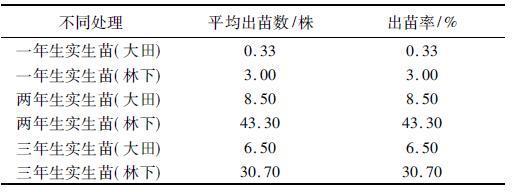
2.1 Emergence Rate of Polygonatum cyrtonema Seedlings of Different Ages Under Different Treatments From Table 1, it can be concluded that the field emergence rates of one-year, two-year, and three-year-old seed-propagated Polygonatum cyrtonema seedlings were respectively: 0.33%, 5.50%, 6.50%, and the under-forest emergence rates were respectively: 3.00%, 43.30%, 30.70%. This indicates that the emergence rates of one-year, two-year, and three-year-old seedlings transplanted in the field and under forest all differed greatly, and the under-forest emergence rates were all higher than the field emergence rates of seedlings of the same age. The emergence rate of one-year-old Polygonatum cyrtonema seedlings was relatively low both in the field and under forest, and they may not be suitable for transplanting. After transplanting two-year-old seedlings, there was a large difference in emergence rate between the field and under forest: the field rate was 8.50%, far less than the under-forest transplanting rate of 43.30%, indicating that newly transplanted two-year-old seedlings grow suitably under forest. After transplanting three-year-old seedlings, the difference in emergence rate between the field and under forest was also relatively large: the field emergence rate was 6.50%, greater than the one-year-old rate of 0.33% and less than the two-year-old rate of 8.50%; the under-forest emergence rate was 30.70%, greater than the one-year-old rate of 3.00% and less than the two-year-old rate of 43.30%. The results show that two-year-old seedlings had the highest emergence rate when transplanted under forest, making this the most suitable transplanting age.
2.2 Differences in Agronomic Traits and Yield of Polygonatum cyrtonema Seedlings Under Different Treatments The various agronomic traits and yield measurement indicators of seed-propagated Polygonatum cyrtonema seedlings transplanted to the field and under forest are as follows. From Figure 1, it can be seen that under the field environment, the values of the 8 indicators were respectively: three-year-old > two-year-old > one-year-old, indicating that three-year-old Polygonatum cyrtonema seedlings are more suitable for field growth. From Figure 2, it can be seen that except for plant height, leaf length, and leaf width, which continuously increased with the increase in seedling age, the other 5 indicators first increased and then decreased, indicating that two-year-old Polygonatum cyrtonema seedlings are more suitable under forest. From Figures 3 and 4, it can be concluded that the one-year-old and two-year-old Polygonatum cyrtonema seedlings showed a gradually increasing trend in all 8 indicators in both the field and under forest, and the two-year-old under-forest seedlings had the highest values for all indicators, indicating that two-year-old seedlings grew and developed better than one-year-old seedlings in both the field and under forest. From Figure 5, analysis shows that for three-year-old Polygonatum cyrtonema seedlings, except for plant height, leaf length, and leaf area, which were greater under forest than in the field, the other 5 indicators were all smaller than in the field, indicating that three-year-old seedlings are more suitable for transplanting in the field. The above results indicate that three-year-old Polygonatum cyrtonema seedlings are suitable for field transplanting, and two-year-old Polygonatum cyrtonema seedlings are suitable for under-forest transplanting [Jishan Huayao].
Table 1 Emergence Rate of Polygonatum cyrtonema Seedlings of Different Ages Under Different Treatments
Figure 1 Agronomic Traits and Yield of Polygonatum cyrtonema Seedlings Under Field Treatment
Figure 2 Agronomic Traits and Yield of Polygonatum cyrtonema Seedlings Under Under-Forest Treatment
Figure 3 Agronomic Traits and Yield of One-Year-Old Polygonatum cyrtonema Seedlings Under Field and Under-Forest Treatments
Figure 4 Agronomic Traits and Yield of Two-Year-Old Polygonatum cyrtonema Seedlings Under Field and Under-Forest Treatments
Figure 5 Agronomic Traits and Yield of Three-Year-Old Polygonatum cyrtonema Seedlings Under Field and Under-Forest Treatments
3 Conclusion and Discussion
From the experimental results, it can be concluded thattwo-year-old seedlings had the highest emergence rate when transplanted under forest, making this the most suitable transplanting age. Three-year-old Polygonatum cyrtonema seedlings are suitable for field transplanting, and two-year-old Polygonatum cyrtonema seedlings are suitable for under-forest transplanting. Wang Qiang, Bi Yanwen, Li Shi and others found that wild Polygonatum grows better in under-forest thickets or shady mountain slopes. Through comparative analysis of various biological indicators of Polygonatum cyrtonema transplanted to the field and under forest, this study concludes that the emergence rate, various agronomic traits and yield of under-forest Polygonatum cyrtonema seedlings are superior to those in the field, indicating that the under-forest environment is more suitable for the growth of Polygonatum cyrtonema. However, for three-year-old Polygonatum cyrtonema seedlings, except for plant height, leaf length and leaf area, which were greater under forest than in the field, the other 5 indicators were all smaller than in the field. This may be because in the field, the waxy corn used for early shading had not yet emerged or grown large, so the seedlings were directly exposed to sunlight, and soil temperature and humidity changed quickly, making it difficult for the seedlings to adapt to the environment. However, three-year-old seedlings themselves are more robust than one-year-old and two-year-old plants, and are more easily able to adapt to the field environment, so a situation arose in which they grew better than under forest. Therefore, when planting in the field, conditions suitable for the growth of Polygonatum cyrtonema should be created as much as possible, and measures such as shading treatment in the early growth period, timely watering to maintain soil moisture, and application of organic fertilizer should be taken to provide good conditions for the growth of Polygonatum cyrtonema and ensure the emergence rate.
Overall analysis concludes thatlow-age Polygonatum cyrtonema seedlings propagated from seed are not suitable for transplanting, because the seedlings are weak and small, and by the time of spring transplanting they have already grown buds and fibrous roots, making it easy to damage the roots and buds and reduce the survival rate.