Who would have thought this big-eyed emerald beauty is actually a pest
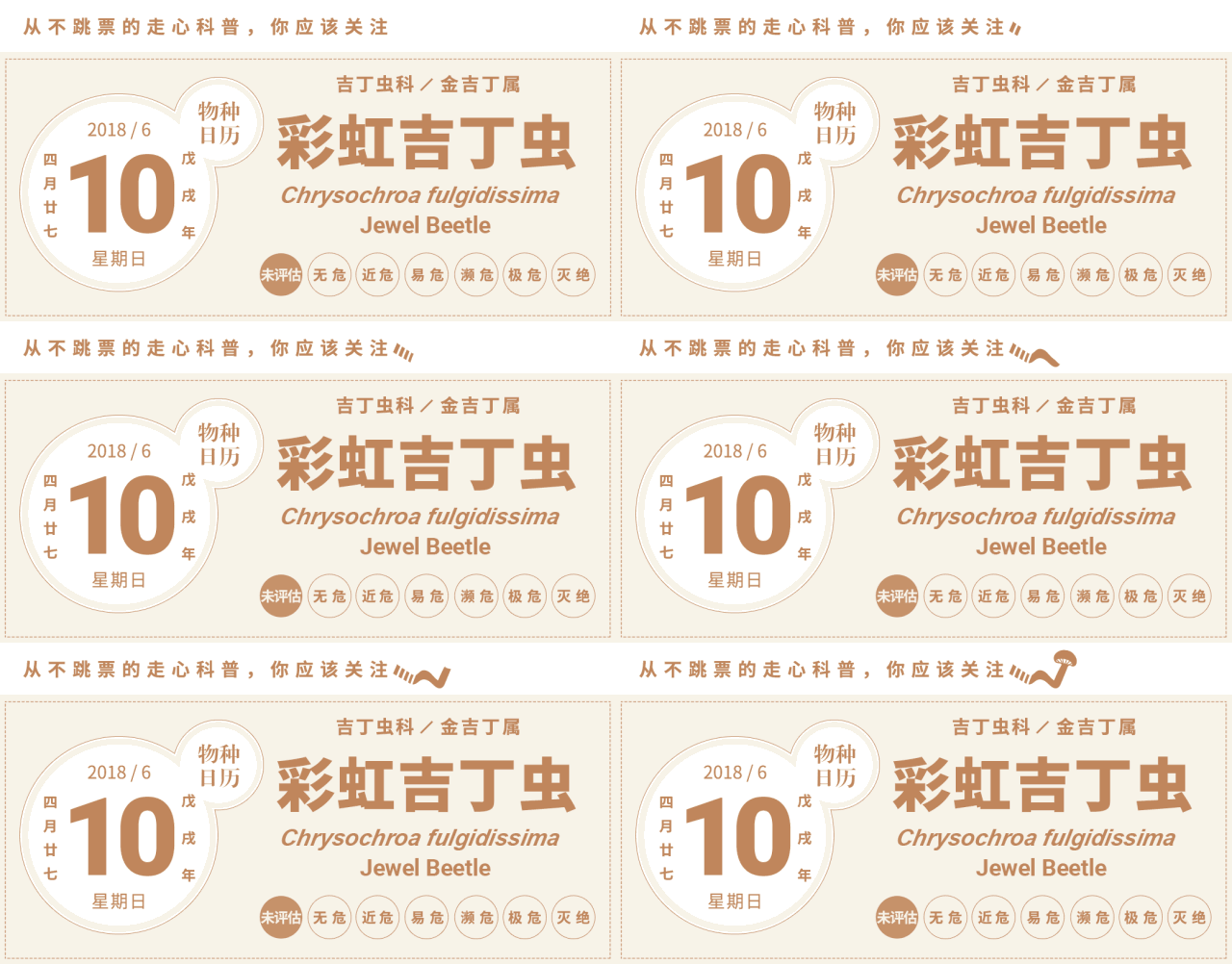
On the Earth we live on,there are about 400,000 known species of beetles,accounting for about a quarter of all species in the entire animal kingdom. This is only the known portion; there are still far more than 400,000 species of beetles yet to be discovered and named by humans.
Beetles are the collective name for insects of the order Coleoptera. Theirforewings (i.e., elytra) are as hard as sheaths, protecting the soft hindwings and abdomen. At the same time, their elytra are brilliantly colorful, forming all kinds of wondrous patterns and colors, and have also become a source of inspiration for many artists and writers. Jewel beetles are among the most outstanding representatives of beetles, and today's protagonist is one of them --the rainbow jewel beetle。
A rainbow jewel beetle with wings spread, about to fly. Image: xuite.net
A rainbow-colored little boat
The rainbow jewel beetle is more commonly known in China asthe tamamushi jewel beetle, with a body length of 3-4 cm; the color isgolden-green,The whole body is like a boat, with both ends curving upward; the head is covered with irregular coarse punctures, and the pronotum and each elytron have apurple-red longitudinal band; when the elytra are magnified, they look as gorgeous as a rainbow, densely covered with fine punctures.
The rainbow jewel beetle curves slightly upward at both ends, like a golden-green little boat. Image: umihoshi.com
Its scientific name is Chrysochroa fulgidissima; dissim means "most" and fulgidus means "shining," so together they meanthe most resplendent. Surely the namer was captivated by this stunning color scheme at first sight.
Magnified, the elytra of the rainbow jewel beetle show rainbow-like stripes. Image: cocolog-nifty.com
The rainbow jewel beetle is mainly distributed in Southeast Asia. Some ethnic minorities in Taiwan, China call the rainbow jewel beetle the "rainbow's eye,"and only the elders of the tribe are qualified to sew their wings onto clothing as decoration。
A rainbow jewel beetle on a fingertip is like an emerald. Image: umihoshi.com
In Japan, the rainbow jewel beetle is called Yamato tamamushi (タマムシ), meaning "soul insect," and is alsoa symbol of good luck. In the eastern part of the Sumeru altar at Horyu-ji Temple, there is a tamamushi shrine (a shrine is a small Buddhist niche for enshrining Buddhist statues), inside which a Guanyin statue is enshrined. This shrine was made around after the 7th century AD and is decorated with the elytra of more than 30,000 rainbow jewel beetles. It is a Japanese national treasure and perfectly embodies the architectural art of the Asuka period.
In South Korea, in the Gold Crown Tomb of the ancient tomb cluster in Gyeongju, a Silla-era chan [chàn] (a piece of horse gear placed on both sides under the saddle to block splashing mud) dating back more than a thousand years was found, also decorated with inlaid elytra of the rainbow jewel beetle. Judging from archaeological artifacts from other tombs,the rainbow jewel beetle was a very high-grade decorative craft item at that time。
A beautiful pest
There are about 20,000 known species of jewel beetles in the world, and about 600-plus species in China. They are mainly found in the tropics and are typical insects of hot, humid forests,liking to be active during sunny daytime。
Various jewel beetles. Image: blogspot.com
Like other beetles, their life goes throughegg -- larva -- pupa -- adultgrowth process. Small jewel beetles in the larval stage willhide under leaves and feed on the leaf mesophyll, and as they grow they become wood-boring pests of trees. Medium-to-large jewel beetle larvae live between the phloem and xylem of trees,tunneling and feeding inside the wood, leaving winding tunnels filled with frass.
Mature larvaemake a pupal chamber in the wood to pupate, and after becoming adults they chew their way out of the wood. Jewel beetle larvae are mostly white or cream-colored, with broad, flat heads, making it completely impossible to imagine that the adults would be so beautiful.
Jewel beetle larva. Image: wikimedia
For agriculture and forestry production, jewel beetles are outright pests.The larvae are trunk-boring pests, and when the damage is severe they can cause bark to split and branches to die, hence they are also called "bark-splitting insects,"while the adults feed on leaves. Their natural enemies are mainly various parasitic wasps and birds.
The jeweled insect
Most jewel beetles are small species less than 1 cm in size, while medium-to-large jewel beetles are favorites in the specimen-collecting world, as they often carry strong metallic colors, with color schemes and patterns beyond people's imagination, truly living jewels, and therefore in English they are calledjewel beetles。
An embroidered dress made from jewel beetle elytra (from India), collected by the Victoria and Albert Museum, the world's largest museum of decorative and design arts. Image: alaintruong.com
Besides being beautiful, jewel beetles are alsovery easy to catch. Theyhave a death-feigning behavior, and as soon as they are touched they tuck in their six legs and drop to the ground pretending to be dead. At this point we can easily pick them up and carry them away.
A rainbow jewel beetle looking dopey. Image: Brian Adler / wikimedia
The metallic elytra of jewel beetles are widely used to makespecimens, necklaces, and earrings, oras appliques decorating clothing, jewelry boxes, and other handicrafts and artworks. Today, jewel beetles are still a source of inspiration for some artists. Belgian artist Jan Fabre is extremely fond of jewel beetles and has created a series of artworks using their elytra.
A decorative piece made by Jan Fabre using jewel beetle elytra. Image: designcloud.nl
Artwork created by Jan Fabre using jewel beetle elytra. Image: designcloud.nl
Across time and cultures, people independently chose beautiful beetles as ornaments, and not without reason. In nature, the colors of living things fall into two types: one ispigment color, also called chemical color; the other isstructural color, also called physical color。The colors of beetles are structural colors.
The reason structural colors arise is that the wax layers, punctures, grooves, and othermicroscopic structures on insect elytra are comparable to the wavelength of light, and through interference, diffraction, scattering, and other pathwaysproduce reflection of incident light at specific wavelengths and in specific directions, thereby producing colorful colors.
Jewel beetle necklace. Image: marknolldesigns.com
Compared with pigment colors,structural colors are more brilliant, colorful, and stable. In printing and dyeing, textiles, and other industries, they have also brought people new inspiration and application prospects.
Finally, let's enjoy another round of exquisite clothing and accessories made from jewel beetle elytra.
A 19th-century Indian dress decorated with jewel beetle elytra. Image: blogspot.com
Jewel beetle brooch. Image: nasvete.com
Earrings made from jewel beetle elytra. Image: etsy.com
An incense box appliqued with rainbow jewel beetle wings. Image: takumi88.com
This is the 161st article of the 4th year of Species Calendar, from Species Calendar author @Sandieji.
If you like her, you can also follow
Sandieji
id: sandieji2016
Nature observation records, travel notes, popular science book recommendations, and essays
Calendar Lady's Golden List
Time to hand in your papers~
The following three friends performed outstandingly in this Calendar Lady reading comprehension quiz
Each will receivea "Youren Youyu" notebookone volume
Please remember to leave the recipient's name, address, and phone number in the backend
Of course, if you like the fish notebook, you can just buy it directly!
Scientific and fun
Uncover the secrets of fish without entering the kitchen
Illustrations + notes
Knowledge can also be delicious
There are more illustrated guides waiting for you to explore