17 Houseplants That Can Grow Without Sunlight
Reading note:
"Growing Flowers" is an essay written by Mr. Lao She for a newspaper in 1956, published in the "Wenyi Bao" on December 12, 1956. Through describing the process of growing flowers, it expresses the joy of growing flowers: there is happiness and worry, laughter and tears, flowers and fruit, fragrance and color. It requires both labor and broadens knowledge. It expresses the author's thoughts and feelings of loving life. The full text follows the order from events to reasoning, advancing layer by layer, revealing the main theme of the entire text.
Growing Flowers(Lao She)
I love flowers, so I also love growing flowers. I have not yet become an expert at growing flowers, because I have no time to research and experiment. I simply treat growing flowers as a kind of pleasure in life; I do not mind whether the flowers bloom large or small, good or bad, as long as they bloom, I am happy. In my small courtyard, once summer comes it is full of flowers and plants, and the kitten has no choice but to go up on the roof to play; there is no playground for them on the ground.
Although there are many flowers, there are no rare flowers or exotic grasses. Precious flowers and plants are not easy to keep alive, and watching a fine flower fall ill and about to die is a sad thing. Beijing's climate is not considered very good for growing flowers: winters are cold, springs are windy, summers are either drought or torrential rain, and autumn is the best, but sudden frosts can occur. In this kind of climate, to keep southern fine flowers alive, I still do not have that much skill. Therefore, I only grow some flowers and plants that are easy to plant, easy to keep alive, and able to struggle on their own.
However, even though flowers and plants can struggle on their own, if I ignore them and let them live or die on their own, most of them will still die. I have to look after them every day and care for them like good friends. Over time, I have figured out some tricks: some like shade, so do not put them in the sun; some like dryness, so do not water them too much. Once you figure out the tricks, the flowers and plants stay alive, and for three to five years they keep living and blooming. How interesting that is! This is not boasting; this is knowledge! Gaining more knowledge is definitely not a bad thing.
Do I not have a leg ailment? It is not only bad for walking, but also bad for sitting for long periods. I do not know whether the flowers and plants are grateful to me for my care; but I must be grateful to them. When I work, I always write for a while, then go out to the courtyard to look, water this one, move that pot, then go back inside and write for a while, then go out again. This cycle gives proper adjustment between mental labor and physical labor, which benefits body and mind and is better than taking medicine. If a violent storm or sudden change in weather comes, the whole family has to be mobilized to rescue the flowers and plants, and it is extremely tense. Several hundred pots of flowers all have to be quickly carried into the house, making one's back ache and legs hurt and sweat pour down. The next day, when the weather is good, all the flowers have to be moved out again, and once again one's back aches and legs hurt and sweat pours down. But how interesting this is! Without labor, one cannot even keep a single flower alive. Is this not the truth?
The comrade who delivers milk praises "so fragrant" as soon as he enters the door, which makes our whole family feel proud. When the epiphyllum blooms, I invite a few friends to come and look, and it has even more the flavor of a night outing with candles -- the epiphyllum always blooms at night. When the flowers divide their roots, one plant splitting into several, I give some to friends. Watching friends take away the fruits of my labor naturally makes me especially happy.
Of course, there are also sad times. This summer there was one such occasion. Three hundred chrysanthemum seedlings were still on the ground (before it was time to move them into pots), a rainstorm came, the neighbor's wall fell, and more than thirty varieties, over one hundred chrysanthemum seedlings, were crushed to death. The whole family went several days without smiles.
There is happiness and worry, laughter and tears, flowers and fruit, fragrance and color; it requires both labor and broadens knowledge. This is the joy of growing flowers.
17 kinds of plants are suitable for growing indoors,
they do not need sunlight to grow!
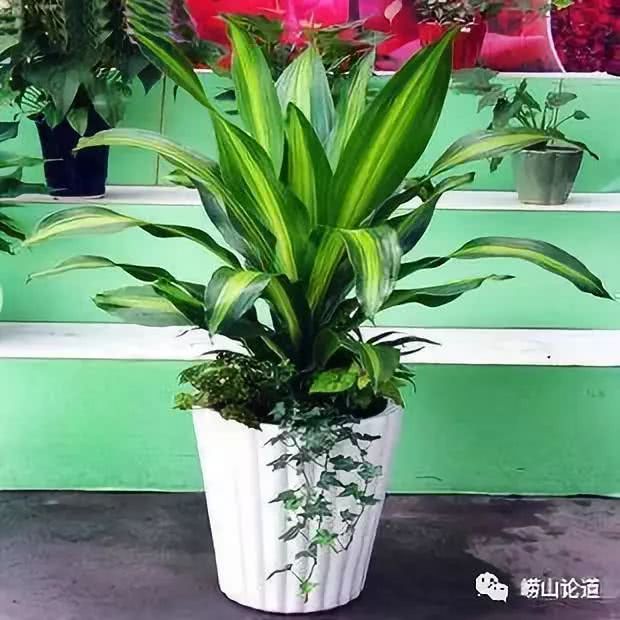
1. Dragon tree (Dracaena): needs to be kept away from sunlight, avoid overwatering, and remember to prune regularly.
2. Ornamental pineapple (Bromeliad): do not let it get too cold.
3. Maidenhair fern (Adiantum): does not need direct sunlight, and can grow very well with diffused light.
4. Parlor palm (Chamaedorea elegans): even placed in a dark corner it will not change, just be careful to water when dry, do not let water accumulate, as it easily causes root rot.
5. Papyrus: suitable for indoor planting and shady swamp gardens.
6. Snake plant (Sansevieria): does not need much care, and will not die even if kept in a dark environment all year round.
7. Climbing fig (Ficus pumila): water when the soil is dry, does not like water accumulation.
8. Goosefoot plant (Philodendron bipinnatifidum): also known as "spring rain," adapts to dark environments, likes moisture but cannot have water accumulation; water again when cracks appear in the soil.
9. Peacock plant (Calathea makoyana): grows in a diffused-light environment, but the temperature must not go below 13 degrees.
10. Arrowroot (Maranta): does not need sunlight, just some light.
11. Sword fern (Nephrolepis): has no strict requirements for light.
12. Peperomia: has no strict requirements for light.
13. Pothos (Epipremnum aureum): has no strict requirements for light.
14. Japanese sedge (Carex): likes to grow in shady environments.
15. Spider plant (Chlorophytum): cold-resistant and shade-tolerant.
16. Peace lily (Spathiphyllum): shade-tolerant, with a very strong ability to purify air.
17. Silver queen (Aglaonema): has no strict requirements for light.