Lucky bamboo can be shaped like this too - what are the advantages of growing it in water?
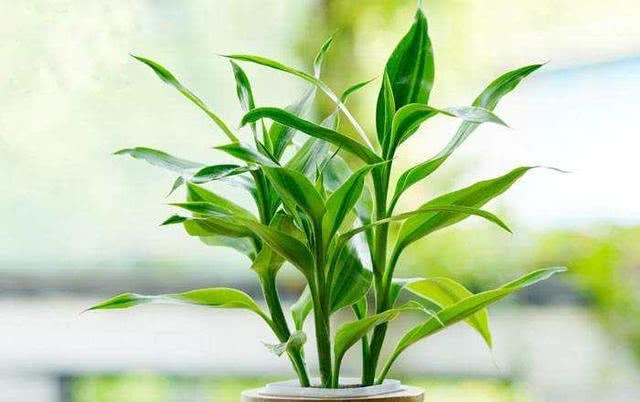
Lucky bamboo is also known as kaiyun bamboo. Its emerald-green leaves are elegant, and its upright, straight form gives a feeling of vitality and resilience, making it highly ornamental. That is why it is extremely popular as a household potted plant in our country. Because the rhizome of the plant is knobby and there are many varieties, its symbolic meaning is also very good. Therefore, according to different needs, people prune lucky bamboo into various shapes to cater to popular tastes. Lucky bamboo can be shaped like this too - what are the advantages of growing it in water?
Common lucky bamboo shapes fall into column type, bottle type, pagoda type and jungle-style bonsai. Let me introduce them one by one below.
1. Column-type lucky bamboo potted plant
In fact, the "column" type lucky bamboo is the easiest of the several shapes to handle. For friends who have 1-2 lucky bamboo plants at home, if they want the plant to take on a columnar form, during care they only need to do the following: try not to change its placement, do not prune the plant too much, and just let it grow normally. When the potted lucky bamboo grows to about 1 m, it will naturally form a "column"-like shape, making it look even more distinctive.
2. Bottle-type lucky bamboo potted plant
For the bottle-type lucky bamboo potted plant, the specific method is: select the rhizome part of lucky bamboo, cut it to a length of about 15-20 cm, then decide how many bamboo stems are needed according to the capacity of the bottle. For a medium-sized bottle, generally only 4-6 stems are needed. Finally, insert the bamboo stems into the bottle, then add water, taking care that the water level is not too full, and then top up the water in the bottle regularly. Once done, place the bottle in a suitable spot.
3. Pagoda-type lucky bamboo potted plant
The pagoda-type lucky bamboo potted plant is somewhat more complicated. Because lucky bamboo has a well-developed rhizome and grows quickly, to obtain the "pagoda" shape, the final result must be lucky bamboo stems that are clearly layered from top to bottom. First, trim the top part of the lucky bamboo into suitably sized terminal buds. Second, following the principle that the bottom is flat, the middle part is higher, and the outer part is relatively shorter, tie the inner cuttings together so they form a shape similar to a "pagoda." Finally, once completed, grow it in water. In addition, it should be noted that pagoda-type lucky bamboo needs regular pruning, and the top of each bamboo stem must be kept neat, so that a relatively perfect proportion can be maintained and the overall plant form can achieve the desired effect.
4. Jungle-style lucky bamboo potted plant
The last one is the jungle-style lucky bamboo potted plant. There is not much difference between it and the shaping method for column-type lucky bamboo, and it is also relatively easy. The specific method is: first prepare an appropriate amount of lucky bamboo stems, then let them grow naturally. As long as the plant's dead leaves, dense leaves and weak leaves are cut away at intervals, allowing the plant itself to show its emerald-green, bright side, the effect can be achieved.
Lucky bamboo cultivation is generally divided into two methods: soil culture and water culture, and water culture is the one we often choose. The reason is that, from the appearance point of view, water-cultured lucky bamboo is simpler and easier, and the leaves that grow appear more emerald-green and slender. From the plant itself, water-cultured lucky bamboo is less likely to suffer from pest problems than soil-cultured lucky bamboo, and it is more suitable for the requirements of growing small lucky bamboo at home.