A Detailed Guide to Summer Management Methods for Growing Orchids on a Balcony
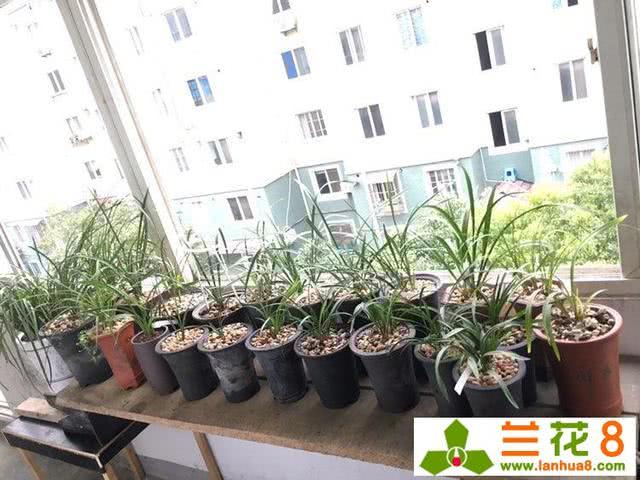
Growing orchids with a calm mind, over time everyone develops a certain amount of experience and know-how. People, regions, environments, potting media, ventilation, light, water and fertilizer, and cultivation philosophies differ, so various differences are inevitable. What suits you at present is the best. Different paths lead to the same goal. Here is a brief introduction to the general, universal summer management for growing orchids on balconies in the northern Central Plains region. Fellow orchid growers, please critique and correct:
I. Ventilation
When growing orchids on a balcony, try to keep windows open for air convection. Orchids should preferably be placed at the window of a south-facing balcony. In addition to strengthening ventilation at the pot surface, pay attention to ventilation at the bottom of the pots. Raise the orchid pots as high as possible, and at the same time place a fan below the pots to blow a gentle breeze on them;
II. Placement ⟧7⟧According to differing light needs, place Cymbidium faberi (Faber's cymbidium) on the outermost layer, Cymbidium goeringii (spring orchid) in the middle, Cymbidium ensifolium (four-season orchid) in the middle and inner layers, with appropriate spacing between dense and sparse. Cymbidium tortisepalum (lianban), Cymbidium tortisepalum var. longibracteatum (spring sword), Cymbidium kanran (cold orchid), and Cymbidium sinense (Chinese cymbidium) go toward the inner side;
According to their different light requirements, Cymbidium faberi is placed in the outermost layer, Cymbidium goeringii in the middle, Cymbidium ensifolium in the middle and inner layers, with appropriate spacing; Cymbidium tortisepalum, Cymbidium tortisepalum 'Chunjian', Cymbidium kanran, and Cymbidium sinense are placed toward the inner area;
III. Increasing Humidity
Do not deliberately increase humidity. Place a water tray under the orchid pots for natural evaporation. In addition, if evaporation is too great, you can replenish water at the pot surface in the evening;
IV. Light Use
Do not shade too much. Bamboo or reed blinds are best for shading, with shade netting second. Before 8:00 in the morning and after 18:00 in the afternoon, light can shine directly. Avoid prolonged exposure of the pot walls;
V. Watering
It is best to use aged water. Along with the water, you can add a very small amount of liquid fertilizer; bacterial fertilizer, inorganic phosphorus and potassium fertilizer, and organic fertilizer are all fine. The best time to water is after 20:00 in the evening; around 5:00 in the morning is also acceptable. Appropriately increase watering frequency, and pay attention to ventilation after watering;
VI. Fertilizing
Use long-acting organic fertilizer as the base. According to differences in seedling condition, you can mix and apply Hyponex, Osmocote, and Magic Fertilizer at the pot surface. During the vigorous growth season, use a larger amount but do not overdo it;
VII. Temperature Control
Appropriately extend the most suitable growing temperature. When it exceeds 30 degrees, keep the upper and lower fans running for long periods to blow a gentle breeze, with natural convection as the main method. It is not recommended to use an air conditioner for sealed cooling;
VIII. Timing
Rainy days in summer are the golden time for balcony orchids. Remove the shading, and after the rain has been falling for a while, let the orchids receive rain outdoors as much as possible. When a good cool breeze comes, try to place plants growing poorly in indoor corners outdoors to receive the wind;
IX. Pest Prevention
Window screens are a very good protective net. In summer, first guard against small snails; metaldehyde works very well. For scale insects, thrips, fungus gnats, and similar pests, imidacloprid is highly toxic, so use it with caution. There are quite a few targeted pesticides, and you can choose on your own. Choose a time when no one is home to apply the pesticide;
X. Sterilization
Use carbendazim early in spring and summer, at an interval of three weeks, about three times in a row. Spray evenly on leaf surfaces and pot surfaces, with the ideal being that the leaf surfaces are not dripping. The concentration should not be too high;
XI. Supplementing Bacteria
The potting medium must be permeable and alive. Carbendazim will kill miscellaneous bacteria on leaf surfaces and in shallow areas. Pouring beneficial orchid bacteria at the roots can enhance the activity of the potting medium and noticeably increase the proportion of orchid bacteria in the medium. When there are many good orchid bacteria, miscellaneous bacteria will naturally be fewer, and the probability of the two rots will also decrease. One day after watering, pour at the roots, with the ideal being that the fertilizer liquid does not flow out from the bottom of the pot;
XII. Careful Inspection
Summer is precisely the golden season for growth. Any early abnormality in plant growth should be taken seriously enough. If problem plants are found, such as stagnant growth, yellow leaves, abnormal leaf loss, or failure to sprout, repot, divide, and change the potting medium as early as possible, so that losses can be minimized. Author: Zhou Xuerun. I publish orchid knowledge and pictures every day, taking you to understand orchids in depth and teaching you to grow orchids easily. If there is anything about orchids you do not understand, you can ask me at any time or leave a message below. If my knowledge has helped you, I hope you can give me a like or share it to help more people!