Do potted hydrangeas really need hard pruning to bloom?
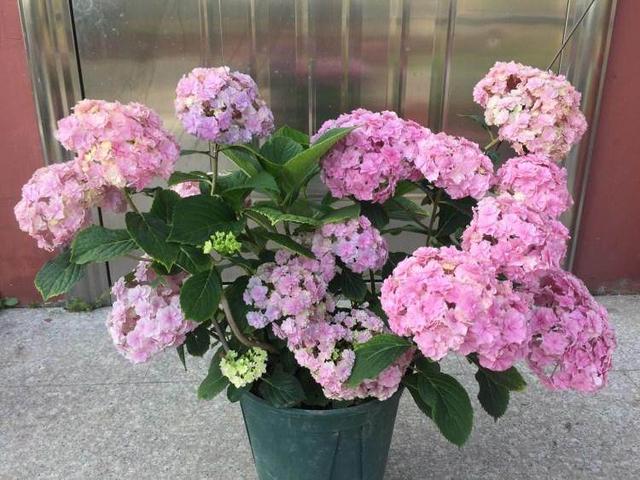
Hydrangea, the flower commonly known to gardeners as huaxiuqiu (mophead hydrangea), has explosive blooming power, producing a whole large pot of blooms at once, every one a big flower ball. However, many gardeners do not understand whether potted hydrangeas really need "hard pruning." Is "hard pruning" the only way to get blooming hydrangeas? Let's take a look!
To encourage a compact hydrangea plant shape with abundant, even and vivid flowers, it is very necessary for gardeners to prune appropriately, but whether to "hard prune" depends on the situation.
Appropriate pruning of hydrangea generally means pinching when the new shoots of the seedling reach about 10~15 cm, to encourage new branches. When the new branches reach 8~10 cm, carry out a second pinching. After that, do not pinch again, to avoid new branches sprouting too late and affecting flower bud differentiation in autumn. Then, after the hydrangea flowers fade, cut the branches back short to encourage new branches, and when the new branches reach 8~10 cm, pinch them so that the buds on the new branches develop fully.
The situation that requires "hard pruning" is: when pruning in early spring of the following year, shorten the retained hydrangea branches once, keeping 2~3 buds per branch, to encourage new branches. If gardeners do not carry out the above shaping and pruning, the base of the hydrangea will become woody year by year, produce no new shoots, and easily form a hollow lower part of the plant, affecting its ornamental value.
In addition, when caring for hydrangeas, besides pruning, you also need to pay attention to these points:
1. Hydrangea originates from southern China, likes warmth, and is not very cold-tolerant. In northern China it is mostly grown in pots and brought indoors to overwinter. In the East China area, plants grown in the ground need to be earthed up for warmth to overwinter safely. Hydrangea is suitable for relatively fertile neutral to slightly acidic soil. For potting soil, use half leaf mold and half garden soil mixed with a small amount of sand. Hydrangea likes semi-shade and avoids fierce sun, so in summer and autumn it must be placed in a semi-shaded spot or under a shade curtain for cultivation.
2. Hydrangea likes fertilizer. During the growing period, apply a dilute organic liquid flower fertilizer once every half month, diluted 500 times and watered onto the roots; during the bud stage, apply 1~2 additional applications of organic nutrient solution at 800 times dilution to promote large, vivid flowers.
3. Hydrangea has large leaves and needs a lot of water, so the soil should often be kept moist, but do not water too much either; hydrangea has fleshy roots, and too much water makes the roots prone to rot. In autumn, as the weather gradually turns cool, gradually reduce watering so the branches grow firm, which helps dormancy, overwintering and growth the following year.
3. When caring for hydrangea, remove the leaves before Frost's Descent and move it into a low-temperature room, keeping it at about 5°C to encourage dormancy. From January and mid-February, move the pot to a sunny spot and keep it at 15~20°C to promote the growth of branches and leaves, and move it outdoors for care the following Grain Rain.