The elephant's leg succulent blooms with incredibly gorgeous flowers, and the more sun it gets, the more flowers it produces.
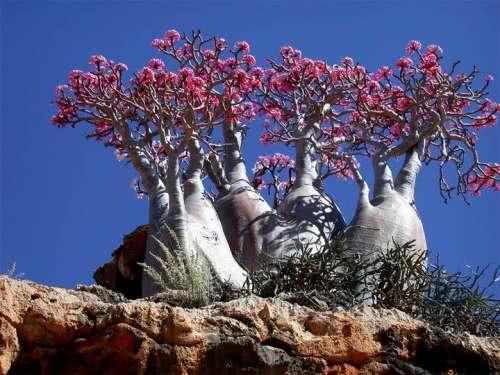
Desert rose does not actually grow in deserts, nor is it a rose. Its scientific name is Adenium obesum, and it belongs to the dogbane family (Apocynaceae). It is a succulent plant that grows on extremely barren Gobi gravel with intense sunlight. Its trunk is thick and sturdy, and its flowers are brilliantly colorful. It is known as "flowers blooming on an elephant's leg."
Desert rose loves high temperatures, dry conditions, and a sunny environment. Even at noon in summer, there is no need to shade it. So when we care for it, we should follow its habits. It can be placed outdoors in full sun.
For soil, use loose, breathable sandy soil. We can mix leaf mold with large-grained river sand or coal cinder. As long as the soil is loose and breathable, that is enough.
Light
Because desert rose grows on Gobi flats with intense sunlight, when we care for it, we must give it a full-sun environment. Leaving it outdoors to grow in the open is also very good.
Watering
The root system of desert rose is not very developed; it has relatively thick fleshy roots. So we usually water thoroughly only after the soil has dried out completely. Its huge trunk can also store some water. That is why we must never water too much. When the trunk feels a little soft to the touch, we can give it a thorough watering all at once.
Fertilizing
The root system of desert rose is not very developed, so we must not fertilize too much. Fertilize once a month. During the growing season, apply a multi-element fertilizer once a month. Before flowering, apply a phosphorus-potassium fertilizer. Be sure to use dilute fertilizer and apply it frequently, and do not make the intervals too short. Its huge trunk has the ability to store water and nutrients, so too much fertilizer is more likely to burn the roots.