Detailed Explanation of Key Technical Points for Rapid Orchard Establishment of Newly Planted Clonal Tea Gardens
Rapid Orchard Establishment Technology for Newly Planted Clonal Tea Gardens
For a newly planted clonal tea garden, it generally takes 3 to 4 years from tea seedling transplanting to orchard establishment and harvesting. If planting and management are poor, it takes even longer. Since there is no income for many years before tea harvesting, some farmers, seeking immediate benefits, interplant various crops at high density in young tea gardens, while others go out to work and neglect management of the newly planted tea garden, resulting in slow growth of tea seedlings and failure to establish an orchard for harvesting even after many years. Researching rapid orchard establishment technology and finding ways to shorten the time from tea seedling transplanting to orchard establishment and harvesting has become the key to mobilizing farmers' enthusiasm for building and managing tea gardens, and thereby improving tea garden benefits.
In recent years, with the continuous improvement and perfection of clonal tea garden construction technology, as well as the continuous innovation and development of clonal tea seedling cultivation technology, rapid orchard establishment of newly planted clonal tea gardens has gradually changed from an ideal into reality. At present, as long as the following "three changes" are carried out well, the orchard establishment speed can be shortened by at least 1 year on the existing basis, that is, harvesting and income can be achieved 2 to 3 years after clonal tea seedling planting.
I. Change transplanting "plug tray seedlings" to "bag-cultivated large seedlings"
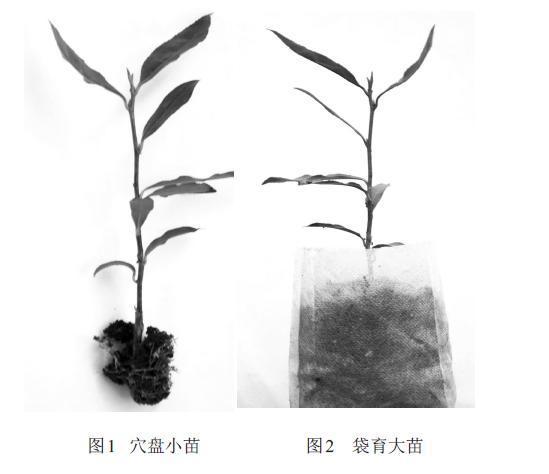
In the past, clonal tea garden construction mainly used "field-cutting seedlings" with roots and less soil, which recovered slowly after transplanting and had a low survival rate. In recent years, this was changed to "plug tray seedlings" (Figure 1), with cuttings raised in spring and sold from the nursery in autumn of the same year. Because tea seedlings can be transplanted with the entire root system and substrate, the survival rate is significantly improved. However, because the seedling age is short and the tea seedlings are small at planting, their disaster resistance is weak, and varying degrees of seedling death still occur after planting. At the same time, after the tea seedlings are planted separately, topdressing management is relatively difficult, growth speed is relatively slow, and shaping pruning is also inconvenient, causing many farmers not to carry out timely shaping pruning at all, which affects the later shaping of the tea plant tree form and the formation of the canopy surface. If changed to "bag-cultivated large seedlings" cultivated in special seedling bags (Figure 2), these problems can be readily solved.
There are several methods for cultivating bag-cultivated seedlings. At present, the most reliable and feasible method is: tea farmers prepare nutrient soil themselves, temporarily plant the plug tray seedlings in seedling bags, and then manage and cultivate them intensively in the seedbed for 1 year, so that they grow into large seedlings before being transplanted to the newly planted tea garden. This method has many benefits. First, farmers cultivate them themselves, which can reduce costs. Second, cultivating them locally for 1 year helps the tea seedlings adapt to the local climate and environment, enhances stress resistance, and can also solve problems such as the difficulty of transporting large seedlings. Third, intensive cultivation in the seedbed facilitates strengthening management such as topdressing, weeding, and pest and disease control, and measures such as covering and shading can be used to prevent various disasters, creating a growth environment far superior to the field for tea seedling growth and promoting rapid tea seedling growth. Fourth, centralized shaping pruning in the seedbed is fast and convenient, which helps shape a reasonable tree form. Fifth, bag-cultivated large seedlings have well-developed root systems, carry more soil, and have strong adaptability. In addition, transplanting with the bag causes no damage to the root system, thus greatly improving the survival rate of tea seedling transplanting, basically achieving full seedling survival after transplanting, and at the same time the growth speed of tea seedlings after transplanting will also be significantly accelerated.
II. Change no fertilization in the early stage to deep application of base fertilizer and frequent light topdressing
In the past, when building clonal tea gardens, first due to funding constraints, and second for fear that fertilization would damage the young tender roots of tea seedlings, the method of "planting with no fertilizer" was mostly adopted, with no base fertilizer applied in the early stage and no topdressing, resulting in slow growth of tea seedlings due to lack of nutrients.
To accelerate the growth speed of tea seedlings and achieve early orchard establishment and early harvesting, fertilization must be applied in the early stage. First, base fertilizer must be applied deeply. If the tea garden is trenched, layered deep application of base fertilizer can be carried out in combination with backfilling. If there is not enough time to trench, a ditch can be opened in the middle of the tea row for deep application of base fertilizer, then ridges can be formed to bury the fertilizer, and tea seedlings can be transplanted on both sides of the ridge. Generally, per 666.7 sq m, apply more than 3000 kg of long-acting organic fertilizer and more than 75 kg of tea-specific fertilizer, mixing soil and fertilizer evenly. As long as the distance between fertilizer and tea seedling roots is appropriate, it will not damage the tea seedlings, but instead can promote rapid early growth of tea seedlings and at the same time lay a good foundation for later high yield of the tea garden. Second, topdressing must be timely. In the past, when plug tray seedlings were used, the roots of tea seedlings were relatively weak just after transplanting, so topdressing indeed could not be applied. However, after transplanting and survival, topdressing should be carried out by the method of "frequent light applications, small meals more often," and the concentration and amount of fertilizer should be gradually increased according to the growth of the tea seedlings. After changing to bag-cultivated large seedlings, even more attention should be paid to timely topdressing. In the early stage, foliar spraying can be adopted, or diluted manure water, biogas slurry, urea aqueous solution, etc. can be applied as topdressing in combination with watering for drought resistance. In the later stage, shallow ditches can be opened on both sides of the tea row for topdressing with urea. As long as the amount is appropriate and the distance is suitable, it will not damage the tea seedlings.
III. Change open-field cultivation to plastic film mulching cultivation
In the past, tea seedling transplanting generally adopted open-field cultivation without plastic film mulching. The advantage of this method is that it is simple and saves labor, but there are many problems: First, most clonal tea gardens are built in secondary high mountain areas with relatively low annual effective accumulated temperature (altitude 800 to 1200 m), where warming in early spring is slow and cooling in autumn is early. Without plastic film mulching, the annual growth time of tea seedlings is limited, affecting the speed of orchard establishment. Second, open-field cultivation is afraid of drought, rainfall, and freezing damage. Continuous high temperature and drought can cause severe drought stress to tea seedlings, continuous rainy weather can make soil moisture too high, heavy rain can cause soil hardening, and low temperatures can easily freeze tea seedlings. These are all unfavorable to the survival and growth of tea seedlings. Third, for tea seedlings not covered with film, weeds are likely to grow near the roots. If weeds are not removed, they affect tea seedling growth; if weeds are removed, it is easy to disturb or even damage the tea seedlings, affecting tea seedling survival [Jishan Huayao].
Covering with plastic film during tea seedling transplanting can better solve the above problems. First, film covering can increase temperature and preserve warmth. In early spring and late autumn, it can effectively increase soil temperature, promote tea seedling root development, prolong tea seedling growth time, and significantly increase annual tea seedling growth. Second, film covering can increase tea seedling drought tolerance, cold tolerance, and stress resistance. During continuous drought, the plastic film can play a moisture-preserving role and reduce evaporation and loss of soil moisture. At low temperatures, the plastic film can play a warming and heat-preserving role and reduce freezing damage to tea seedlings. During continuous rain or heavy rain, the plastic film can play a shielding role, keeping soil moisture inside the film suitable, loose, and breathable. In short, film covering can keep soil temperature and humidity as suitable as possible and promote rapid tea seedling growth. Third, film covering can inhibit weed growth near the roots of tea seedlings and create good conditions for tea seedling growth.
Tea seedling plastic film covering can adopt multiple methods. In the past, when transplanting plug tray seedlings, it was possible either to cover first and then plant, or to plant first and then cover. If transplanting bag-cultivated large seedlings, because the aboveground stems and leaves are abundant, it is only possible to cover first and then plant. It is best to form ridges and cover with film in advance when soil moisture is suitable, and then use a mechanical hole puncher to punch holes in the film surface and plant seedlings. This is not only fast and efficient, but also ensures transplanting quality and improves tea seedling survival rate.