Apple Tree Double-Dwarf High Spindle Training and Cultivation Techniques
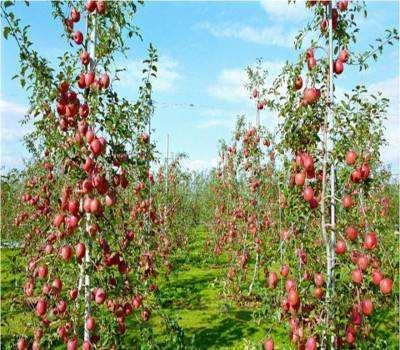
"Double-Dwarf" Apple Tree High Spindle Training and Cultivation Techniques
Special Project for the Construction of the National Modern Apple Industry Technology System (CARS-28).
The dwarf rootstock intensive cultivation model is currently the main model adopted by advanced apple-producing countries worldwide, and China is vigorously promoting it [Jishan Huayao]. The apple "double-dwarf" cultivation model combines the dual dwarfing advantages of spur-type varieties and dwarfing rootstocks, making it more suitable for high-density planting. It can effectively reduce tree height, control the canopy, and is easy to manage, achieving early fruiting and high yield [2]. However, in the old course of the Yellow River region, the "double-dwarf" apple orchard using dwarf rootstock intensive cultivation techniques failed to achieve ideal results. For this reason, the Shangqiu Comprehensive Experimental Station of the National Apple Industry Technology System carried out technical research on "double-dwarf" cultivation and obtained successful experience and supporting techniques.
1 Overview of the Demonstration Orchard
The "double-dwarf" dense planting demonstration orchard was established in Sunji Village, Zhangge Town, Liangyuan District, Shangqiu City, Henan Province (114°49'-116°39' E, 33°43'-34°52' N). This area has a warm temperate semi-humid continental monsoon climate with four distinct seasons. The annual average temperature in the demonstration area is 12.5-15.5 °C, with maximum and minimum temperatures of 39 °C and -9 °C respectively; the local annual average sunshine hours are 1,944.5 h, the frost-free period is 180-211 d, and the annual precipitation is 600-950 mm; the terrain is flat, the soil is loam, the pH value is 6.5, drainage and irrigation are convenient, and the site conditions are basically uniform.
The main cultivar in the orchard is spur-type Fuji with M26 interstock, and Malus robusta Rehd. as the rootstock; "double-dwarf" high-quality 2-year-old large seedlings were used to establish the orchard, with a seedling height of about 1.5 m, ground diameter of 1.5-2.0 cm, bearing 8-10 branches, interstock length of 25-30 cm, more than 5 lateral roots on the rootstock, and good graft union healing; the interstock is exposed 10-16 cm above the ground, with a spacing of 2.5 m × 4 m, and a high spindle tree form. Research by Gao Dengtao et al. [4] showed that the M26 interstock has suitable dwarfing degree, good adaptability, and excellent production performance in the old course of the Yellow River region; especially the combination of spur-type Fuji/M26 interstock showed good adaptability to the regional environment in terms of yield performance, fruit quality, and disease resistance. A trellis system was established at the time of orchard establishment.
2 Training and Pruning Techniques
The high spindle tree form is adopted for the main branches, with a tree height of about 3.3-3.5 m, trunk height of 0.6 m, and a straight and vigorous central leader. The diameter ratio of the central leader to the main branches is 5-6:1, with about 28-30 main branches distributed; the main branches have no whorls, are arranged in gaps, spiral upward, with branch angles of 90-110°; main branches are 1.0-1.5 m long, do not overlap between trees, and hang downward for three-dimensional fruiting.
(1) After planting in the same year, use bamboo poles to straighten the seedlings, head the tree at a plump bud, and bend 4-5 of the longest branches to open the angles, with the basal angle reaching 90-110°; remove the 2nd to 6th buds from the top of the central leader; in winter, remove vigorous new shoots growing from the trunk. After the first year of pruning, the tree height can reach 2.0-2.5 m.
(2) Pruning in the 2nd year. In spring, all lateral branches of the "double-dwarf" fruit trees are completely removed, leaving only the central leader. In summer, the main work is bud removal and branch selection, bending all lateral branches longer than 25 cm to below horizontal, with the basal angle reaching 90-110°. In late August, widen the waist angle and tip angle to control their vigor and promote the growth of the central leader; after the 2nd year of pruning, the tree height can reach 2.8-3.3 m.
(3) Pruning in the 3rd year. In spring, all lateral branches are still removed, leaving only the central leader; in summer, buds are removed and branches are selected, and all lateral branches longer than 25 cm are bent to below horizontal; after 2 years of pruning, the tree height can reach 3.5-4.0 m.
(4) Pruning in the 4th year. Lateral branches with a diameter exceeding 1/3 of the diameter of the central leader at their point of attachment are all removed using the oblique cut method, leaving a stub with a short upper part and a long lower part; remove upward-growing branches, diseased and pest-infested branches, weak branches, etc., select branches with moderate vigor and wide angles as small main branches, do not head them, and lightly shorten the extension shoot of the central leader; usually when there are two branches at the top of a lateral branch, remove the lower branch and eliminate excess small branches. Spring and summer pruning mainly consists of bud removal and branch bending. All lateral branches longer than 25 cm are bent to below horizontal, with the basal angle reaching 90-110°, to control their vigor and promote the transformation from vegetative growth to reproductive growth.
When the tree height is about 3 m, it can bear fruit abundantly. In spring, remove flower buds every 15 cm to reduce the fruit load. In autumn, bend new shoots on the central leader to 95-120°. For new shoots on 1-year-old branches, use methods such as shoot twisting and branch bending to moderate tree vigor and increase yield.
(5) Pruning in subsequent years. Ensure the dominance of the central leader, with no overly thick lateral branches competing with it, and remove all lateral branches with a diameter greater than half the diameter of the central leader; prune all lateral branches so that the small branches (fruiting branches) on them are arranged in a uniaxial pattern. Use the oblique cut method for pruning: remove or shorten lateral branches that are too low, and generally remove lateral branches below 60 cm from the ground.
Growing-season pruning mainly involves branch bending, shoot pinching, and shoot twisting, removing competitive branches, overlapping branches, crossing branches, diseased and pest-infested branches, and upright vigorous branches, to improve ventilation and light penetration in the canopy. Fruiting branch pruning: retain vigorous, medium and short fruiting branches as the main fruiting branches, cut off 1/4-1/3 of the length of long fruiting branches, remove densely growing branches from medium fruiting branches, and retain one branch every 10 cm or so for short fruiting branches. Later-stage pruning mainly consists of light pruning and delayed pruning, appropriately retaining more flower bud branches for fruiting.
3 Soil, Water, and Fertilizer Management
Soil management focuses on deep plowing and soil improvement, applying more organic fertilizer to improve soil structure and achieve the goals of air permeability, water retention, and fertilizer retention; continuous inter-row grass growing for many years, mowing when the grass grows to 30-40 cm, and mulching the tree basin with the cut grass. Grass mulching can effectively stabilize soil temperature, maintain soil moisture, and increase soil porosity.
Apply sufficient base fertilizer at orchard establishment, and expand the holes and deep plow 60 cm every autumn. In the early growth stage, nitrogen fertilizer is mainly used; in the middle stage, phosphorus and potassium fertilizers are mainly used; in the later stage, more potassium fertilizer is applied; on average, per 667 sq m, apply 3,000-5,000 kg of decomposed high-quality farmyard manure, 300-500 kg of commercial organic fertilizer, 45-70 kg of urea, 35-50 kg of potassium chloride, and 80-150 kg of superphosphate, followed by sufficient irrigation; starting from early to mid-July each year, spray the canopy with a mixed fertilizer solution of 0.3% monopotassium phosphate and 0.2% urea, once every 10-15 days, for 5 consecutive sprays, which can prevent early defoliation and restore tree vigor.
Promote and apply the integrated water and fertilizer technology. In normal years, water well at bud break, after flowering, during fruit enlargement, and before freezing; under special circumstances, water as appropriate according to weather conditions. Build orchard drainage facilities well and drain accumulated water from the orchard at any time.
4 Pest and Disease Control
Integrated application of agricultural, physical, and chemical control methods, using high-efficiency, low-toxicity, low-residue, pollution-free pesticides and their pollution-free application techniques. The main pests and diseases in the "double-dwarf" dense planting demonstration orchard include Alternaria leaf spot, brown spot, anthracnose leaf blight, ring rot, and woolly apple aphid. Use a 0.067% concentration solution of 48% chlorpyrifos, or a 0.125% concentration solution of 75% mancozeb, or a 0.125% concentration solution of 50% carbendazim to control Alternaria leaf spot; 60% Baitai to control apple anthracnose leaf blight; Lunwen Zhongjiezhe to control ring rot; and imidacloprid, abamectin, etc. to control woolly apple aphid.
On the basis of strengthening integrated soil, fertilizer, and water management, tree management, enhancing tree vigor, thorough orchard sanitation, and eliminating orchard pathogens through agricultural measures, apply Bordeaux mixture for full-season protection from after bagging until September. Alternate Bordeaux mixture with fungicides mainly containing pyraclostrobin as the active ingredient or organic fungicides such as trifloxystrobin·tebuconazole to control infection by ring rot, decay, and brown spot pathogens, while also eliminating pathogenic bacteria on the surface and outer layers of branches and trunks. In early July, late July, mid-August, and early September, spray Bordeaux mixture 4 consecutive times.
At the same time, install frequency-vibration electronic insect-killing lamps and hang yellow sticky boards in the orchard to control pests. Combined with winter and spring pruning, cut off diseased and pest-infested branches, scrape off overwintering cocoons, and carry them out of the orchard for burning. Strengthen cultivation management, enhance tree vigor, apply more organic fertilizer, and improve the insect resistance of apple trees.