Symptoms and Characteristics of Jujube Witches' Broom Disease and Detailed Control Measures
Symptoms and Characteristics of Jujube Witches' Broom Disease and Control Measures
Jujube witches' broom disease, also known as "jujube cancer disease", witches' broom disease, or broom disease, is a devastating infectious disease of jujube trees. Once a jujube tree is infected with this disease, it generally dies completely 2 to 6 years after onset. In recent years, jujube witches' broom disease has occurred severely in Cangxian County and has shown an outbreak trend. According to surveys by technicians of the Forest Pest Control Station of the Cangxian County Landscaping Bureau, jujube witches' broom disease occurs commonly in the jujube-growing areas of Cangxian County, with the annual incidence rate of affected plants in many jujube orchards exceeding 70%, causing great losses to jujube production.
1 Symptom Characteristics
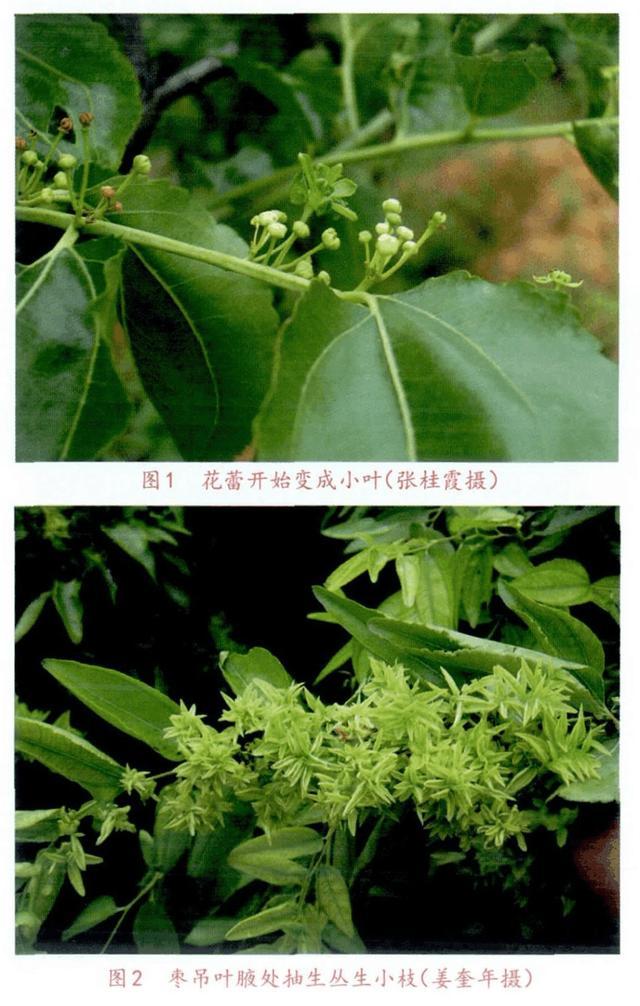
In Cangxian County, jujube witches' broom disease has a relatively high incidence rate on varieties such as Jinsi small jujube and Po jujube, while no diseased plants have yet been found on winter jujube. After onset, diseased plants mainly show clustered branches, leaf yellowing, and floral organ phyllody. When the disease occurs, floral organs degenerate, and flower buds and flowers become small leaves (Figure 1). The small leaves can produce short shoots with very short internodes (Figure 2), and the small branches and leaves cluster together. First, individual witches' broom branches appear in the canopy, then they cover the entire tree (Figure 3). The clustered small branches are slender, with short internodes and small leaves, and are not easy to shed in winter (Figure 4). The leaves on diseased branches first turn yellow in the mesophyll while the veins remain green, and later the entire leaf yellows, the leaf margins curl upward, the leaves become dull, hard, and brittle. Branches that become diseased late can still bear fruit. Jujube fruits on diseased branches vary greatly in size, with uneven coloring on the fruit surface and an uneven, bumpy appearance; the raised areas are red, and the sunken areas are green. The flesh tissue is loose and soft and is not edible.
2 Disease Occurrence Pattern
2.1 Pathogen
Jujube witches' broom disease is caused by a phytoplasma (that is, a mycoplasma-like organism). After the pathogen invades the tree body, it first travels to the roots, and after multiplication, it is conducted upward through the phloem to the growing point, where disease occurs. The pathogen moves through the sieve tubes of the phloem. When buds sprout in spring, it is conducted from the roots to the canopy, and in autumn when branch and leaf growth stops, it is conducted from the canopy to the roots. During the growing season, the pathogen is present in both the canopy and the roots. At the end of the dormant season (March to April), there is basically no pathogen in the aboveground diseased branches, while the pathogen is always present in the roots.
2.2 Transmission Routes
There are two routes for the transmission of jujube witches' broom disease. The first is infection through asexual reproduction. Whether a diseased plant is used as rootstock or as scion, the disease can be transmitted through grafting (including cleft grafting, bud grafting, and root grafting); root suckers from infected trees can be spread to other locations during transport. The second is transmission through vector insects (such as leafhoppers). Once a leafhopper ingests the mycoplasma-like organism of jujube witches' broom disease, it will carry the pathogen for life and can successively infect many jujube trees. When landscaping tree species that host vector insects are planted in other locations, they can transmit the pathogen to local jujube trees, causing the occurrence and spread of jujube witches' broom disease in the local area.
2.3 Disease Development Process
The disease development process of jujube witches' broom disease can be divided into 5 pathological stages: leaf-change stage, flower-change stage, branch-change stage, witches' broom tree stage, and decline and death stage (Figure 5)
Figure 5 Disease development process
2.4 Conditions for Disease Occurrence
Judging from the survey situation, the ecological environment of jujube orchards plays an important role in the occurrence and spread of jujube witches' broom disease. Jujube orchards with poor soil, extensive management, and weakened tree vigor have more severe disease; jujube orchards overgrown with weeds and surrounded by pine and cypress trees also have severe disease. In jujube-growing areas with a relatively high level of management, because diseased trees are promptly removed, the pathogen is reduced; and because pests and diseases are effectively controlled, the number of vector insects is reduced, so the incidence rate of jujube witches' broom disease is low and the speed of spread is slow.
For many years, jujube witches' broom disease rarely occurred in the jujube-growing areas of Cangxian County. The reason was not that saline-alkali soil conditions inhibit jujube witches' broom disease, but rather that the ecological environment and management methods were not conducive to the spread of jujube witches' broom disease. As the economic benefits of small jujube production continued to decline, jujube farmers' enthusiasm for managing jujube trees decreased, resulting in simple and extensive jujube orchard management. At the same time, a large number of foreign seedlings (especially scattered large pine and cypress seedlings) were brought in for urban and rural landscaping. These seedlings very likely carried leafhoppers, the vector insects of the jujube witches' broom disease pathogen, and became a direct source of transmission of jujube witches' broom disease, creating conditions for the introduction of the jujube witches' broom disease pathogen and leading to the large-scale occurrence of the disease in Cangxian County.
3 Control Measures
3.1 Quarantine
Strengthen quarantine law enforcement, and strictly prohibit jujube witches' broom disease seedlings from entering jujube-growing areas. Select disease-free mother plants for collecting scions, cuttings, and propagating root suckers. When carrying out local landscaping and afforestation, seedlings from areas where jujube witches' broom disease occurs, especially pine and cypress species, should be promptly quarantined and disinfected to eliminate the vector insects that transmit the jujube witches' broom disease pathogen.
3.2 Strengthen Jujube Orchard Management and Enhance Tree Vigor
Strengthen water and fertilizer management in jujube orchards, carry out reasonable pruning, maintain an appropriate fruit load, promptly clear weeds in and around the jujube orchard, and combine this with pesticide spraying to reduce the occurrence of pests and diseases and enhance the disease resistance of the tree body [Jishan Huayao].
3.3 Increase Publicity Efforts
Through methods such as distributing publicity posters and media broadcasts, let the general public understand the harm of jujube witches' broom disease and knowledge about its control. If control is not carried out in time, the disease will rapidly spread to other jujube trees, affecting the economic income of oneself and neighbors.
3.4 Thoroughly Remove Diseased Jujube Witches' Broom Disease Plants
During the growing season, for jujube trees that have already developed the disease, systemic herbicides such as glyphosate can be used to completely kill the diseased plants by smearing at the trunk ring or spraying the branches and leaves, leaving no root suckers. The width of the trunk ring should be more than 5 cm. When spraying, take care not to spray surrounding healthy jujube trees and crops.
3.5 Timely Control Vector Insects and Cut Off Transmission Routes
After leafhoppers feed on diseased trees and then feed on disease-free trees, they can transmit the disease. In late April, mid-May, and late June, carry out unified pesticide spraying on jujube trees. Try not to plant pine and cypress species around jujube orchards. If pine and cypress are planted, after leafhoppers move to pine and cypress in October and before leafhoppers move to jujube trees in spring, carry out concentrated pesticide spraying on the pine and cypress to reduce the insect population base and reduce the probability of infection. For the pesticide, a mixture of 10% (mass fraction, the same below) beta-cypermethrin 5,000-fold solution + 10% imidacloprid 3,000-fold solution can be selected.