Money Tree Care and Pruning Methods, Easy to Learn at Once
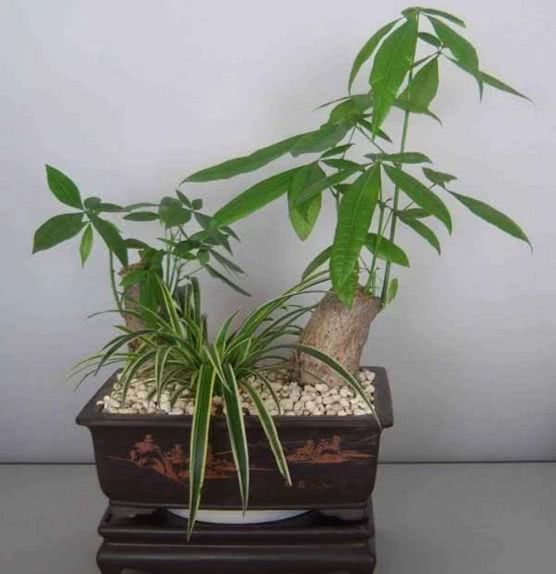
Money tree, an evergreen tree, loves high temperature and high humidity climates, has poor cold resistance, seedlings are afraid of frost, adult trees can tolerate light frost and long-term low temperatures of 5-6C, in South China it can overwinter outdoors, in areas further north it must be moved into a greenhouse in winter to protect against the cold, and it loves fertile, loose, air-permeable and water-retentive sandy loam, prefers acidic soil, and dislikes alkaline soil or heavy clay soil; it is fairly tolerant of water and moisture, and also slightly tolerant of drought.
The money tree has a graceful posture, a majestic leaf crown, and emerald-green leaves. Placed in a family living room, it is both elegant and generous, and very likable.
The money tree is a perennial evergreen shrub, native to the Malay Peninsula and the South Seas Islands area. In recent years, through cultivation and breeding, it has widely entered urban and rural households in our country. For home cultivation, based on its living habits of loving high temperature and high humidity and being intolerant of frost, cold and dryness, one should focus on grasping the following four points:
1. Pay attention to sunlight
The money tree likes high temperature, humidity and sunlight, and cannot be shaded for a long time. Therefore, during care and management it should be placed in a spot indoors with ample sunlight. When placing it, the leaf surface must face the sunlight. Otherwise, because the leaves are phototropic, the entire branches and leaves will become twisted. In addition, every 3 to 5 days, spray water on the leaves once with a spray bottle. This not only helps photosynthesis proceed, but also makes the branches and leaves look more beautiful.
2. Pay attention to watering
Watering is an important part of the care and management process. If the amount of water is small, branch and leaf development stagnates; if the amount of water is too large, it may cause root rot and death; if the amount of water is moderate, the branches and leaves are plump. The first principle of watering is to prefer moist over dry, and the second is "two more and two less", that is, water more in the high-temperature summer season and water less in winter; water more for large and medium-sized plants with vigorous growth, and water less for small newly potted plants. When the watering amount is too large, the plant is prone to root rot, causing the leaves to droop, lose their luster, and even fall off. At this time, it should immediately be moved to a cool place, the watering amount reduced to the minimum, as long as the potting soil is not dry, and spray water on the leaf surface multiple times a day with a spray bottle, stop fertilizing with water, and after about 15 to 20 days it can gradually recover.
3. Pay attention to fertilizing
The money tree is a flowering plant that likes fertilizer, and its demand for fertilizer is greater than that of common other flowering plants. When repotting every year, the proportion of fertilized soil can account for 1/3, or even more. Fertilized soil has a wide range of sources; you can collect broadleaf tree leaf humus, add a little garden soil and mixed bone meal and bean cake residue to prepare it. This fertilized soil has high effectiveness and is convenient and easy to obtain, but attention should be paid to fully decomposing it, so as not to "burn" the leaves yellow. In addition, during the growth period of the money tree (May to September), every 15 days, apply a fully decomposed liquid fertilizer or mixed flower-growing fertilizer once, to promote deep roots and lush leaves.
4. Pay attention to temperature and humidity
The money tree has relatively high requirements for temperature and humidity. If the temperature is relatively low or humidity is lacking, leaf drop often occurs, and in severe cases the branches become bare, which not only hinders ornamental value but also very easily causes the plant to die. Therefore, during cultivation and care, attention should be paid to maintaining a temperature above 15C, and frequently spraying water on the branches and leaves to increase the necessary humidity. In late autumn and winter, attention should be paid to doing a good job of overwintering cold protection and freeze protection management.
Illustrated guide to money tree pruning methods and precautions
Pruning time
Money tree pruning is generally carried out in spring, with the specific time in April to May. In early May, the weather is warm, the plant's branches and leaves are budding, and metabolism is vigorous. Pruning at this time can allow new branches to sprout relatively quickly, and they grow robustly.
Preparations before pruning
Prepare tools: gardening scissors, specially for cutting thick branches. Try not to use ordinary household scissors, which not only blister the hands but also cause overly large cuts, affecting later recovery. Gloves are also necessary; when pruning branches and leaves, it is best to wear work gloves to protect both hands and avoid stab injuries from stems and branches.
Plant preparation: one month before pruning, place the money tree in an environment it likes, and apply a thin liquid fertilizer mainly based on nitrogen once, so that after pruning the money tree has enough nutrients to sprout branches and buds.
Pruning steps for the money tree
Take a large money tree as an example. The money tree below has grown fairly shapely, with a braided stem and luxuriant branches and leaves, but it is wearing a thick hat on top, and the branches and leaves are a bit messy.
Quickly and without overthinking, cut off all the branches and leaves. Keep the small tender buds of the branches and leaves, that is, the green part in the picture, keeping about 10 cm. For branches that are too weak, cut them all off, because their sprouting ability is relatively weak, and they will also compete with other branches for nutrients, so they cannot be kept.
After pruning, there is no need to apply anything; the money tree is not easily infected. After pruning, place it in a place with slightly dim light for care. This is how it looks after 22 days; many tender buds have already grown, and a few scattered leaves have also emerged.
Ta-da, this is how it looks a month and a half after pruning; isn't it much more compact and refined than before.
Differences in pruning large and small money trees
Large money tree: The pruning principle for large money trees is short cutting, removing leggy branches, and keeping robust branches. You can cut off all branches, and appropriately remove thin and weak branches.
Small money tree: A height of less than 30 cm can be regarded as a small variety. This type of money tree is not suitable for branch pruning. During growth, clearly let it continuously grow thicker and taller, and promptly remove side buds.
Care and management after money tree pruning
Do not contact water
After the money tree is pruned, do not spray water or let it get rained on, to avoid the cut openings rotting. Place it in a bright, shaded or cool place, and reduce watering. The watering amount should be reduced by half compared with usual, because with the loss of leaf transpiration, water demand is also reduced. If watered too much, causing root rot, it will affect the money tree's recovery after pruning.
Supplement nutrients
Before the branches sprout, apply a liquid fertilizer mainly based on nitrogen once. During this period, also water once with a fungicide to prevent root rot. One month later, the branches will grow small leaves and gradually extend, and normal care can begin.
Money tree pruning and shaping
Single-stem upright type
This is a relatively common plant, with only a bare upright single stem, and the leaves at the top gathered into an umbrella shape, which can be large or small.
Braided type
An artistic shape with relatively strong ornamental value, which requires wire to shape. The pruning method is the same as for ordinary money trees.
Short and sturdy type
For small money trees, during pruning, focus on removing buds and promoting thick and sturdy stem nodes.
Multi-cluster type
Multiple money trees in one flowerpot, a relatively large potted plant, usually placed in offices and living rooms.
The "Bonsai Floral Art" WeChat public platform shares the most valuable bonsai culture.
Some text and image materials come from the internet. We express deep respect to the original authors. If there are objections regarding copyright, contact us for deletion.
Follow the official account to learn more flower and tree information