Introduction Performance and Main Cultivation Techniques of Yuehua Apple in the Jinzhou Region
Introduction Performance and Main Cultivation Techniques of Yuehua Apple in the Jinzhou Region
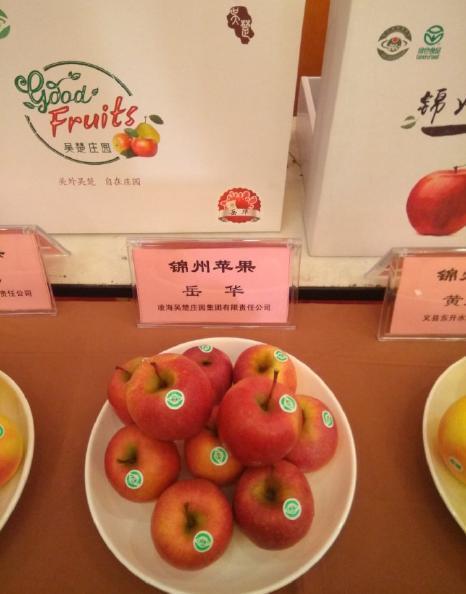
Yuehua is a high-quality late-maturing apple cultivar bred by the Liaoning Institute of Pomology through hybridization, with Hanfu as the female parent and Yueshuai as the male parent. In 2009, the Liaoning Institute of Pomology introduced Yuehua to the Jinzhou region of Liaoning for regional trials. After years of cultivation, Yuehua has shown strong adaptability, good productivity and excellent quality in the Jinzhou region (Figure 1), and is suitable for promotion and cultivation in the Jinzhou region.
Figure 1 Yuehua apple exhibited at the "Jinzhou Apple Agricultural Product Geographical Indication" exhibition
1 Basic Information of the Demonstration Orchard
The Jinzhou region has a north temperate semi-arid monsoon continental climate, with cold winters and warm summers and abundant sunshine. The annual average temperature is 8-9 °C, the average January temperature is -8.8 to -11 °C, the average July temperature is 24-26 °C, the annual precipitation is 450-650 mm, and the frost-free period is 150-180 days. During the fruit ripening season (starting in early September), the temperature difference between day and night is large, with a difference of 10-13 °C between high and low temperatures, which is favorable for fruit coloring and sugar accumulation. These are uniquely favorable climatic conditions, very suitable for high-quality apple production. The demonstration orchard is located at the fruit tree production base of Wuchu Manor Group Co., Ltd. in Xinglongyu Village, Baitaizi Township, Linghai City, Jinzhou, Liaoning Province, with a cultivation area of 2 ha, north-south row orientation, and a spacing of 3 m × 4 m between plants and rows. The pollinizer is Hanfu. The orchard land is hillside land with sandy loam soil, deep soil layers, and an organic matter content (mass fraction) of about 0.9%.
2 Introduction Performance
2.1 Fruit Economic Traits
The fruit is oblong in shape, with a longitudinal diameter of 8.0 cm, a transverse diameter of 8.5 cm, and a fruit shape index of 0.94. The fruit shape is regular; the average single fruit mass is 230 g; at maturity, the fruit surface is bright red with stripe coloring, and the ground color is yellow-green, with a smooth and glossy fruit surface; the stem cavity and calyx cavity are deep; the flesh is yellow-white, crisp and tender in texture, rich in juice, sweet and sour in taste, and aromatic; the soluble solids content (mass fraction) is 12.6%, and the fruit firmness is 7.1 kg/sq cm.
2.2 Growth and Fruiting Habits
The growth vigor is relatively strong, the tree posture is open, the branches are thick and sturdy, and the internodes are relatively short. The germination rate is high, and the branching ability is strong; young trees mainly bear fruit on axillary flower buds and long fruiting branches, while trees in full bearing period mainly bear fruit on medium and short fruiting branches; the productivity is good, and the ability to bear fruit continuously is relatively strong (Figure 2). In the Jinzhou region of Liaoning, trees begin to bear fruit in the 3rd year after planting. The average yield per tree is 20 kg for 4-year-old trees, 35 kg for 5-year-old trees, and 50 kg for 6-year-old trees.
Figure 2 Fruiting state of Yuehua apple
2.3 Phenological Period
In the Jinzhou region, Yuehua apple buds break in mid-April, begins to bloom in late April, reaches full bloom in early May, with a flowering period of about 1 week. The fruit begins to color in late September, ripens in mid-October, and leaves fall in early November. The fruit development period is about 160 days, and the vegetative growth period of the tree is about 215 days.
2.4 Cold Resistance
Yuehua apple has strong cold resistance. After years of cultivation in the Jinzhou region, no freezing damage has occurred to the trunk or branches. In the first year after planting, slight freezing damage occurred to the terminal buds, with a terminal bud death rate of 18%, lower than that of Hanfu apple (terminal bud death rate 25%). As the tree age increases, the death rate of terminal shoots continues to decline.
3 Main Cultivation Techniques
3.1 Planting
It is best to choose sandy loam plots with deep and fertile soil layers, a relatively low groundwater table, no water accumulation during the rainy season, and convenient drainage and irrigation. In the autumn of the year before planting, dig the planting trenches and apply sufficient base fertilizer. Before bud break the following year, plant at a spacing of 3 m × 4 m between plants and rows. After planting, irrigate promptly and cover with plastic film to increase temperature and preserve soil moisture.
3.2 Training and Pruning
A spindle-shaped tree form is adopted. During winter pruning, the central leader extension shoot is cut back by 60-70 cm each year, while the main branch extension shoots are best lightly pruned or not pruned, so as to moderate the growth vigor. When the central leader reaches the expected height, it may no longer be headed back. Main branches are pulled to more than 90° in May-June. Competing shoots and water sprouts that develop during extension and growth should all be removed.
3.3 Soil, Fertilizer and Water Management
Sod culture is practiced between rows, and crop straw is used as mulch within rows. In August-September, sufficient base fertilizer is applied, mainly decomposed farmyard manure, mixed with an appropriate amount of phosphorus and potassium fertilizer. In June-July, a nitrogen-phosphorus-potassium compound fertilizer is applied as a top dressing twice. Irrigation should be carried out promptly at the bud break stage, fruit enlargement stage, and before the soil freezes. The freezing water should be applied thoroughly in one go before the soil freezes, which is beneficial for the apple trees to overwinter safely and for growth and development in early spring.
3.4 Flower and Fruit Management
Yuehua has relatively large fruit, so flower and fruit thinning must be strictly carried out. Flower thinning is done by the distance method, removing overly dense and weak flower clusters, and keeping one vigorous flower cluster every 25-30 cm. Fruit thinning is carried out at a branch-to-fruit ratio of 5:1, selecting and keeping large and good fruit. Fruit bagging is carried out 50 days after flowering. One to three days before bagging, spray the entire orchard carefully once with a pollution-free, low-toxicity fungicide and insecticide. Remove the bags 20 days before fruit maturity. After bag removal, lay reflective film to promote fruit coloring.
3.5 Pest and Disease Control
Yuehua has relatively strong disease resistance in the Jinzhou region of Liaoning and is relatively resistant to apple trunk ring rot. Attention should be paid to controlling leaf roller moths, red spiders, apple woolly aphids, and apple leaf miners. During the dormant period, clean the orchard and thoroughly remove fallen leaves, weeds, and dead branches, and bury them deeply or burn them in a centralized manner. Before bud break in spring, carefully spray the entire orchard once with 3-5 Baume degrees lime sulfur mixture to eliminate latent pathogens. From the red bud stage to the flower cluster separation stage, spray 200-fold trichlorfon solution to control leaf roller moths. After petal fall, spray 5% (mass fraction, same below) hexythiazox 1,200-fold solution to control red spiders. In early June, spray 48% chlorpyrifos 1,200-fold solution to control apple woolly aphids. In mid-to-late August, spray 25% diflubenzuron 1,500-fold solution to control apple leaf miners.