What soil management measures are there for Yanshan chestnut orchards?
Soil management measures for Yanshan chestnut orchards
Yanshan chestnut orchards are mostly built on mountain land, rarely have irrigation conditions, suffer from severe nutrient deficiency, and serious weed overgrowth. Soil management in chestnut orchards should focus on deep soil tillage, scientific fertilization, and skillful use of herbicides to achieve year-round weed-free management, so as to achieve high and stable yields, good quality, and high efficiency every year.
1 Deep soil tillage
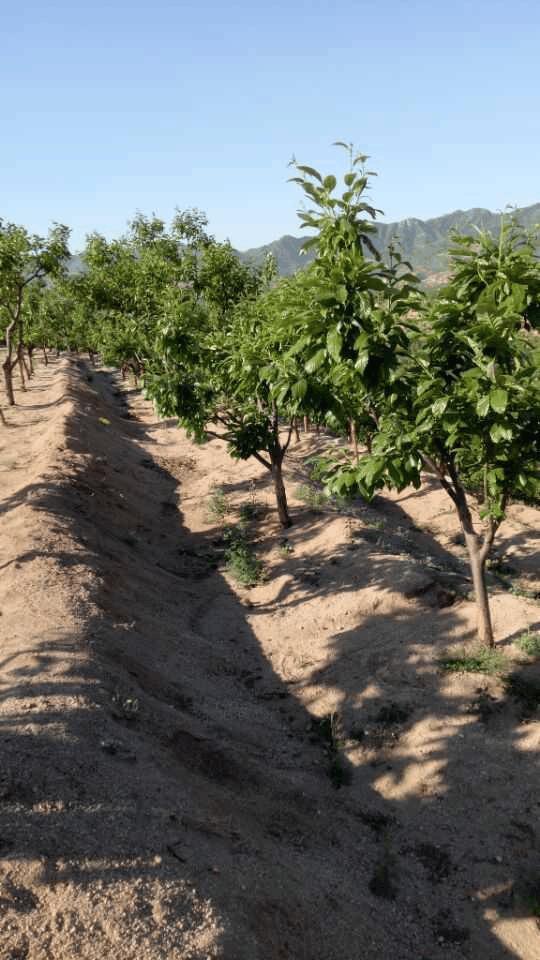
Yanshan chestnuts are mostly planted on mountain land, so soil and water conservation works should be done first. It is best to use an excavator to dig trenches before planting, with a depth and width of more than 1 m, to fully meet the needs of chestnut tree root growth and development. Strive to achieve: "gentle slopes terraced, steep slopes turned into water basins, dams in mountain gullies, tree plates under the trees." Second, deep tillage and hole expansion should be carried out. Within 3 years after planting, complete deep tillage of the whole orchard, press soil and green manure, improve the soil, and increase soil organic matter; make the soil reach "deep, fertile, and loose." Cultivation and weeding should also be carried out. The depth of cultivation is generally 10-30 cm, shallower near the trunk and deeper away from the trunk, to avoid damaging roots (Figure 1).
Figure 1 Deep soil tillage in a chestnut orchard
Figure 1 Deep soil tillage in a chestnut orchard
2 Scientific fertilization
2.1 Traditional fertilization misunderstandings
Many chestnut grower friends do not apply chemical fertilizers to chestnut trees at all, because they believe that fertilizing chestnut trees does not significantly increase yield, which discourages fruit growers' enthusiasm for fertilization.
2.1.1 Wrong timing of chemical fertilizer application. The main Yanshan chestnut production areas are dry in spring with little rain, and most chestnut orchards have no irrigation conditions. There is also technical misinformation that "chestnut fertilizer works well when applied after rain," so the fertilization time cannot keep up with the period of greatest nutrient demand of chestnut trees. This causes a mismatch between fertilizer supply and demand, disconnects them from each other, and prevents the maximum benefit of fertilizer from being fully realized.
2.1.2 Unreasonable choice of chemical fertilizers. Chestnut growers who fertilize generally apply only nitrogen fertilizer, mostly urea or diammonium phosphate, etc., causing nutrient imbalance in chestnut trees and excessive vegetative growth. The effective period of ordinary chemical fertilizers is generally 50-80 days. After chemical fertilizers are applied to the soil, they decompose quickly. If not fully absorbed by chestnut trees, they are fixed by the soil, evaporate into the air, leach away with rain, and most are wasted. Only about 15% can be absorbed. When the key period of chestnut tree fertilizer demand truly arrives in autumn, fertilizer supply cannot keep up, causing late-stage fertilizer deficiency. Therefore, biased fertilizer application does not have a significant effect on increasing yield.
2.2 Fertilizer demand patterns of Yanshan chestnuts and fertilizer selection
(1) Yanshan chestnut orchards are mostly built in gneiss mountainous areas, and soil nutrients are characterized by: "nitrogen deficiency, low phosphorus, and insufficient potassium," which should be supplemented in time.
(2) Chestnuts are sensitive to the trace elements "manganese, iron, and boron," and are prone to disease when lacking them.
(3) The vast majority of Yanshan chestnut orchards cannot be irrigated, and fertilization during drought is basically ineffective.
(4) From mid-to-late April (bud break) to late June (shedding of male chestnut flowers) is the key period for flower formation and fruit setting of Yanshan chestnuts, and is the period of greatest fertilizer demand for chestnuts, requiring 70% of the annual nutrients; mid-to-late July is the period of rapid expansion of chestnut fruits, and is the peak period of potassium fertilizer demand; after chestnut fruit harvest in September, autumn basal fertilizer should be applied to supplement nutrients.
Based on the above characteristics, a fertilization method has been explored for Yanshan chestnuts in which high-nitrogen fertilizer is suitable in the early stage, high-potassium compound fertilizer is suitable in the later stage, and basal fertilizer is applied in autumn. Chestnuts are chlorine-sensitive crops, so potassium fertilizer should be of the sulfur-based type. According to the fertilizer demand pattern of chestnuts, the most suitable "potassium sulfate-type slow and controlled-release compound fertilizer" specially for chestnuts should be selected. This compound fertilizer contains nitrogen, phosphorus, and potassium, and also contains trace elements such as manganese, iron, and boron to which chestnuts are sensitive. Slow and controlled-release fertilizer is a breakthrough advance in chemical fertilizer production. The effective period of this fertilizer is increased from 50-80 days for ordinary chemical fertilizers to more than 150 days, and the fertilizer utilization rate is increased from 25% for ordinary chemical fertilizers to 45%-50%. Potassium sulfate-type slow and controlled-release compound fertilizer has a coating on the outside and does not dissolve immediately after being applied to the soil. As temperature rises, soil moisture increases, and the nutrient demand of the tree body increases, nutrients are gradually released, consistent with the fertilizer demand period of chestnut trees. More nitrogen fertilizer is released in the early stage, and more phosphorus and potassium fertilizer is released in the later stage, which can meet the needs of chestnut trees throughout the entire growth period without fertilizer deficiency.
2.3 Chestnut fertilization methods
2.3.1 Fertilization period. Seize the return-slurry period from early March to early April when the soil freezes at night and thaws during the day, and fertilize chestnuts in time while soil moisture is good. Fertilizing during the return-slurry period, when soil moisture is good, can decompose part of the chemical fertilizer and meet the needs of the bud break period. Around May 1 in a normal year there is a "planting rain," which can meet the maximum nutrient demand of chestnut trees. After that, nutrients are slowly released and can supply the needs of chestnut trees throughout the entire growth period. Applying slow and controlled-release compound fertilizer year after year as required can increase chestnut yield by 50%-100%. After chestnut fruit harvest in autumn, apply more organic fertilizer.
2.3.2 Fertilization amount. Based on the predicted chestnut yield, for hillside land, surrounding-mountain rotation land, and other chestnut orchards with poor soil quality, apply 1 kg of potassium sulfate-type slow and controlled-release compound fertilizer for 3-5 kg of chestnut fruit produced. For chestnut orchards with deep and relatively fertile soil, apply 1 kg of slow and controlled-release compound fertilizer for 7-10 kg of chestnut fruit produced.
2.3.3 Fertilization method. During fertilization, work in groups of 2. Around the drip line at the outer edge of the tree canopy, one person uses a pointed iron shovel to dig a pit 20 cm deep, lifting the soil with the shovel, while the other person sprinkles chemical fertilizer, and then the soil is put back. Dig 1 pit per 1 sq m, and apply 100-150 grams of fertilizer per pit (Figure 2).
Figure 2 Early spring fertilization of chestnuts
Figure 2 Early spring fertilization of chestnuts
3 Weed control in chestnut orchards
Yanshan chestnut orchards mostly grow on mountain land, with poor soil quality and low nutrient content. Year-round weed-free management should be achieved to avoid weeds competing for fertilizer and water and to create a good environment for chestnut tree growth. Manual weeding has the best effect, but manual hoeing is labor-intensive, time-consuming, and costly, and it is difficult to achieve year-round weed-free management. For large-area chestnut orchards, chemical weed control can be used, with chemical weeding three times throughout the year.
3.1 Weed control periods and methods
The first time is in early June. In a normal year in the Yanshan area, there is a "planting rain" around May 1. After the rain, a batch of spring weeds emerges one after another. By around June 1, they have no more than 5 leaves, and the weed roots are still very small, making them very easy to remove. Use paraquat plus a cornfield pre-emergence closure treatment. The weeds that have emerged are removed, and the weeds that have not emerged are blocked, giving a very good effect. This can effectively prevent vigorous summer weed growth and avoid serious weed overgrowth.
The second time is from mid-to-late July to early August. Use paraquat plus 2,4-D butyl ester to remove summer weeds. After removal, keep the ground clean to facilitate chestnut fruit harvest.
The third time is in early October. Before winter, remove various overwintering weeds such as Artemisia species and sow thistle, using paraquat with an effective content of 20% or more (mass fraction, same below) plus 2,4-D butyl ester. Weeds touched by the herbicide cannot return nutrients before winter, accumulate insufficient nutrients, cannot overwinter normally, and are frozen to death together with their roots. This is a good method combining chemical weed control with phenological weed control, reducing the number of weeds in the following spring.
After three chemical weed control treatments throughout the year, labor, herbicide, and effort are saved, and year-round weed-free management can be achieved. With such management for three consecutive years, there will basically be no weeds, and weed damage can be effectively controlled (Figure 3).
Figure 3 Weed control in a chestnut orchard
Figure 3 Weed control in a chestnut orchard
3.2 Methods for controlling Vitex negundo and wild jujube roots
Chestnut orchards are mostly planted on mountain land, and removing Vitex negundo and wild jujube roots is very difficult, and they are prone to regrowth after removal. Vitex negundo and wild jujube are small woody shrubs. It is best not to use the method of digging out Vitex negundo and wild jujube roots, first because weed elimination is incomplete, and second because it causes soil and water loss. If you want to eradicate them at once, you can choose glyphosate plus 2,4-D butyl ester.
(1) Time: around the Beginning of Autumn (August 5) is the nutrient return period of Vitex negundo and wild jujube. One application can completely eradicate them with no future trouble [Jishan Huayao].
(2) Method: ① Add 1 kg of 10% glyphosate aqueous solution to one sprayer of water (15 kg), then add 3 bottle caps (10 mL) of 2,4-D butyl ester, and add a handful of laundry detergent (to serve as a sticking agent). ② Use 2 bags of 77% powdered glyphosate added to 15 kg of water, then add 3 bottle caps (10 mL) of 2,4-D butyl ester. When spraying, pay attention to the weather forecast, ensure that there is no rainfall within 8 hours after spraying, and avoid times with dew. Also make sure to spray the herbicide on both the front and back of all Vitex negundo and wild jujube leaves. In this way, one application can completely eradicate them.