Detailed Explanation of the Key Technical Points for Seedling Raising and Afforestation of Rhodoleia championii
Seedling Raising and Afforestation Techniques for Rhodoleia championii
1 Introduction
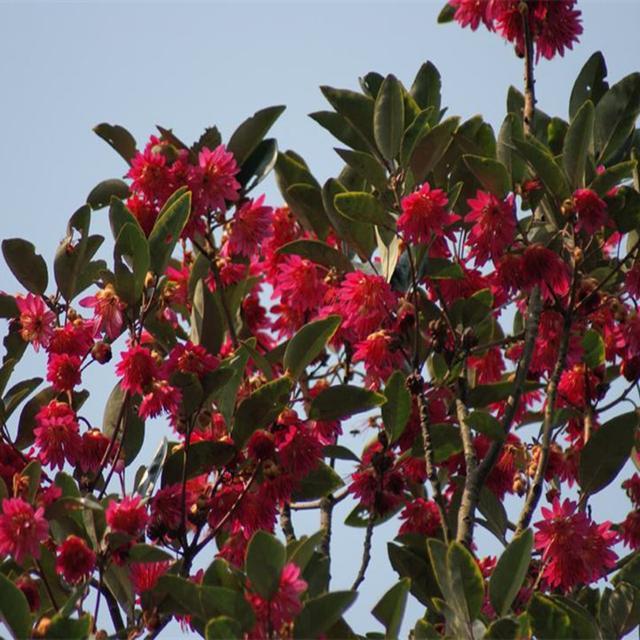
Although Rhodoleia championii is native to southern China, it is loved by many people for its enormous ornamental value and has become a high-quality ornamental tree selected for courtyards and scenic areas. As a unique ornamental plant of Shimen Park, Rhodoleia championii has, through continuous planting, become a scenic forest area of several thousand mu. When the red flowers bloom, it attracts large numbers of literati, photography enthusiasts and tourists every year, driving the development of the local tourism industry and creating enormous economic value for the local area.
2 The Planting Value of Rhodoleia championii
2.1 Ornamental Value
The trunk of Rhodoleia championii is upright and can grow to about 12 m, with branches spreading outward, giving the tree a graceful overall appearance. It is an evergreen tree with leathery leaves that are ovate in shape, dark green and glossy on the surface, with a layer of blue waxy bloom on the underside, making it very attractive. As a tree with a relatively large flower yield, its flowering period is particularly long, lasting from late December each year all the way to April of the following year, with the peak flowering period in March to April each year. When Rhodoleia championii blooms, the whole tree is covered in red flowers, creating a spectacular scene, and it therefore has great ornamental value.
2.2 Wood Processing
The trunk of Rhodoleia championii is relatively thick and strong, hard in texture and corrosion-resistant. The wood is reddish-brown or brown, relatively low in density and easy to process. Therefore, it is also a high-quality wood material, generally used for furniture, building decoration and renovation, and vehicle components. It not only drives the growth of the local forestry economy but also solves the employment problem of local people, promotes the deep processing of forestry, and is conducive to the economic development of the primary and secondary industries.
2.3 Medicinal Value
Rhodoleia championii is not only an ornamental plant but also has medicinal value. The leaves of Rhodoleia championii can be used as medicine; its nature and flavor are pungent and warm. Its main efficacy is in treating external injuries, especially knife wounds, for which it is most effective. At the same time, Rhodoleia championii leaves can treat bleeding disorders. Rhodoleia championii honey also has certain medicinal value; the nectar has effects such as dispelling wind-dampness, promoting blood circulation and dispersing blood stasis, and reducing swelling and relieving pain. It is very effective for treating rheumatism, lumbar muscle strain, traumatic blood stasis and swelling pain, and postpartum wind paralysis.
3 Seedling Raising Techniques for Rhodoleia championii
3.1 Seed Propagation
3.1.1 Seed Collection
If seeds are used for seedling raising, high-quality Rhodoleia championii seeds must be selected. Generally, robust trees free of pests and diseases that have grown for more than 15 years are selected, preferably with straight trunks, vigorous growth and relatively sufficient light, as mother trees. The seed collection time is generally chosen in October to November each year; this period is when the Rhodoleia championii seeds mature. Once the fruit ripens, it will split open and the seeds are easily scattered. Therefore, when collecting seeds, the fruit should first be observed; it is best when the fruit changes from green to yellow-green, and collection should preferably be done before the seeds split open. After the seeds are collected, they can be placed in a shaded area to air-dry until the fruit shells split open, then plump seeds are selected out and stored sealed, to be taken out again in a suitable planting season.
3.1.2 Sowing
For sowing Rhodoleia championii seeds, January each year is the best time. Before sowing, the land must be leveled. Because the seeds of Rhodoleia championii are relatively small, they can be fully mixed with fine sand when sowing and then broadcast into the land. In particular, note that after sowing, a layer of burnt soil should be spread over the land, about 0.3-0.5 cm, and then a layer of rice straw should be covered, followed by watering. After clearing the weeds in the field, dig ring-shaped trenches 5-10 cm deep between the plants, then spread fertilizer into the trenches, and then cover with topsoil to avoid loss of fertility. The fertilizer application rate for each Rhodoleia championii plant in the current year is 0.1 kg, increasing year by year thereafter.
3.1.3 Transplanting
When the seeds have been sown for about 20 d, the seeds have already germinated and emerged. At this time, the seedlings should be watered frequently to keep the land moist, until the seedlings grow to 3-4 leaves, at which point they can be transplanted. This transplanting moves the seedlings from the land into nutritional bags, and the water and fertilizer management of the seedlings should be strengthened until the seedlings grow to about 30 cm, when they can be moved out of the nursery for the next stage of the afforestation project [Jishan Huayao].
3.2 Cutting Propagation
3.2.1 Seedbed Preparation
In order to create an environment suitable for the growth of Rhodoleia championii, the preparation of the seedbed must be careful and meticulous, choosing conditions as close as possible to those of Rhodoleia championii tree growth, promoting the healthy growth of seedlings and improving seedling quality. A mixture of 80% yellow subsoil and 20% river sand can be fully mixed as the seedling substrate. Before cutting, the seedbed should first be watered to wet the substrate, and then the soil should be disinfected with a 0.25% potassium permanganate solution to prevent viruses and bacteria in the soil and substrate from affecting seedling growth.
3.2.2 Cutting Treatment
In order to cultivate high-quality Rhodoleia championii seedlings, care must be taken when selecting mother plants and cuttings, trying to choose Rhodoleia championii that are free of pests and diseases and growing well. After selecting the mother plant, select lignified current-year branches on the sunny side as cuttings. The length of the cuttings is usually 6-8 cm, and 1 leaf must be retained at the top. When collecting cuttings, the cut should be flat on top and slanted at the bottom to reduce damage to the mother plant. When necessary, the cut should also be coated with a chemical agent for disinfection to avoid infection and effects on tree growth. For cuttings that have already been collected, the base 2-4 cm should be soaked in a 2000 mg/L naphthalene acetic acid solution for 30 min, which can achieve the purpose of disinfection and effectively improve the survival rate of the cuttings.
3.2.3 Cutting
Rhodoleia championii is propagated by cuttings. Generally, the cuttings are inserted obliquely. The cutting depth should be neither too deep nor too shallow, preferably maintained at about 1/2 of the cutting. The cuttings are inserted into the soil, and then watering is carried out, thoroughly watering the soil. Finally, a small arched shed can be built with iron strips or bamboo poles and covered with plastic film. This not only plays a role in keeping warm and preventing cold but also maintains humidity inside, effectively improving the survival rate of cutting propagation.
3.3 Tissue Culture
3.3.1 Surface Sterilization
First, the prepared Rhodoleia championii stem segments with axillary buds must be disinfected and sterilized. The best sterilization method is treatment with 75% alcohol for 10 s + 0.1% HgCl2 for about 8 min; for stem segments with terminal buds, treatment with 75% alcohol for 10 s + 0.1% HgCl2 for 5 min. After disinfection, bacteria and the like on the surface of the leaf buds are all killed, thus reducing tissue mortality during tissue culture, which helps reduce cultivation costs and lower economic losses.
3.3.2 Primary Culture
In order to culture the primary tissue well, the most suitable culture medium formula combination can be used, such as MS + 6-1.5 mg/L + NAA 0.2 mg/L. Experimental studies show that with this formula, the initiation rate of stem segments with axillary buds is 96%, the callus induction rate reaches 91%, and the sprouting index of Rhodoleia championii exceeds 1.8; the initiation rate of terminal buds is 86.34%, the callus induction rate is 76%, and the sprouting index is 1.6.
3.3.3 Subculture
For subculture, the optimal combination generally used is WPM + 6-BA 0.5 mg/L + NAA 0.2 mg/L. Using this formula, the multiplication multiple can reach 4.2.
3.3.4 Rooting Culture
For rooting culture, the most suitable formula is 1/2 WPM + NAA 0.2 mg/L + IBA 0.5 mg/L. Using this formula, the Rhodoleia championii plants can grow healthily, the rooting time is significantly shortened to about 16 d, and the rooting rate of the plants can reach 84.34%. The roots of the cultured tissue develop healthily and in relatively large numbers, with about 4 roots per plant and a length of 2-3 cm. After rooting, Rhodoleia championii can be transplanted. The optimal transplanting substrate is a mixture of peat and vermiculite in a ratio of 1:1. At this time, the seedling survival rate of Rhodoleia championii is the highest and the growth is good.
4 Afforestation Techniques for Rhodoleia championii
4.1 Land Preparation
Before afforestation, land leveling work must be done well; this is also the preparatory work for planting Rhodoleia championii. The land surface should be level, with no excessively large clods of soil. Rhodoleia championii is usually planted in holes. After the land is leveled, dig open holes, with the size of the holes maintained at about 50 cm x 50 cm x 40 cm, and the row spacing between plants at 2.5 m x 3 m. After digging, apply additional base fertilizer in the holes, usually compound fertilizer, with 0.15 kg applied per hole, and then 0.2-0.25 kg of superphosphate [Jishan Huayao].
4.2 Seedling Planting
In order to improve the survival rate of seedlings, the transplanting time must also be chosen well. Try not to choose winter for transplanting. Transplanting during this period will reduce the plant's growth functions to the minimum, and the climate is not conducive to plant growth. If Rhodoleia championii is transplanted at this time, it will not only grow slowly but also have a very high mortality rate. Therefore, the transplanting time should be set in spring, with planting completed before April. Planting after rain is best. At this time, the soil is relatively moist. After opening the nutritional bag of Rhodoleia championii, place it together with the root soil ball into the dug tree hole, then straighten the seedling and press the soil around it firmly with the foot. After planting, the saplings should be inspected regularly. If dead plants are found, they should be removed promptly and replanted in time.
4.3 Field Management
For the saplings that have already been transplanted, tending work should be carried out next. This is relatively long-term work, generally requiring continuous tending for 3 years, twice each year. The first tending time is May to June each year, and the second is October to November. When doing tending work, the main tasks are clearing weeds, loosening the soil around the roots, and fertilizing. In addition, pest and disease control for Rhodoleia championii should also be done well. During the growing period, 90% trichlorfon can be sprayed 2-3 times at regular intervals, or 500-600 times diluted 80% malathion emulsion, which can effectively prevent the occurrence of pests and diseases.