A Detailed Guide to New Techniques for Apple Ring Rot Prevention and Control, with Practical Treatment Methods Shared
New Techniques for Apple Ring Rot Prevention and Control
Apple ring rot, apple tree canker, and apple early defoliation disease are the three major apple diseases in China. Because they are closely related to climate, the disease is more severe in the fruit-growing regions of North China, Northeast China, and East China.
1 Symptoms of Infection
Apple ring rot mainly infects branches and fruit.
1.1 Symptoms on Branches
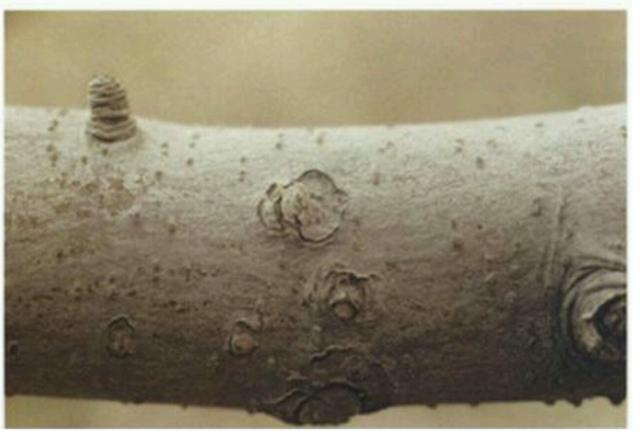
Dark brown, water-soaked or small canker spots form centered on the lenticels, with the center raised into a tumor-like shape, then dehydrating and sinking, with the edges cracking and lifting. Over several consecutive years the lesions expand outward from the center, forming concentric ring-shaped spots. When many lesions cluster together, the bark of the trunk and large branches becomes rough, which is also called "rough bark disease" (Figures 1-3).
Figure 1 Early-stage symptoms of apple ring rot damaging branches
Figure 3 Late-stage symptoms of apple ring rot damaging branches
Figure 4 Early-stage symptoms of apple ring rot damaging fruit
Figure 2 Mid-stage symptoms of apple ring rot damaging branches
Figure 5 Mid-stage symptoms of apple ring rot damaging fruit
1.2 Symptoms on Fruit
Centered on the lenticels, water-soaked, nearly round brown spots appear and spread outward, forming concentric rings of alternating light and dark shades. In the late stage of the disease, the affected area
2 Occurrence Pattern
Ring rot overwinters as mycelium, pycnidia, and pseudothecia on infected branches, and the mycelium can survive in the diseased branch tissues for 4 to 5 years. After temperatures rise in spring, the pathogen begins to release spores when it rains, and they spread with wind and rain. In the north, in May (after apple petal fall), the first rainfall triggers a large release of spores, which peaks in July and August. Rainfall amount and rainfall duration are important factors affecting the timing and quantity of spore release. Generally, a peak of spore release occurs after each rainfall (among these, May rainfall is the key factor affecting how many apple ring rot spores are produced in the whole year). The pathogen first infects the branches but does not cause disease there, instead lurking only in the phloem. When rainfall exceeds 10 mm and the bark is soaked through, all the ring rot spore containers hidden in the trunk phloem open and release spores. After fruit set, because young fruit have much cork tissue and also because high acidity and high tannin content are unfavorable to mycelial growth, the pathogen only lurks in the fruit skin without spreading or causing disease. After the fruit expands, the cork tissue in the fruit transforms into flesh cells, and because acidity is low, sugar content increases, and tannin content decreases, the pathogen can easily infect the fruit.
3 Influencing Factors
3.1 Climate
The occurrence of apple ring rot is closely related to climate. When the temperature is above 20°C, the relative humidity is above 75%, or there is continuous rainfall with precipitation reaching 10 mm or more, it is favorable for pathogen reproduction and massive spore release, and the disease becomes more severe. Conversely [Jishan Huayao], in dry years with little rain, the disease is milder.
3.2 Varieties
Apple varieties differ noticeably in their resistance to apple ring rot. Golden Delicious, Fuji, and Jinyun are the most susceptible, Red Delicious is next, Shouhong and Ralls Janet are relatively resistant, and Tsugaru is the most resistant.
3.3 Tree Vigor
Apple ring rot is a pathogen with relatively weak parasitic ability. When tree vigor is strong, the disease is mild; conversely, when tree vigor is weak, the disease is severe. Therefore, applying more organic fertilizer, reasonably controlling the ratio of nitrogen, phosphorus, and potassium fertilizers, and managing scientifically to strengthen tree vigor can effectively resist the occurrence of apple ring rot.
Figure 6 Late-stage symptoms of apple ring rot damaging fruit
4 Prevention and Control Measures
The Plant Protection Research Laboratory of the Tangshan Academy of Agricultural Sciences in Hebei Province spent 18 years conducting long-term systematic research on the characteristics and patterns of apple ring rot occurrence, achieved breakthrough results, and proposed abandoning the old control concept of scraping bark, changing the focus from mainly spring control to mainly mid-to-late-stage control, and seizing the key periods for concentrated control. After 3 years of pilot trials by us, this technique can effectively prevent and control the occurrence of apple ring rot. That is, after the first rainfall in May, all the mature spore containers hidden in the diseased tumors and lifted bark on the branches open and release pathogen spores. [Jishan Huayao] At this time, spraying once with the special fungicide Ring Rot No. 1 at 400 times dilution can achieve twice the result with half the effort, and it can also protect tree vigor (when applied at this time, the pesticide quickly penetrates through the many pores into the bark to kill the apple ring rot mycelium, which helps promote the shedding of old diseased rough bark, so that diseased rough bark no longer forms and there is no need to scrape bark). Before bagging, spray once with Ring Rot No. 1 special fungicide at 400 times dilution. For bagged fruit, spray Ring Rot No. 1 again 5 to 7 days after removing the fruit bags; for non-bagged fruit, begin using Ring Rot No. 1 in mid-July (spray once every 15 days) for 3 consecutive sprays, then spray once more 5 to 7 days before harvest. The control effect is over 90%.
Therefore, fruit growers no longer need to perform "scraping the bone to cure the wound" on fruit trees. They should focus on strengthening tree vigor and mid-to-late-stage control, persist in scientific prevention and control, and strengthen integrated management. Apple ring rot can be cured.