How to control flower thrips pests in blueberry cultivation?
Flower thrips pest control methods in blueberry cultivation
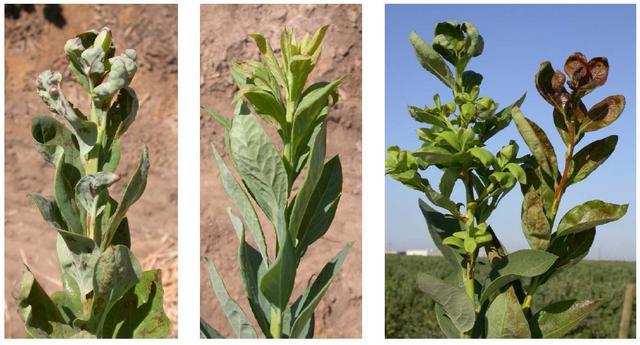
Flower thrips are one of the most common pests in blueberry cultivation. When flower thrips feed on leaves, they hinder the growth of new shoots, causing leaves to curl and become deformed, internodes to shorten, and wounds to appear on stems (Figure 1) [Jishan Huayao]. Flower thrips damage causes a decline in pollination rate and fruit set rate in blueberries, resulting in yield losses. Monitoring and control of flower thrips pests in blueberry orchards should be strengthened to prevent serious damage.
Figure 1 Symptoms of flower thrips damage on blueberry leaves
1 Characteristics
Flower thrips are about 1-1.3 mm long and orange-yellow in color (Figure 2), feeding on plant tissue cell sap. Flower thrips have a short life cycle, lasting only 18-22 days under ideal conditions, and can complete several generations per year. Flower thrips like to gather together. Flower thrips go through four stages from egg to adult, of which only stages 1 and 2 harm plants; stage 3 and stage 4 larvae drop to the soil or into dead branches and fallen leaves and do not feed on plants.
Figure 2 Adult flower thrips
Flower thrips harm blueberries mainly in two ways. One is by directly feeding on pollen, ovaries, petals, fruit, etc. (Figure 3), causing reduced fruit quality and yield. The second is that females lay eggs inside flowers, harming flower growth and development. Flower thrips numbers are related to the degree of flower opening, and when the population is at its peak, about 90% of flowers are in full bloom.
Figure 3 Blueberry fruit damaged by flower thrips
2 Monitoring
There are many methods for monitoring flower thrips. White sticky boards or blue sticky boards can be used to monitor adults. Sticky boards should be placed within the tree canopy, using one sticky board per 3 mu of land. Because flower thrips populations can increase in a short time, sticky boards should be checked once a week. For direct field sampling analysis, 10 trees can be selected in each sampling area, and new shoots can be selected from each tree for analysis, directly counting the number of flower thrips with a magnifying glass.
For rabbiteye blueberries, control measures should be taken when there are more than 2 flower thrips per flower, or when more than 45 flower thrips are captured on a sticky board [Jishan Huayao].
3 Control methods
Insecticides such as malathion, spinosad, acetamiprid, and novaluron can effectively control flower thrips, but there have been many reports that flower thrips easily develop resistance, so it is recommended to rotate different insecticides to prevent resistance. Dinotefuran is a systemic insecticide that can be used after flowering ends to prevent harm to pollinating insects.