Key Technical Points for Stumping Graft Renovation of Old Apple Orchards in the Weibei Dry Plateau Region of Shaanxi
Stumping Graft Renovation Technology for Old Apple Orchards in the Weibei Dry Plateau Region of Shaanxi
The Weibei apple-producing area in Shaanxi is the most suitable region for apple production. The apple industry is the local dominant industry and has made enormous contributions to increasing farmers' income and developing the local rural economy. However, most of the orchards here were established in the 1980s and 1990s. The trees have become weakened and aged, and some orchards have varieties with poor economic returns. Destroying the orchard and replanting requires large investment and a long cycle. The stumping graft technique mainly involves sawing off the rotted trunk, inserting new scions into the cut surface, and making full use of the original tree's strong root system. It can effectively eliminate the allelopathic inhibition caused by harmful substances in replanted orchards, overcome replant disease obstacles, and after grafting the new plant establishes its balance relationship quickly, has strong sprouting ability, and grows vigorously. The newly inserted branches are then approach-grafted, which can quickly achieve the target tree form, realize early bearing, high yield, and stable production, and give the fruit trees a second lease on life. In 2017, after the provincial on-site meeting on old orchard renovation was held, we promptly summarized the local existing stumping graft technique and, through practice, developed the stumping graft renovation technology for vigorous apple orchards in Weibei, which achieved excellent economic benefits and received praise from the majority of fruit growers and attention from provincial and municipal leaders.
1 Suitable Orchards for Stumping Graft
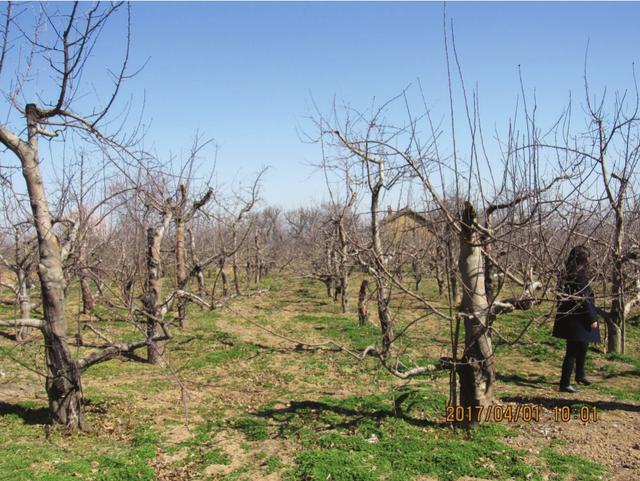
Orchards selected for stumping graft renovation are generally those with tree ages over 20 years, with many trunk and branch diseases, weakened tree vigor, intact root crown, and per-mu returns below 2,000 yuan; for some orchards with severely outdated varieties and low economic returns, stumping graft renovation can also be carried out (Figure 1). For orchards with severe missing plants, stumping graft renovation is not recommended, because the total number of plants is insufficient and the expected benefits are difficult to achieve after renovation.
Figure 1 Orchard before renovation
2 Preparatory Work before Renovation
After apple leaf fall before winter, promptly remove the side branches from the fruit trees. After applying pruning sealant to the saw cuts, apply a 30-fold dilution of 43% tebuconazole or apply Guokangbao stock solution to the wounds. Before stumping graft, take all the sawn branches out of the orchard (Figure 2) to avoid damaging the scions by dragging branches after stumping graft. If irrigation conditions are available, water the entire orchard once with winter irrigation before winter, and the survival rate of stumping graft the following year will be higher.
Figure 2 Removing large side branches and clearing them out of the orchard before stumping graft
3 Collection and Storage of Scions
According to local market conditions, select scions with good market potential and excellent varieties to ensure the renovated orchard achieves the expected economic benefits. Make a preliminary estimate of the number of scions needed for stumping graft. Collect healthy one-year-old branches in winter, tie every 100 into a bundle, and label them clearly. If the collected scions are insufficient (especially when the selected scions are from newly approved and promoted varieties, when scions are often in very short supply and relatively expensive), budget 2 scions per tree, and the remainder can be supplemented with healthy scions of local conventional varieties, but they must be clearly labeled and stored separately in moist sand. The moist sand should hold together when squeezed in the hand and crumble when released. The storage location is generally in a shaded place around the yard or orchard. Check regularly to prevent the sand from becoming too dry and causing the scions to lose water.
4 Stumping Graft
In the Weibei area, the suitable time for stumping graft is mid-April (around flowering). It should not be too early, because if the bark and xylem of the tree to be stumped are not separated, the survival rate of stumping graft is not high; it also should not be too late, otherwise the temperature is too high and the scions lose water too quickly after stumping graft, which also affects the survival rate.
Before stumping graft, first use a shovel to dig a deep pit around the trunk with a diameter of 1 m and a depth of about 20 cm. Because winters in the Weibei area are cold, the root crown is susceptible to freezing and often has canker lesions. At about 10 cm below the tree, the bark is generally intact and smooth, which is convenient for carrying out stumping graft. To facilitate tying the scions, it is recommended that the pit depth be 20 cm.
Select the plump bud section in the middle of the scion, cut every 4 buds into one segment, with the upper cut positioned slightly farther from the bud and the lower cut closer to the bud, and soak the cut scions in clean water. According to the position of the topmost bud (ensuring that after stumping graft the top bud faces the center of the trunk to facilitate the later second approach grafting), cut the scion into long and short cut faces, with the side corresponding to the topmost bud longer (3 cm) and the back side shorter (1 cm), and gently scrape off about 2 cm of the outer bark to expose the green layer; trim the stumping graft surface flat and smooth (Figure 3), gently pry open the bark with the tip of a knife, insert the scion (Figure 4), and tap gently with the back of the knife to ensure about 0.5 cm of the cut surface is exposed. Determine the number of scions to insert according to the thickness of the main trunk, generally inserting one scion every 10 cm of circumference. If the scions of the new variety to be grafted are limited, insert 2 scions of the new variety in opposite directions and mark them clearly, and fill the remaining positions requiring scions with backup scions. After all scions are inserted, tightly bind the outer bark with plastic film or straw rope, press the ends of the plastic film and rope firmly with fresh soil, then compact fresh soil around the outer bark, then compact fresh soil around each scion one by one, and finally cover the entire stump and scions firmly with soil (Figure 5), leaving only the topmost bud of each scion exposed. To prevent water evaporation, cover the piled fresh soil mound with plastic film and apply pruning sealant to the top of the scions (Figure 6). To prevent damage to the scions during field operations, insert a branch about 1 m long beside the scion insertion point as a reminder and protection.
Figure 3 Trimming the stumping graft site flat and smooth
Figure 4 Inserting the scion
Figure 5 Binding the inserted scions and compacting with fresh soil
Figure 6 Covering with plastic film and applying pruning sealant to the scions
5 Management after Stumping Graft
After the scions survive, promptly remove all new shoots except the terminal bud. For suckers sprouted by the original fruit tree itself, appropriate retention can be made according to their density. When the orchard is dry, water promptly. Carefully protect the new tender shoots to prevent browsing by cattle and sheep. When the new shoots grow to 30-40 cm, tie the scions to the branches previously inserted beside them. When the new shoots grow to 80 cm, bind all branches together. To improve the orchard's benefits after stumping graft renovation of old orchards, watermelons can be intercropped between tree rows. On the one hand, this increases benefits; on the other hand, while planting watermelons, the growth of the newly inserted branches can be observed and corresponding management measures taken. It can also prevent the ground from being bare, maintain orchard moisture, and avoid scorching of tender leaves by high summer temperatures.
6 Second Approach Grafting
When the new shoots grow to about 1 m (generally in early to mid-July in the Weibei area), carry out approach grafting promptly. Before approach grafting, first select the most vigorously growing branch as the central leader. For the other branches, select adjacent ones and first approach-graft them in pairs, and finally approach-graft them onto the central leader. When approach grafting, first bring the two branches together and choose the place with the largest contact area for approach grafting. According to the contact situation, cut short the branch to be approach-grafted at the place with better contact. Cut the side facing the branch to be approach-grafted into a long cut face, 2-3 cm long, and cut the back side into a short cut face, 0.5 cm long. Bring the cut branch toward the branch to be approach-grafted to determine the position for removing bark on the receiving branch. On the receiving branch, above the approach graft position, make an upward diagonal cut reaching the xylem, then cut from the lower end of the approach graft site up to the upper incision. Then place the two long cut faces together, with the upper end of the cut face of the approach-grafting branch resting in the wedge-shaped groove on the upper part of the receiving branch. Ensure that the bark on one side of the two cut faces aligns, then wrap with clean plastic tape (Figure 7). This process is best done by a team of two, otherwise the branches tend to shift and affect the survival rate of approach grafting. Finally, gently tie the approach-grafted branches together with rope to further secure them. In the Weibei area, there are often strong winds and rainstorms in summer. To prevent the wind from breaking the successfully approach-grafted saplings, insert a bamboo pole or wooden stick beside the main trunk and gently tie the upper part of the stumping-grafted sapling to the bamboo pole (Figure 8).
Figure 7 Aligning the bark and wrapping and tying
Figure 8 Approach grafting completed
7 Comprehensive Management Measures after Approach Grafting
In the Weibei area, summer drought is very likely to occur in July and August, and it is one of the main limiting factors affecting the survival rate of second approach grafting. In orchards after approach grafting, if high-temperature summer drought occurs, water the tree roots promptly in the morning and evening to combat drought and preserve soil moisture.
For orchards renovated by stumping graft, focus on the prevention and control of aphids and apple leaf rollers to prevent pests from feeding on leaves and affecting nutrient accumulation in the plants.
For side branches that sprout later, promptly pinch off the tips to control side branch growth and ensure the absolute dominance of the central leader. During winter pruning, shape the side branches according to the target tree form by removing the strong and retaining the weak.