What are the benefits of planting aquatic plants in an aquarium? Hangtai Aquarium explains in detail
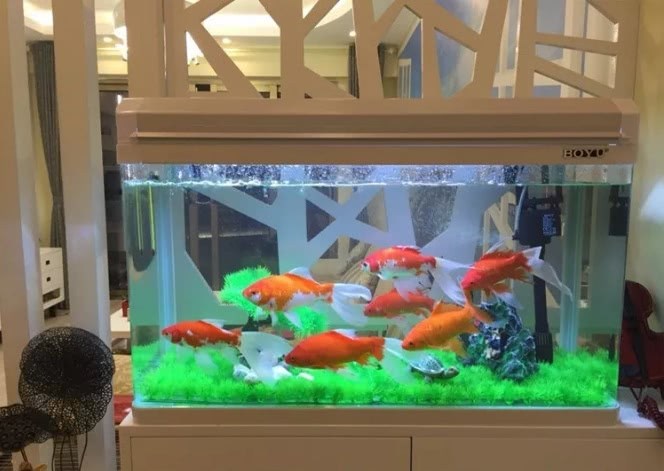
Many fish keepers like to put some green plants in their fish tank. Is it just for the sake of beauty? Actually, that is not the case. Keeping some green plants in a fish tank actually has many benefits. Please read on!
1. Supplying oxygen
This may be something everyone knows, and it is also the greatest function of aquatic plants. Under light, aquatic plants carry out photosynthesis, and they likewise deliver oxygen into the lower layers. Frankly speaking, no artificial equipment can perform the same function. In an aquarium, oxygen is released into the water in a form dissolved in water, but under certain circumstances it is visible, for example: tiny oxygen bubbles may rise from damaged leaf surfaces to the water surface. Light is the importance of oxygen within the aquarium.
2. Consuming waste
Fish metabolism produces a large amount of organic matter, which is then absorbed by aquatic plants. This matter is mainly compounds of nitrogen and phosphate. If their content in the aquarium is not reduced, it will cause excessive growth of algae.
3. Providing surfaces for bacterial activity
Bacteria complete a very important yet hard-to-see task in the aquarium. They continuously decompose and recombine certain compounds. Without these bacteria, they might pose a threat to the aquarium or the fish. Therefore, they need a lot of space for activity, whether on the substrate, inside the filter, or even on aquatic plants, and this is another important function of aquatic plants. So at the initial stage of setting up an aquarium, we need to plant dense aquatic plants in the aquarium, so that many useless bacteria are also decomposed through the aquatic plants. In fact, this still depends on the nitrifying bacteria attached to the surface of the aquatic plants to achieve. Outdoor research shows: after bacteria that continuously proliferate from highly polluted rivers are taken and placed into an aquarium, their numbers are greatly reduced by the densely planted aquatic plants in the aquarium, as well as other objects providing extensive attachment surfaces.
4. Eliminating toxic substances
Related research shows that pollutants such as salicylic acid and carbonic acid and other toxic substances can all be eliminated by aquatic plants. Because untreated wastewater from metal processing plants and slaughterhouses, after being introduced into experimental facilities containing marsh plants, the water that flows out after treatment is already close to the quality of drinking water.
5. Preventing algae growth
Of course, you must not forget a fact emphasized by experienced fish keepers: planting well-growing aquatic plants densely in rows in the aquarium is the best way to prevent algae from spreading, because when competing with algae for nutrients, aquatic plants hold a significant advantage. Of course, the prerequisite for aquatic plants to be stronger than algae is that they must grow and reproduce in the aquarium in a strong, healthy way.
6. Providing refuge and breeding sites
First, let us remind you that the most important function of aquatic plants in an aquarium is to enable fish to breed in the aquarium, and some fish especially like to lay their eggs on the surface of aquatic plant leaves. If there are no aquatic plants, the young fish will have nowhere to hide in the aquarium, and may then be attacked by large fish that eat them.
There is one more thing: small water fleas will live on the stems and leaf surfaces of aquatic plants, making it easy for fish to prey on them. Of course, aquatic plants also depend on what kind of fish you keep in your fish tank, as different fish also have different requirements for aquatic plants.
The above content comes from the internet